p 1 Department of Otorhinolaryngology, Head and Neck Surgery, Klinikstrasse 33, University of Giessen, 35392 Giessen, Germany.
Department of Otorhinolaryngology, Head and Neck Surgery, Medical Faculty, University of Cologne, Kerpener Strasse 62, 50937 Cologne, Germany.
Int J Mol Sci. 2020 Dec 31;22(1):379. doi: 10.3390/ijms22010379.
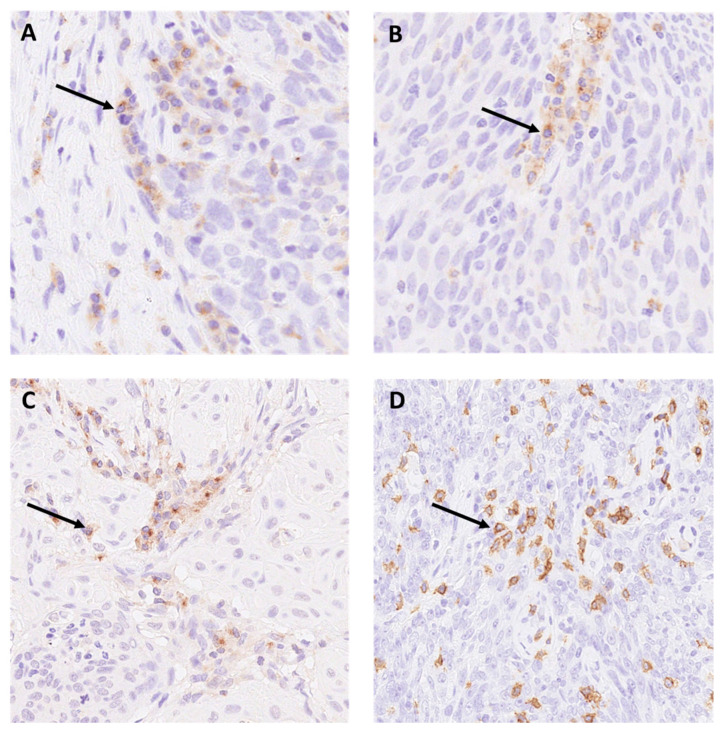
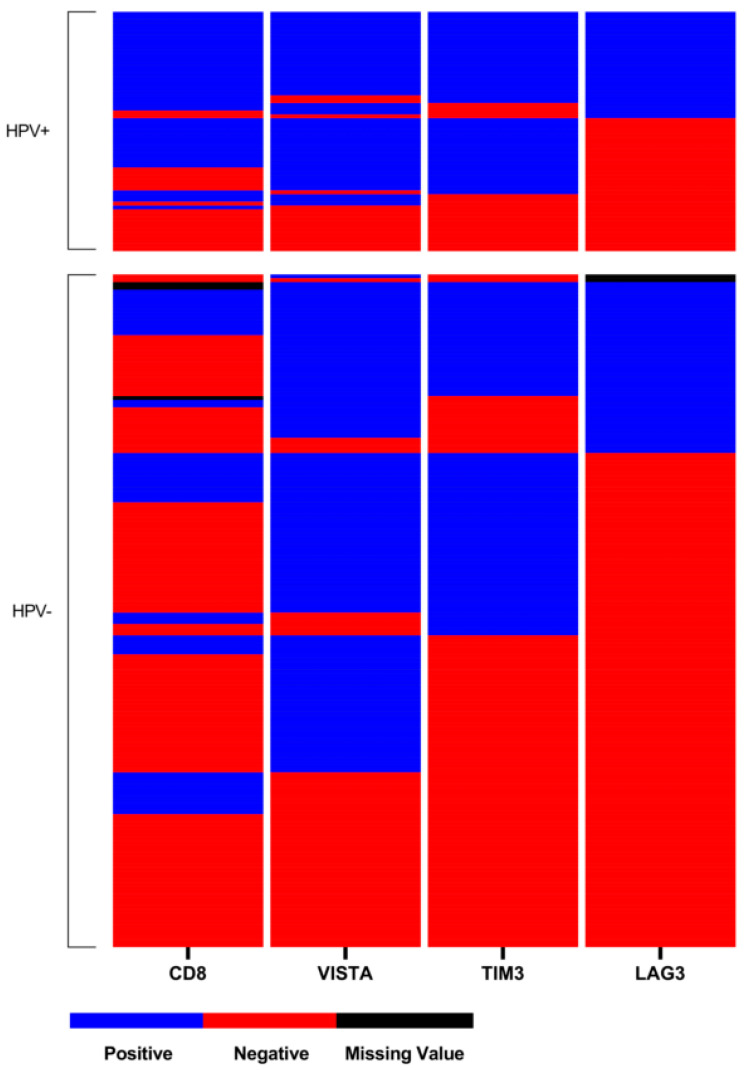
Tumor growth and survival requires a particularly effective immunosuppressant tumor microenvironment (TME) to escape destruction by the immune system. While immunosuppressive checkpoint markers like programmed cell death 1 ligand (PD-L1) are already being targeted in clinical practice, lymphocyte-activation-protein 3 (LAG-3), T-cell immunoglobulin and mucin-domain containing-3 (TIM-3) and V-domain Ig suppressor of T cell activation (VISTA) inhibitors are currently under investigation in clinical trials. Reliable findings on the expression status of those immune checkpoint inhibitors on tumor-infiltrating lymphocytes (TILs) in the TME of oropharyngeal squamous cell carcinoma (OPSCC) are lacking. This work aims to describe the expression of LAG-3, TIM-3, and VISTA expression in the TME of OPSCC. We created a tissue microarray of paraffin-embedded tumor tissue of 241 OPSCC. Expression of the immune checkpoint protein LAG-3, TIM-3, and VISTA in OPSCC was evaluated using immunohistochemistry and results were correlated with CD8+ T-cell inflammation and human papillomavirus (HPV)-status. 73 OPSCC stained positive for LAG-3 (31%; HPV+:44%; HPV-:26%, = 0.006), 122 OPSCC stained positive for TIM-3 (51%; HPV+:70%; HPV-:44%, < 0.001) and 168 OPSCC (70%; HPV+:75%; HPV-:68%, = 0.313) for VISTA. CD8+ T-cells were significantly associated with LAG-3, TIM-3 and VISTA expression ( < 0.001 < 0.001, 0.007). Immune checkpoint therapy targeting LAG-3, TIM-3, and/or VISTA could be a promising treatment strategy especially in HPV-related OPSCC. Future clinical trials investigating the efficacy of a checkpoint blockade in consideration of LAG-3, TIM-3, and VISTA expression are required.
肿瘤的生长和存活需要一种特别有效的免疫抑制肿瘤微环境(TME)来逃避免疫系统的破坏。虽然临床实践中已经针对免疫抑制检查点标志物,如程序性细胞死亡 1 配体(PD-L1)进行了靶向治疗,但淋巴细胞激活蛋白 3(LAG-3)、T 细胞免疫球蛋白和粘蛋白结构域包含 3(TIM-3)和 V 结构域 Ig 抑制 T 细胞活化(VISTA)抑制剂目前正在临床试验中进行研究。目前缺乏关于这些免疫检查点抑制剂在口咽鳞状细胞癌(OPSCC)TME 中肿瘤浸润淋巴细胞(TIL)表达状态的可靠发现。这项工作旨在描述 OPSCC TME 中 LAG-3、TIM-3 和 VISTA 的表达。我们创建了一个包含 241 例 OPSCC 石蜡包埋肿瘤组织的组织微阵列。使用免疫组织化学评估免疫检查点蛋白 LAG-3、TIM-3 和 VISTA 在 OPSCC 中的表达,并将结果与 CD8+T 细胞炎症和人乳头瘤病毒(HPV)状态相关联。73 例 OPSCC 对 LAG-3 染色阳性(31%;HPV+:44%;HPV-:26%, = 0.006),122 例 OPSCC 对 TIM-3 染色阳性(51%;HPV+:70%;HPV-:44%, < 0.001),168 例 OPSCC 对 VISTA 染色阳性(70%;HPV+:75%;HPV-:68%, = 0.313)。CD8+T 细胞与 LAG-3、TIM-3 和 VISTA 的表达显著相关( < 0.001 < 0.001, 0.007)。针对 LAG-3、TIM-3 和/或 VISTA 的免疫检查点治疗可能是一种很有前途的治疗策略,特别是在 HPV 相关的 OPSCC 中。需要进行未来的临床试验,以研究考虑 LAG-3、TIM-3 和 VISTA 表达时,检查点阻断的疗效。