Neuroscience Research Institute, University of California Santa Barbara, Santa Barbara, CA 93117, USA.
Department of Molecular, Cellular and Developmental Biology, University of California Santa Barbara, Santa Barbara, CA 93106, USA.
Nutrients. 2020 Dec 30;13(1):94. doi: 10.3390/nu13010094.
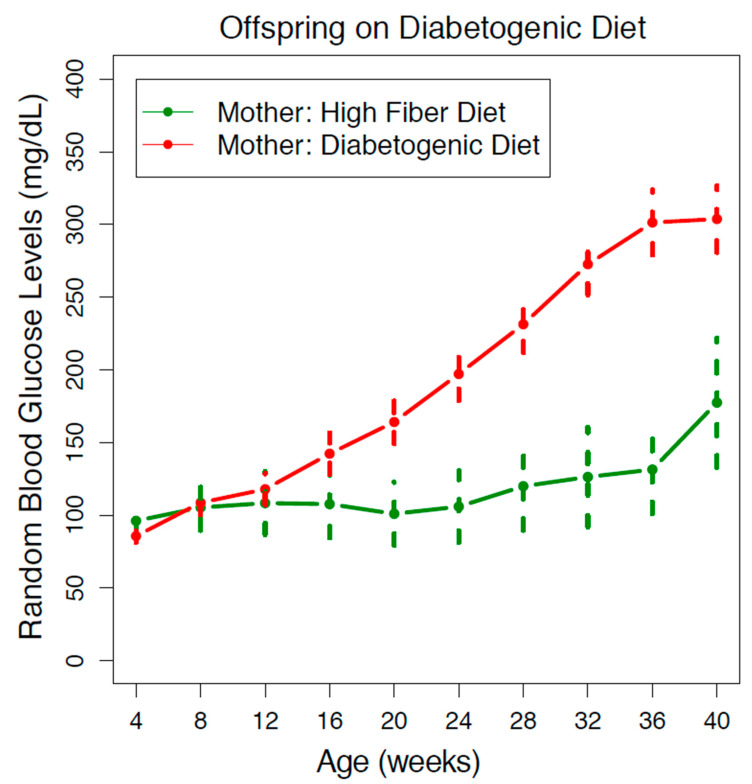
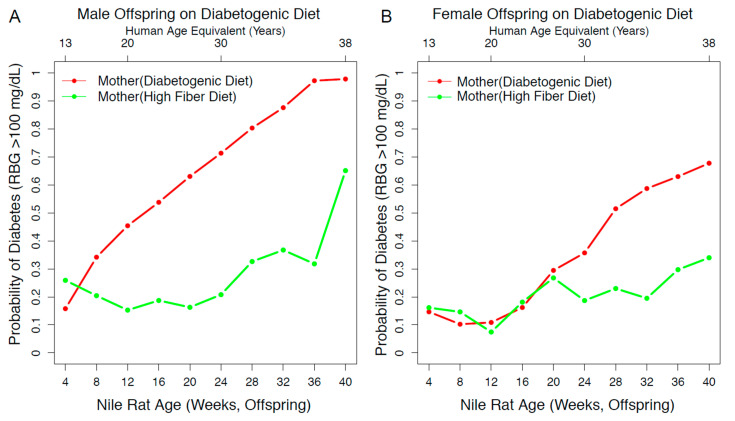
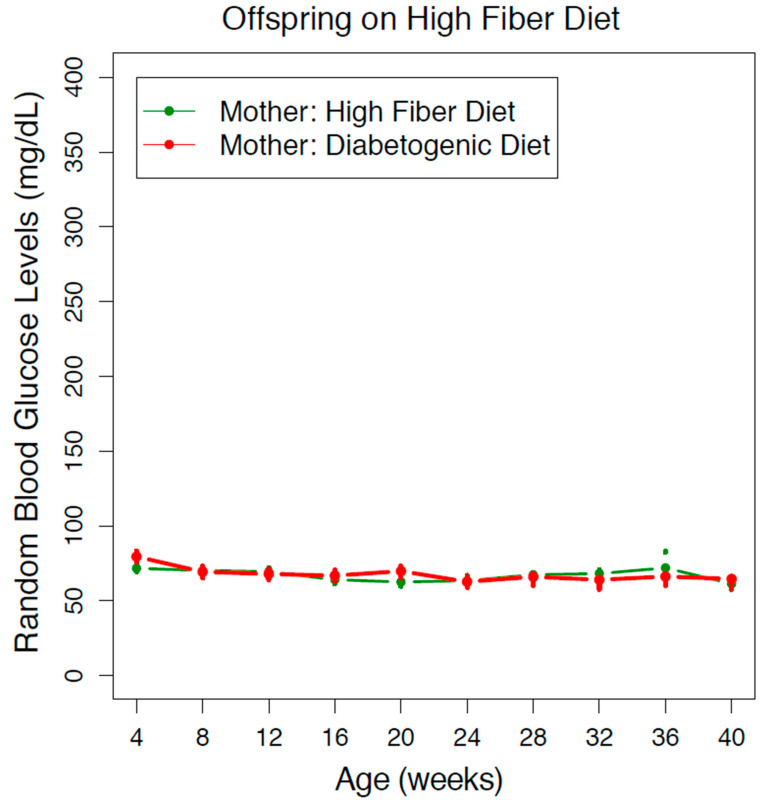
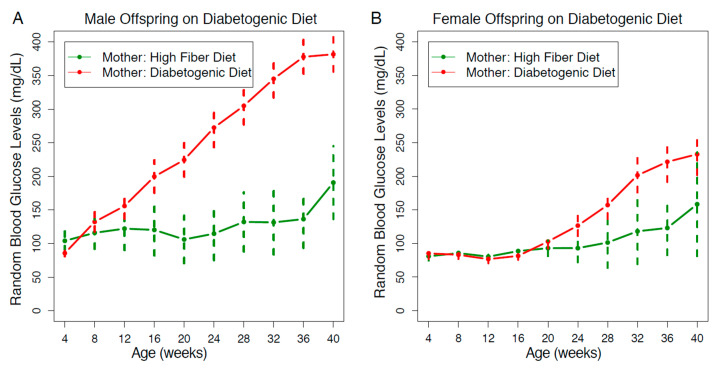
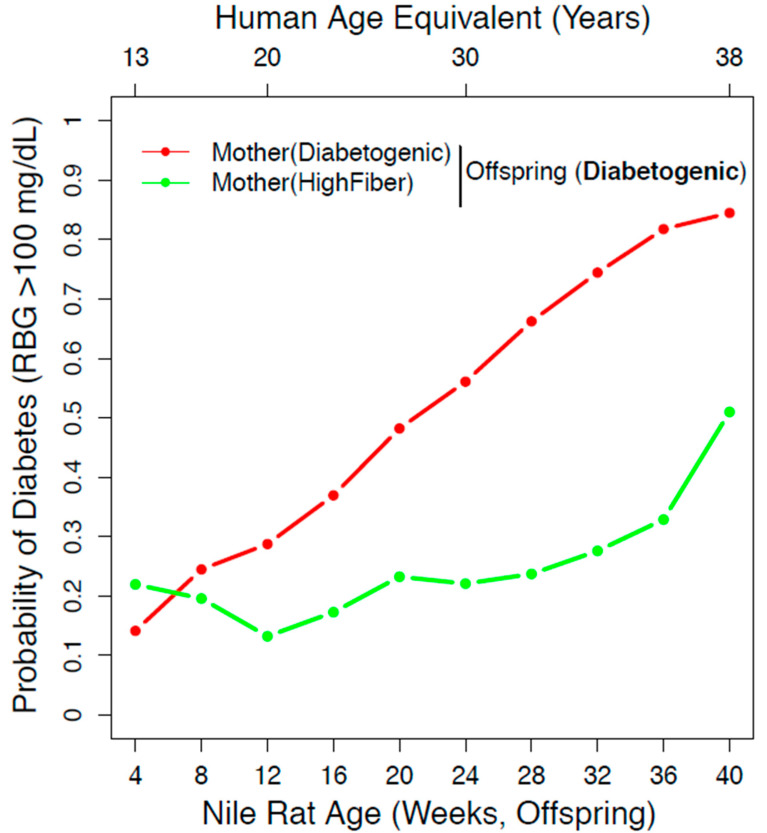
Previous studies have reported that maternal malnutrition is linked to increased risk of developing type 2 diabetes in adulthood. Although several diabetic risk factors associated with early-life environment have been identified, protective factors remain elusive. Here, we conducted a longitudinal study with 671 Nile rats whereby we examined the interplay between early-life environment (maternal diet) and later-life environment (offspring diet) using opposing diets that induce or prevent diet-induced diabetes. Specifically, we modulated the early-life environment throughout oogenesis, pregnancy, and nursing by feeding Nile rat dams a lifelong high-fiber diet to investigate whether the offspring are protected from type 2 diabetes. We found that exposure to a high-fiber maternal diet prior to weaning significantly lowered the risk of diet-induced diabetes in the offspring. Interestingly, offspring consuming a high-fiber diet after weaning did not develop diet-induced diabetes, even when exposed to a diabetogenic maternal diet. Here, we provide the first evidence that the protective effect of a high-fiber diet can be transmitted to the offspring through the maternal diet, which has important implications in diabetes prevention.
先前的研究报告表明,母体营养不良与成年后患 2 型糖尿病的风险增加有关。尽管已经确定了与儿童早期环境相关的一些糖尿病危险因素,但保护因素仍难以捉摸。在这里,我们对 671 只尼罗鼠进行了一项纵向研究,通过使用诱导或预防饮食诱导型糖尿病的相反饮食,研究了儿童早期环境(母体饮食)和后期环境(后代饮食)之间的相互作用。具体来说,我们通过终生喂养高纤维饮食来调节卵子发生、怀孕和哺乳期的儿童早期环境,以研究后代是否免受 2 型糖尿病的影响。我们发现,在断奶前接触高纤维母体饮食可显著降低后代患饮食诱导型糖尿病的风险。有趣的是,即使在暴露于致糖尿病的母体饮食下,断奶后食用高纤维饮食的后代也不会患上饮食诱导型糖尿病。在这里,我们首次提供证据表明,高纤维饮食的保护作用可以通过母体饮食传递给后代,这对糖尿病预防具有重要意义。