Department of Metabolic Medicine, Osaka University Graduate School of Medicine, 2-2, Yamadaoka, Suita, Osaka, 565-0871, Japan.
Department of Metabolism and Atherosclerosis, Osaka University Graduate School of Medicine, 2-2, Yamadaoka, Suita, Osaka, 565-0871, Japan.
Cardiovasc Diabetol. 2021 Jan 4;20(1):4. doi: 10.1186/s12933-020-01206-1.
Tofogliflozin, an SGLT2 inhibitor, is associated with favorable metabolic effects, including improved glycemic control and serum lipid profile and decreased body weight, visceral adipose tissue, and blood pressure (BP). This study evaluated the effects of tofogliflozin on the brachial-ankle pulse wave velocity (baPWV) in patients with type 2 diabetes (T2DM) without a history of apparent cardiovascular disease.
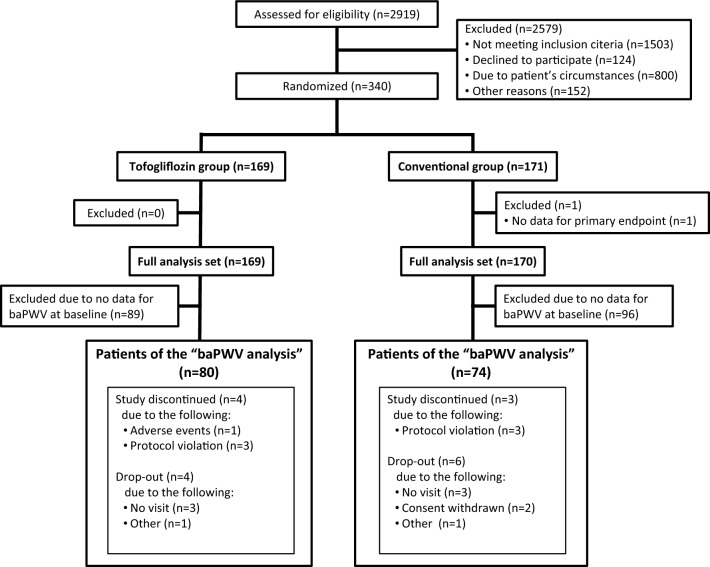
The using tofogliflozin for possible better intervention against atherosclerosis for type 2 diabetes patients (UTOPIA) trial is a prospective, randomized, open-label, multicenter, parallel-group, comparative study. As one of the prespecified secondary outcomes, changes in baPWV over 104 weeks were evaluated in 154 individuals (80 in the tofogliflozin group and 74 in the conventional treatment group) who completed baPWV measurement at baseline.
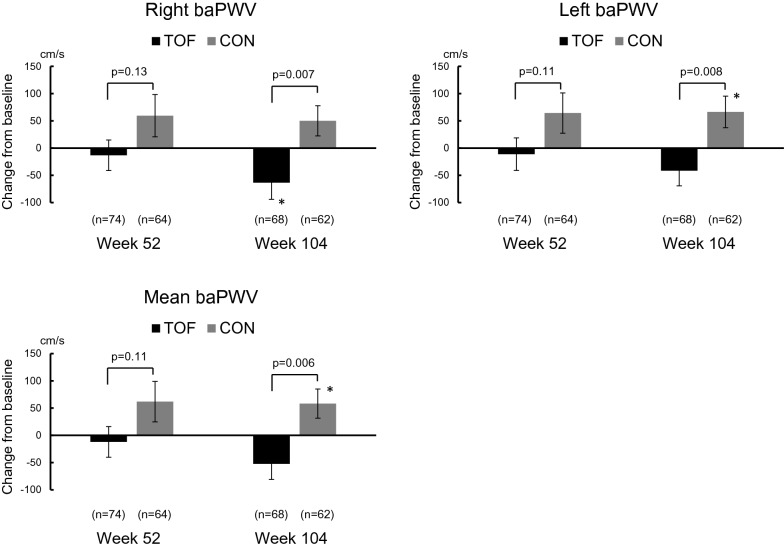
In a mixed-effects model, the progression in the right, left, and mean baPWV over 104 weeks was significantly attenuated with tofogliflozin compared to that with conventional treatment (- 109.3 [- 184.3, - 34.3] (mean change [95% CI] cm/s, p = 0.005; - 98.3 [- 172.6, - 24.1] cm/s, p = 0.010; - 104.7 [- 177.0, - 32.4] cm/s, p = 0.005, respectively). Similar findings were obtained even after adjusting the mixed-effects models for traditional cardiovascular risk factors, including body mass index (BMI), glycated hemoglobin (HbA1c), total cholesterol, high-density lipoprotein (HDL)-cholesterol, triglyceride, systolic blood pressure (SBP), hypertension, smoking, and/or administration of drugs, including hypoglycemic agents, antihypertensive agents, statins, and anti-platelets, at baseline. The findings of the analysis of covariance (ANCOVA) models, which included the treatment group, baseline baPWV, and traditional cardiovascular risk factors, resembled those generated by the mixed-effects models.
Tofogliflozin significantly inhibited the increased baPWV in patients with T2DM without a history of apparent cardiovascular disease, suggesting that tofogliflozin suppressed the progression of arterial stiffness. Trial Registration UMIN000017607. Registered 18 May 2015. ( https://www.umin.ac.jp/icdr/index.html ).
SGLT2 抑制剂托格列净与改善代谢有关,包括改善血糖控制和血清脂质谱,降低体重、内脏脂肪组织和血压(BP)。这项研究评估了托格列净对 2 型糖尿病(T2DM)患者肱踝脉搏波速度(baPWV)的影响,这些患者没有明显的心血管疾病史。
使用托格列净治疗 2 型糖尿病患者可能更好地干预动脉粥样硬化(UTOPIA)试验是一项前瞻性、随机、开放标签、多中心、平行组、对照研究。作为预先规定的次要结果之一,在基线时完成 baPWV 测量的 154 名个体(托格列净组 80 名,常规治疗组 74 名)中,评估了 104 周内 baPWV 的变化。
在混合效应模型中,与常规治疗相比,托格列净治疗可显著减缓右、左和平均 baPWV 在 104 周内的进展(-109.3[-184.3,-34.3](cm/s,p=0.005;-98.3[-172.6,-24.1]cm/s,p=0.010;-104.7[-177.0,-32.4]cm/s,p=0.005)。即使在调整混合效应模型中的传统心血管危险因素(包括体重指数[BMI]、糖化血红蛋白[HbA1c]、总胆固醇、高密度脂蛋白[HDL]-胆固醇、甘油三酯、收缩压[SBP]、高血压、吸烟和/或基线时服用的药物,包括降糖药、降压药、他汀类药物和抗血小板药物)后,也得到了类似的发现。协方差分析(ANCOVA)模型的分析结果,包括治疗组、基线 baPWV 和传统心血管危险因素,与混合效应模型的结果相似。
托格列净可显著抑制无明显心血管疾病史的 2 型糖尿病患者的 baPWV 升高,提示托格列净抑制了动脉僵硬的进展。试验注册 UMIN000017607。注册于 2015 年 5 月 18 日。(https://www.umin.ac.jp/icdr/index.html)。