1st Department of Cardiology, Hippokration Hospital, National and Kapodistrian University of Athens Medical School, Athens, Greece.
Diabetes Center, 2nd Department of Internal Medicine, Medical School, National and Kapodistrian University of Athens, Hippokration General Hospital of Athens, Athens, Greece.
J Diabetes Res. 2018 Dec 4;2018:1232583. doi: 10.1155/2018/1232583. eCollection 2018.
Newer antidiabetic drugs, i.e., dipeptidyl peptidase-4 (DPP-4) inhibitors, sodium-glucose cotransporter-2 (SGLT-2) inhibitors, and glucagon-like peptide-1 receptor agonists (GLP-1 RAs) may exert distinct cardiovascular effects. We sought to explore their impact on vascular function.
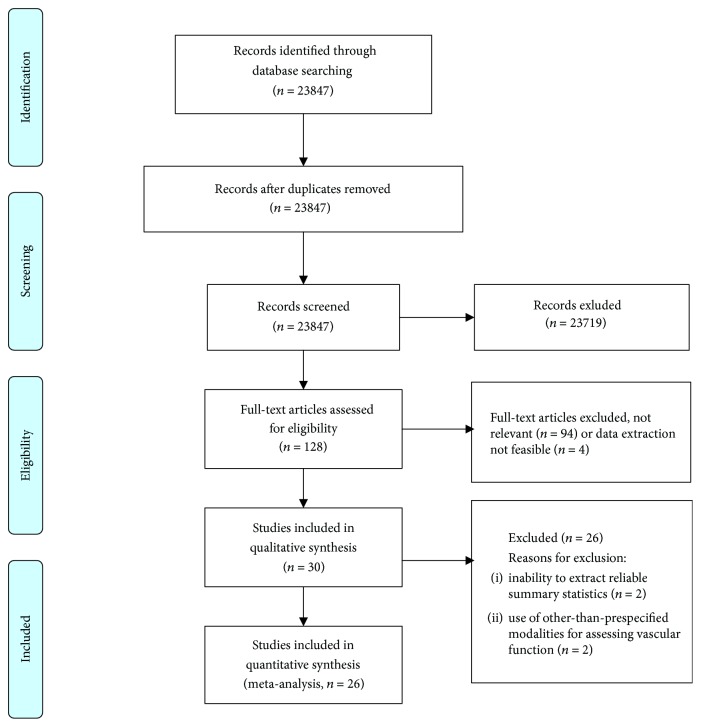
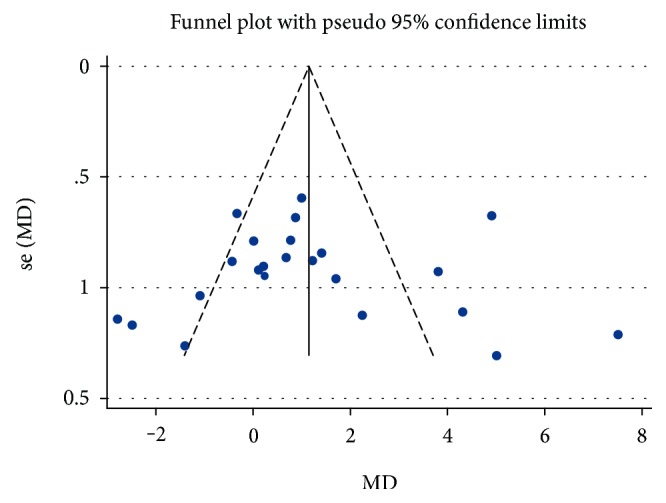
Published literature was systematically searched up to January 2018 for clinical studies assessing the effects of DPP-4 inhibitors, GLP-1 RAs, and SGLT-2 inhibitors on endothelial function and arterial stiffness, assessed by flow-mediated dilation (FMD) of the brachial artery and pulse wave velocity (PWV), respectively. For each eligible study, we used the mean difference (MD) with 95% confidence intervals (CIs) for FMD and PWV. The pooled MD for FMD and PWV were calculated by using a random-effect model. The presence of heterogeneity among studies was evaluated by the statistic.
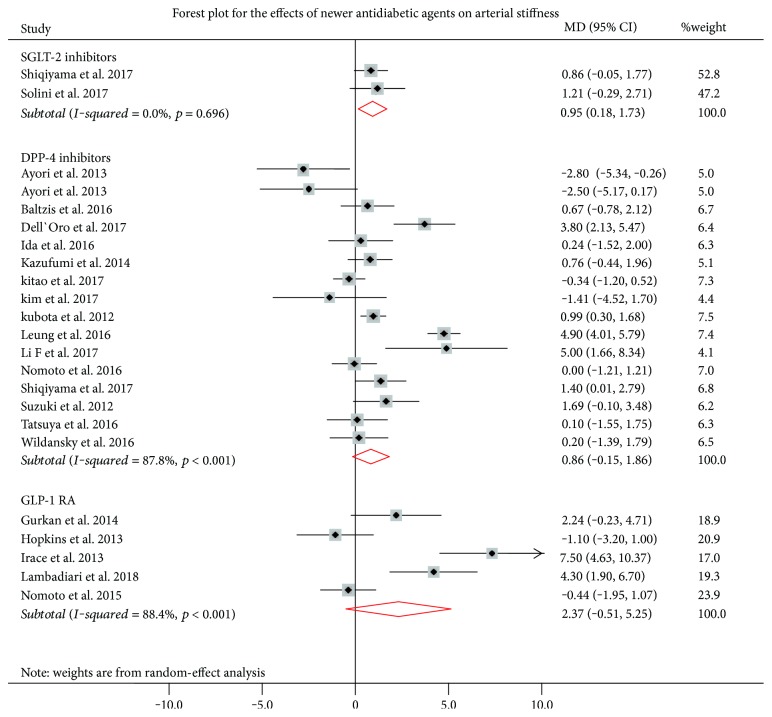
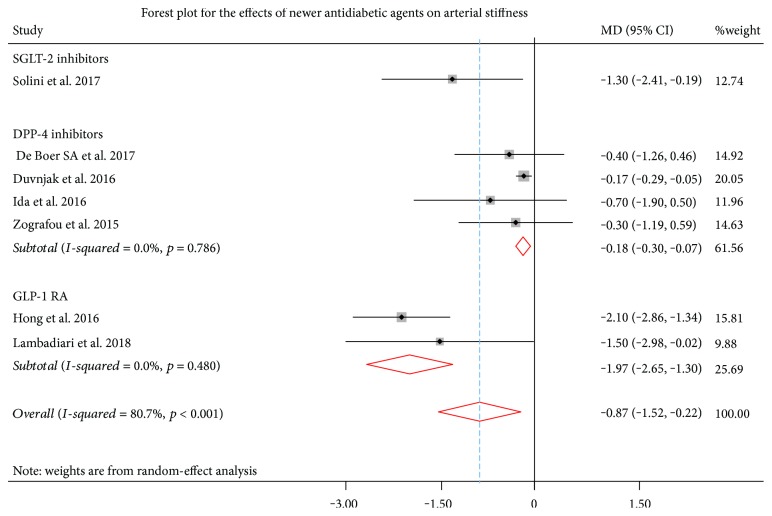
A total of 26 eligible studies ( = 668 patients) were included in the present meta-analysis. Among newer antidiabetic drugs, only SGLT-2 inhibitors significantly improved FMD (pooled MD 1.14%, 95% CI: 0.18 to 1.73, = 0.016), but not DPP-4 inhibitors (pooled MD = 0.86%, 95% CI: -0.15 to 1.86, = 0.095) or GLP-1 RA (pooled MD = 2.37%, 95% CI: -0.51 to 5.25, = 0.107). Both GLP-1 RA (pooled MD = -1.97, 95% CI: -2.65 to -1.30, < 0.001) and, to a lesser extent, DPP-4 inhibitors (pooled MD = -0.18, 95% CI: -0.30 to -0.07, = 0.002) significantly decreased PWV.
Newer antidiabetic drugs differentially affect endothelial function and arterial stiffness, as assessed by FMD and PWV, respectively. These findings could explain the distinct effects of these drugs on cardiovascular risk of patients with type 2 diabetes.
新型抗糖尿病药物,即二肽基肽酶-4(DPP-4)抑制剂、钠-葡萄糖协同转运蛋白-2(SGLT-2)抑制剂和胰高血糖素样肽-1 受体激动剂(GLP-1 RAs)可能具有不同的心血管作用。我们试图探讨它们对血管功能的影响。
系统检索截至 2018 年 1 月的评估 DPP-4 抑制剂、GLP-1 RAs 和 SGLT-2 抑制剂对肱动脉血流介导的扩张(FMD)和脉搏波速度(PWV)分别评估的内皮功能和动脉僵硬的影响的临床研究。对于每项合格的研究,我们使用均差(MD)和 95%置信区间(CI)来评估 FMD 和 PWV。使用随机效应模型计算 FMD 和 PWV 的汇总 MD。通过 统计评估研究之间的异质性。
本荟萃分析共纳入 26 项合格研究(n = 668 例患者)。在新型抗糖尿病药物中,仅 SGLT-2 抑制剂可显著改善 FMD(汇总 MD1.14%,95%CI:0.18 至 1.73, = 0.016),而 DPP-4 抑制剂(汇总 MD 为 0.86%,95%CI:-0.15 至 1.86, = 0.095)或 GLP-1 RA(汇总 MD 为 2.37%,95%CI:-0.51 至 5.25, = 0.107)则不然。GLP-1 RA(汇总 MD 为-1.97,95%CI:-2.65 至 -1.30, < 0.001)和在较小程度上,DPP-4 抑制剂(汇总 MD 为-0.18,95%CI:-0.30 至 -0.07, = 0.002)均显著降低 PWV。
新型抗糖尿病药物分别通过 FMD 和 PWV 评估对内皮功能和动脉僵硬产生不同的影响。这些发现可以解释这些药物对 2 型糖尿病患者心血管风险的不同影响。