Health Management Institute, The Second Medical Center & National Clinical Research Center for Geriatric Diseases, Chinese PLA General Hospital, Beijing, 100089, P. R. China.
Department of Medical Oncology, The First Affiliated Hospital of Xi'an Jiaotong University, Xi'an, 710061, Shanxi, P. R. China.
Nat Commun. 2021 Jan 4;12(1):11. doi: 10.1038/s41467-020-20162-8.
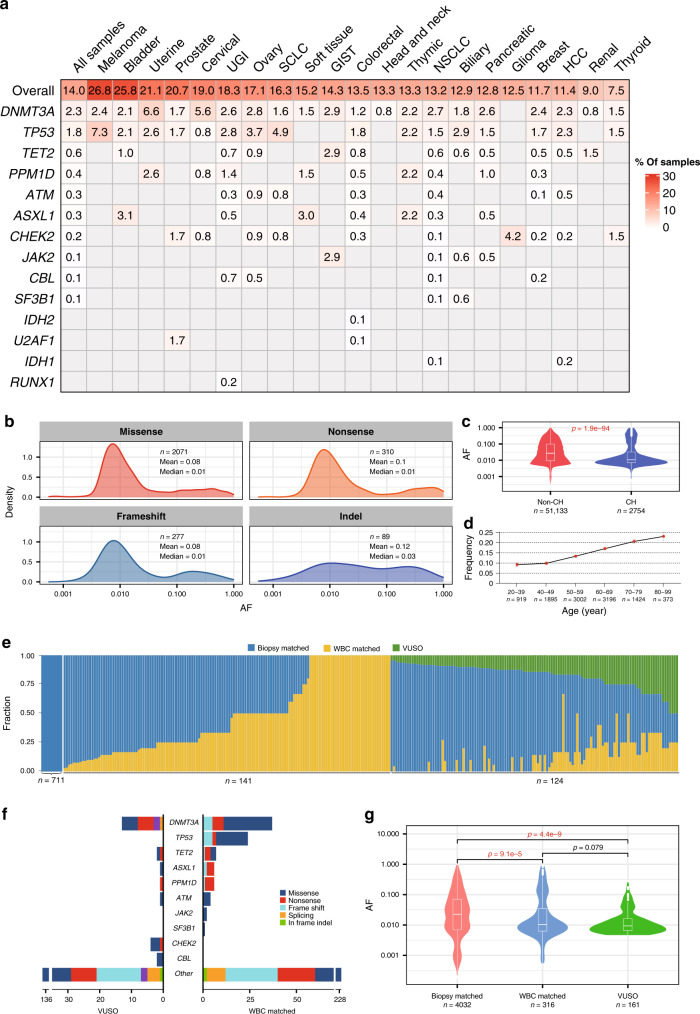
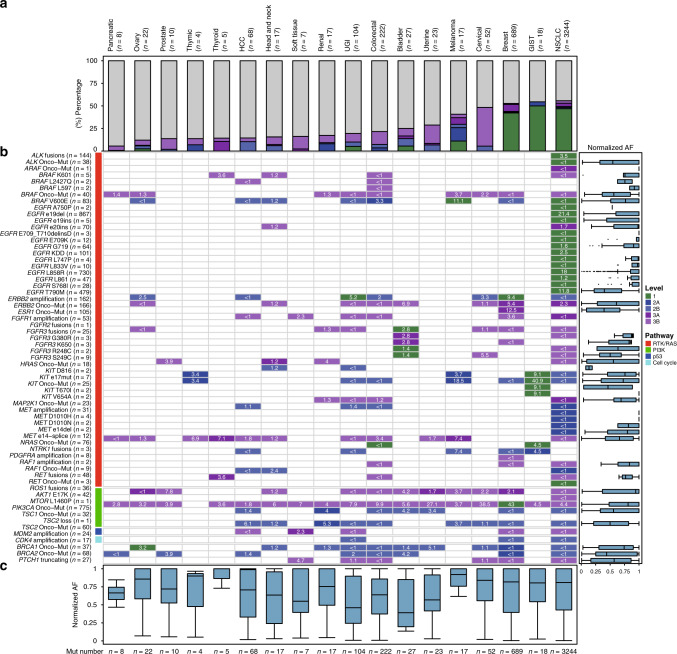
Circulating tumor DNA (ctDNA) provides a noninvasive approach to elucidate a patient's genomic landscape and actionable information. Here, we design a ctDNA-based study of over 10,000 pan-cancer Chinese patients. Using parallel sequencing between plasma and white blood cells, 14% of plasma cell-free DNA samples contain clonal hematopoiesis (CH) variants, for which detectability increases with age. After eliminating CH variants, ctDNA is detected in 73.5% of plasma samples, with small cell lung cancer (91.1%) and prostate cancer (87.9%) showing the highest detectability. The landscape of putative driver genes revealed by ctDNA profiling is similar to that in a tissue-based database (R = 0.87, p < 0.001) but also shows some discrepancies, such as higher EGFR (44.8% versus 25.2%) and lower KRAS (6.8% versus 27.2%) frequencies in non-small cell lung cancer, and a higher TP53 frequency in hepatocellular carcinoma (53.1% versus 28.6%). Up to 41.2% of plasma samples harbor drug-sensitive alterations. These findings may be helpful for identifying therapeutic targets and combined treatment strategies.
循环肿瘤 DNA(ctDNA)提供了一种非侵入性的方法来阐明患者的基因组图谱和可操作的信息。在这里,我们设计了一项针对超过 10000 名泛癌症中国患者的基于 ctDNA 的研究。通过对血浆和白细胞进行平行测序,14%的血浆无细胞 DNA 样本含有克隆性造血(CH)变体,其可检测性随年龄增长而增加。在消除 CH 变体后,73.5%的血浆样本中检测到 ctDNA,小细胞肺癌(91.1%)和前列腺癌(87.9%)的检测率最高。ctDNA 谱分析揭示的潜在驱动基因图谱与基于组织的数据库相似(R=0.87,p<0.001),但也存在一些差异,例如非小细胞肺癌中 EGFR(44.8%对 25.2%)和 KRAS(6.8%对 27.2%)的频率较高,肝癌中 TP53 的频率较高(53.1%对 28.6%)。多达 41.2%的血浆样本携带有药物敏感的改变。这些发现可能有助于确定治疗靶点和联合治疗策略。