Li Qian, Cebrián Rubén, Montalbán-López Manuel, Ren Huan, Wu Weihui, Kuipers Oscar P
Department of Molecular Genetics, Groningen Biomolecular Sciences and Biotechnology Institute, University of Groningen, Nijenborgh 7, 9747AG, Groningen, The Netherlands.
State Key Laboratory of Biocatalysis and Enzyme Engineering, Hubei Collaborative Innovation Center for Green Transformation of Bio-Resources, Hubei Key Laboratory of Industrial Biotechnology, School of Life Sciences, Hubei University, 430062, Wuhan, China.
Commun Biol. 2021 Jan 4;4(1):31. doi: 10.1038/s42003-020-01511-1.
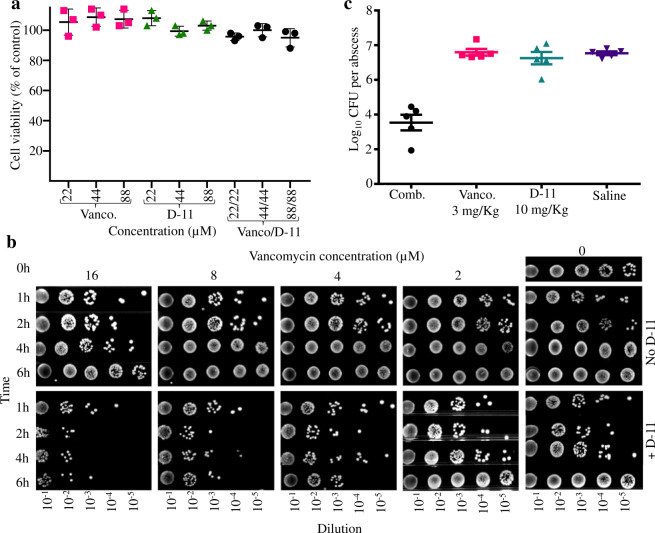
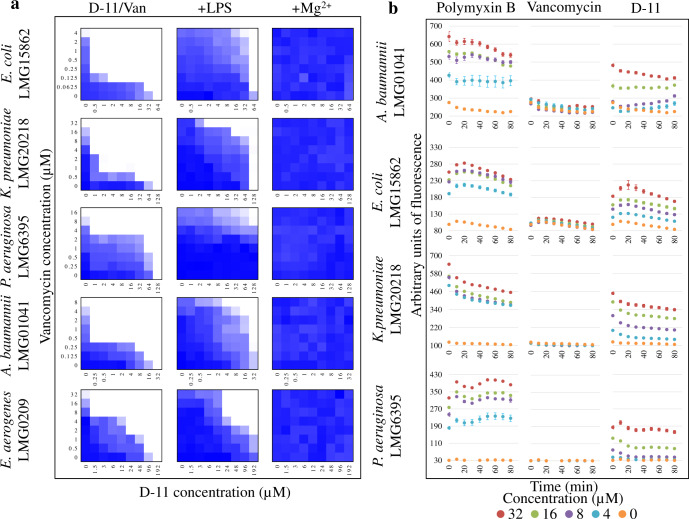
The development and dissemination of antibiotic-resistant bacterial pathogens is a growing global threat to public health. Novel compounds and/or therapeutic strategies are required to face the challenge posed, in particular, by Gram-negative bacteria. Here we assess the combined effect of potent cell-wall synthesis inhibitors with either natural or synthetic peptides that can act on the outer-membrane. Thus, several linear peptides, either alone or combined with vancomycin or nisin, were tested against selected Gram-negative pathogens, and the best one was improved by further engineering. Finally, peptide D-11 and vancomycin displayed a potent antimicrobial activity at low μM concentrations against a panel of relevant Gram-negative pathogens. This combination was highly active in biological fluids like blood, but was non-hemolytic and non-toxic against cell lines. We conclude that vancomycin and D-11 are safe at >50-fold their MICs. Based on the results obtained, and as a proof of concept for the newly observed synergy, a Pseudomonas aeruginosa mouse infection model experiment was also performed, showing a 4 log reduction of the pathogen after treatment with the combination. This approach offers a potent alternative strategy to fight (drug-resistant) Gram-negative pathogens in humans and mammals.
抗生素耐药性细菌病原体的发展和传播对全球公共卫生构成了日益严重的威胁。需要新型化合物和/或治疗策略来应对特别是革兰氏阴性菌带来的挑战。在此,我们评估了强效细胞壁合成抑制剂与可作用于外膜的天然或合成肽的联合效应。因此,我们测试了几种线性肽单独或与万古霉素或乳链菌肽联合使用时对选定革兰氏阴性病原体的效果,并通过进一步改造优化出最佳组合。最后,肽D - 11和万古霉素在低 microM浓度下对一系列相关革兰氏阴性病原体显示出强效抗菌活性。这种组合在血液等生物流体中具有高活性,但对细胞系无溶血和毒性作用。我们得出结论,万古霉素和D - 11在高于其最低抑菌浓度50倍时是安全的。基于所得结果,作为新观察到的协同作用的概念验证,我们还进行了铜绿假单胞菌小鼠感染模型实验,结果表明联合治疗后病原体数量减少了4个对数级。这种方法为对抗人类和哺乳动物中的(耐药)革兰氏阴性病原体提供了一种有效的替代策略。