Department of Anesthesiology, Pain and Palliative Medicine, Radboud University Medical Center, P.O. Box 9101, HP 717, 6500 HB, Nijmegen, The Netherlands.
Department of Radiology and Nuclear Medicine, Radboud University Medical Center, Nijmegen, The Netherlands.
J Clin Monit Comput. 2022 Feb;36(1):141-145. doi: 10.1007/s10877-020-00630-8. Epub 2021 Jan 5.
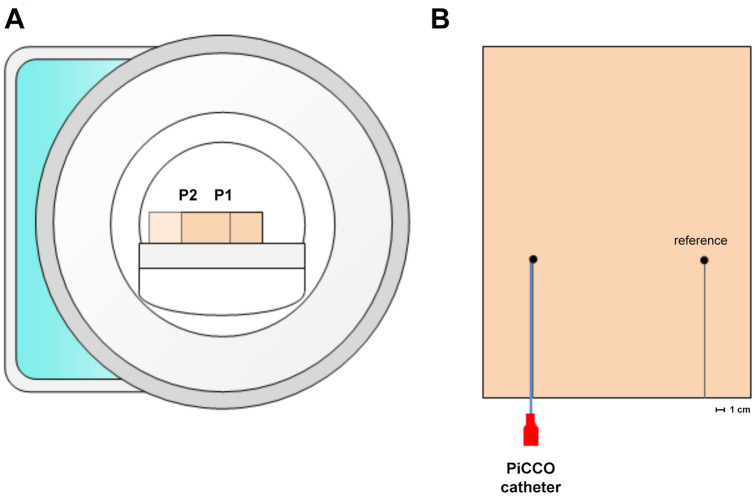
Thermodilution cardiac output monitoring, using a thermistor-tipped intravascular catheter, is used in critically ill patients to guide hemodynamic therapy. Often, these patients also need magnetic resonance imaging (MRI) for diagnostic or prognostic reasons. As thermodilution catheters contain metal, they are considered MRI-unsafe and advised to be removed prior to investigation. However, removal and replacement of the catheter carries risks of bleeding, perforation and infection. This research is an in vitro safety assessment of the PiCCO™ thermodilution catheter during 3 T Magnetic Resonance Imaging (3T-MRI). In a 3T-MRI environment, three different PiCCO™ catheter sizes were investigated in an agarose-gel, tissue mimicking phantom. Two temperature probes measured radiofrequency-induced heating; one at the catheter tip and one at a reference point. Magnetically induced catheter dislocation was assessed by visual observation as well as by analysis of the tomographic images. For all tested catheters, the highest measured temperature increase was 0.2 °C at the center of the bore and 0.3 °C under "worst-case" setting for the tested MRI pulse sequences. No magnetically induced catheter displacements were observed. Under the tested circumstances, no heating or dislocation of the PiCCO™ catheter was observed in a tissue mimicking phantom during 3T-MRI. Leaving the catheter in the critically ill patient during MRI investigation might pose a lower risk of complications than catheter removal and replacement.
热稀释心输出量监测,使用热敏电阻尖端的血管内导管,用于危重病患者以指导血流动力学治疗。通常,这些患者还需要磁共振成像(MRI)进行诊断或预后原因。由于热稀释导管包含金属,因此被认为是 MRI 不安全的,并建议在进行检查之前将其移除。然而,导管的移除和更换会带来出血、穿孔和感染的风险。这项研究是对 PiCCO™热稀释导管在 3T 磁共振成像(3T-MRI)期间的体外安全性评估。在 3T-MRI 环境中,在琼脂糖凝胶、组织模拟体模中研究了三种不同尺寸的 PiCCO™导管。两个温度探头测量射频诱导的加热;一个在导管尖端,一个在参考点。通过视觉观察和断层图像分析评估磁致导管脱位。对于所有测试的导管,在孔的中心处测量到的最高温度升高为 0.2°C,在测试的 MRI 脉冲序列的“最坏情况”设置下为 0.3°C。未观察到磁致导管位移。在测试的情况下,在组织模拟体模中未观察到 PiCCO™导管在 3T-MRI 期间的加热或脱位。与导管移除和更换相比,在 MRI 检查期间将导管留在危重病患者体内可能会降低并发症的风险。