School of Management, Jiangsu University, Zhenjiang, 212013, China.
College of Economics and Management, Nanjing University of Aeronautics and Astronautics, Nanjing, 211106, China.
Environ Sci Pollut Res Int. 2021 Apr;28(14):17119-17131. doi: 10.1007/s11356-020-12130-y. Epub 2021 Jan 4.
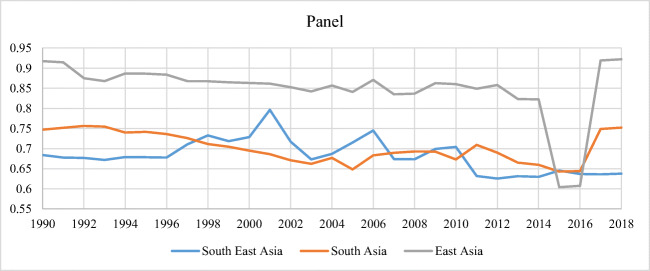
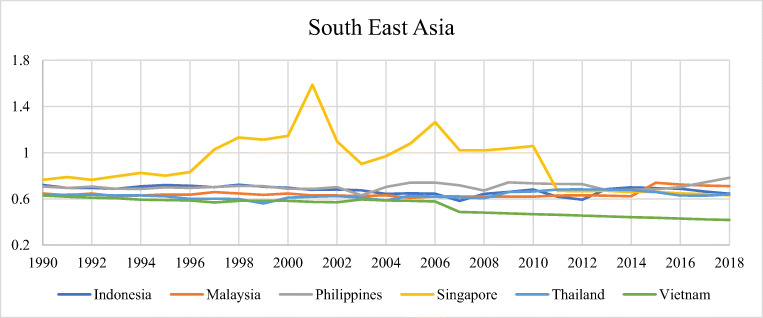
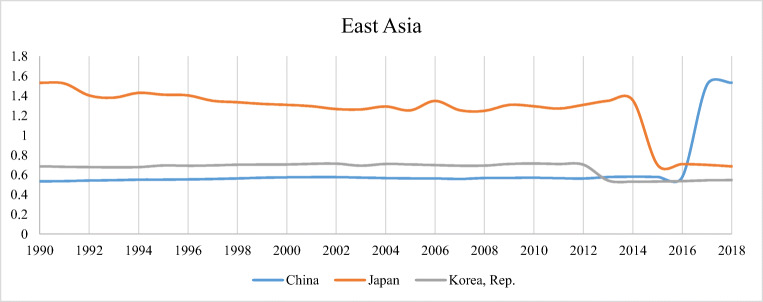
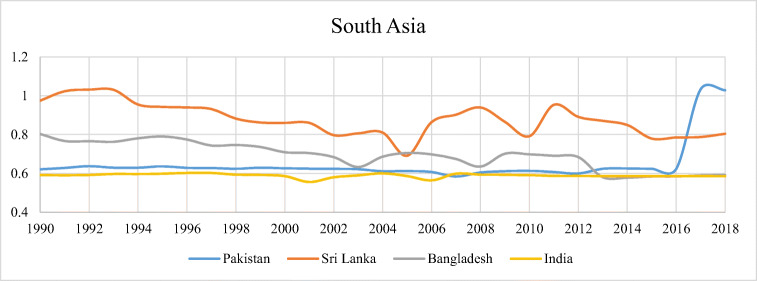
This study employs super-efficiency DEA model with desirable inputs and an undesirable output in calculating environmental efficiency values in different regions in Asia-Pacific from 1990 to 2018. The study compares environmental efficiency index in South East Asia, South Asia and East Asia. The study also evaluates the determinants of environmental efficiency using truncated regression. The mean environmental efficiency score demonstrates that East Asia region is highly efficient whereas South East Asia is the least efficient. Results from the truncated regression established an inverted U-shape relationship between environmental efficiency and Technological Innovation (TI) in the main panel, and the three regions. Also, economic growth shows an inverted "U" shape link with environmental efficiency in the panels except in South East Asia. Human capital promotes environmental efficiency in the main panel and the rest of the regions. Moreover, while FDI promotes environmental efficiency in the main panel and East Asia, it reduces environmental efficiency in both South East and South Asia regions within the Asia-Pacific. In addition, an interaction effect between technological innovation and renewable energy use, advances environmental efficiency within the entire study countries. Based on the findings the study proposes several policy recommendations.
本研究采用带有理想投入和非期望产出的超效率 DEA 模型,计算了 1990 年至 2018 年亚太地区不同地区的环境效率值。本研究比较了东南亚、南亚和东亚的环境效率指数。本研究还使用截断回归评估了环境效率的决定因素。平均环境效率得分表明,东亚地区效率很高,而东南亚地区效率最低。主面板和三个地区的截断回归结果表明,环境效率与技术创新(TI)之间存在倒 U 型关系。此外,除了东南亚,面板中的经济增长与环境效率之间存在倒“U”型联系。人力资本在主面板和其他地区都促进了环境效率。此外,外国直接投资(FDI)在主面板和东亚促进了环境效率,但在东南亚和南亚地区降低了环境效率。此外,技术创新和可再生能源利用之间的交互效应对整个研究国家的环境效率提高有积极影响。基于这些发现,本研究提出了一些政策建议。