Floris Piergiorgio, Dore Maria Pina, Pes Giovanni Mario
Dipartimento di Lettere, Lingue e Beni culturali, University of Cagliari, Cagliari, Italy.
Dipartimento di Scienze Mediche, Chirurgiche e Sperimentali, University of Sassari, Sassari, Italy.
PLoS One. 2021 Jan 5;16(1):e0245006. doi: 10.1371/journal.pone.0245006. eCollection 2021.
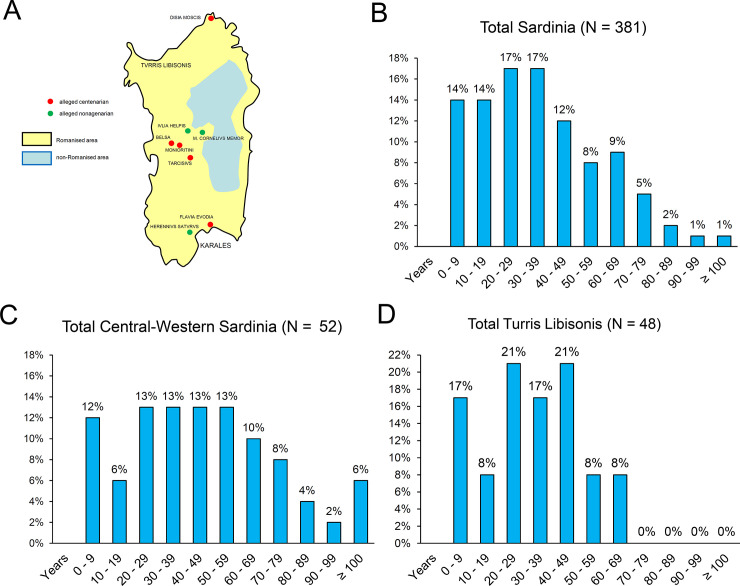
The discovery early in this century of the exceptional longevity of the Sardinian population has given new impetus to demographic studies of this phenomenon during the classical period. In the 1970s, it was hypothesised that the average mortality rate in Roman Sardinia was lower than in metropolitan Rome itself, postulating an ancient precedent for the remarkable longevity observable nowadays in the island's population. In the present study, the available evidence was examined in order to test this hypothesis. Literary, juridical, epigraphic, papyrological, anthropological and archaeological sources regarding the population of the Roman Empire, including Sardinia, were retrieved by accessing Science Direct, PubMed, Scopus and Google Scholar databases, as well as regional libraries, regardless of time limitation, and were independently reviewed by the authors. For Roman Sardinia, only funerary epitaphs were retrieved, in contrast with the numerous sources available for the whole Roman Empire. Inscriptions revealing the existence of three alleged nonagenarians, two centenarians, two ultracentenarians and one supercentenarian were found, corresponding to 2% in a total of 381 inscriptions. The majority were located in a highly Romanised rural area of central-western Sardinia. However, the ages reported in the epitaphs may be inaccurate because of the influence of confounders such as age rounding, approximations and/or amplifications, and are unrelated to the total number of inhabitants. In conclusion, the funerary evidence, the only available data from Roman Sardinia, is too weak to estimate the life expectancy of the local ancient population and cannot offer valuable arguments to support the hypothesis that exceptional longevity has been a Sardinian trait since Roman times.
本世纪初对撒丁岛人口超长寿命的发现,为古典时期这一现象的人口统计学研究注入了新的动力。20世纪70年代,有人提出假设,认为罗马时期撒丁岛的平均死亡率低于罗马城本身,假定如今该岛人口中可观察到的显著长寿现象有古老的先例。在本研究中,对现有证据进行了审查,以检验这一假设。通过访问科学Direct、PubMed、Scopus和谷歌学术数据库以及地区图书馆,检索了有关罗马帝国(包括撒丁岛)人口的文学、司法、铭文、纸莎草文献、人类学和考古学资料,不受时间限制,且由作者独立审查。与整个罗马帝国可获得的大量资料相比,对于罗马时期的撒丁岛,仅检索到了墓志铭。发现有铭文揭示了三名所谓的九旬老人、两名百岁老人、两名超百岁老人和一名超级百岁老人的存在,在总共381篇铭文中占2%。大多数位于撒丁岛中西部罗马化程度很高的农村地区。然而,由于年龄取整、近似和/或放大等混杂因素的影响,墓志铭中报告的年龄可能不准确,且与居民总数无关。总之,作为罗马时期撒丁岛唯一可用数据的丧葬证据太过薄弱,无法估计当地古代人口的预期寿命,也无法提供有价值的论据来支持自罗马时代以来超长寿命就是撒丁岛人的特征这一假设。