Department of Civil, Geological and Mining Engineering, Polytechnique Montréal, Montréal, QC H3C 3A7, Canada.
Water Research Australia, Adelaide SA5001, Australia.
Toxins (Basel). 2021 Jan 1;13(1):25. doi: 10.3390/toxins13010025.
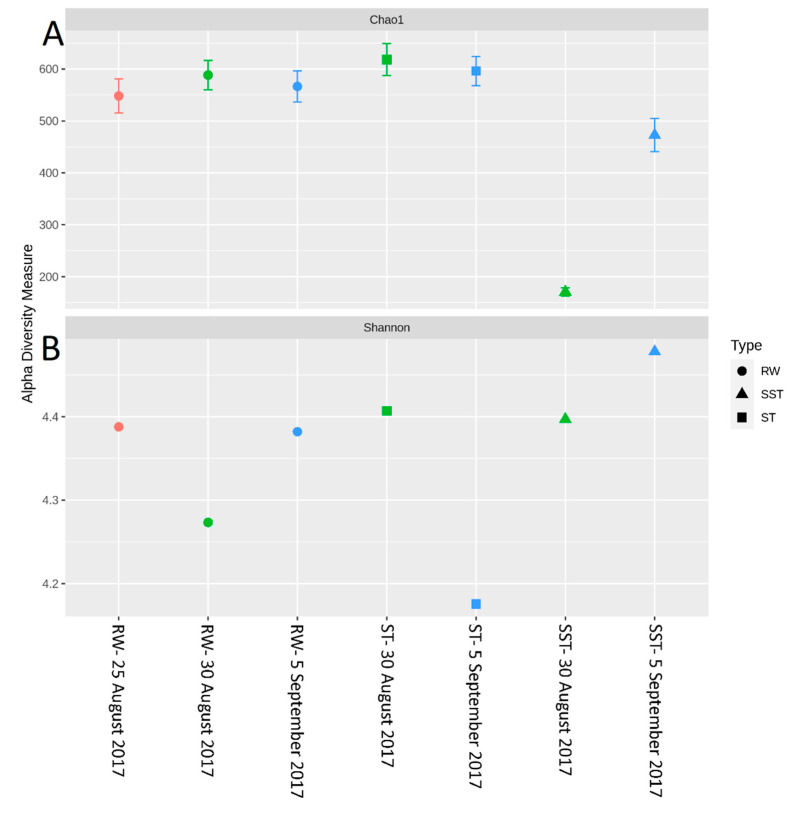
Conventional processes (coagulation, flocculation, sedimentation, and filtration) are widely used in drinking water treatment plants and are considered a good treatment strategy to eliminate cyanobacterial cells and cell-bound cyanotoxins. The diversity of cyanobacteria was investigated using taxonomic cell counts and shotgun metagenomics over two seasons in a drinking water treatment plant before, during, and after the bloom. Changes in the community structure over time at the phylum, genus, and species levels were monitored in samples retrieved from raw water (RW), sludge in the holding tank (ST), and sludge supernatant (SST). and were predominant species detected in RW by taxonomic cell counts. Shotgun metagenomics revealed that Proteobacteria was the predominant phylum in RW before and after the cyanobacterial bloom. Taxonomic cell counts and shotgun metagenomic showed that the bloom occurred inside the plant. Cyanobacteria and Bacteroidetes were the major bacterial phyla during the bloom. Shotgun metagenomics also showed that , and were the predominant detected cyanobacterial genera in the samples. Conventional treatment removed more than 92% of cyanobacterial cells but led to cell accumulation in the sludge up to 31 times more than in the RW influx. Coagulation/sedimentation selectively removed more than 96% of and . Cyanobacterial community in the sludge varied from raw water to sludge during sludge storage (1-13 days). This variation was due to the selective removal of coagulation/sedimentation as well as the accumulation of captured cells over the period of storage time. However, the prediction of the cyanobacterial community composition in the SST remained a challenge. Among nutrient parameters, orthophosphate availability was related to community profile in RW samples, whereas communities in ST were influenced by total nitrogen, Kjeldahl nitrogen (N- Kjeldahl), total and particulate phosphorous, and total organic carbon (TOC). No trend was observed on the impact of nutrients on SST communities. This study profiled new health-related, environmental, and technical challenges for the production of drinking water due to the complex fate of cyanobacteria in cyanobacteria-laden sludge and supernatant.
传统工艺(混凝、絮凝、沉淀和过滤)广泛应用于饮用水处理厂,被认为是消除蓝藻细胞和细胞结合型蓝藻毒素的良好处理策略。在蓝藻水华前后两个季节,通过分类细胞计数和鸟枪法宏基因组学,在一个饮用水处理厂中对蓝藻的多样性进行了研究。在时间上,通过对原水(RW)、储泥罐中的污泥(ST)和污泥上清液(SST)中采集的样本,监测了门、属和种水平上的群落结构变化。通过分类细胞计数,发现 RW 中优势种为 和 。鸟枪法宏基因组学显示,蓝藻水华前后 RW 中的优势菌门为变形菌门。分类细胞计数和鸟枪法宏基因组学显示,蓝藻水华发生在工厂内部。蓝藻和拟杆菌门是水华期间的主要细菌门。鸟枪法宏基因组学还显示,样本中主要的检测到的蓝藻属为 、 和 。常规处理去除了超过 92%的蓝藻细胞,但导致污泥中的细胞积累,比 RW 进水高出 31 倍。混凝/沉淀选择性地去除了超过 96%的 和 。污泥储存期间(1-13 天),污泥中的蓝藻群落从原水到污泥发生了变化。这种变化是由于混凝/沉淀的选择性去除以及在储存时间内捕获细胞的积累造成的。然而,对 SST 中蓝藻群落组成的预测仍然是一个挑战。在营养参数中,正磷酸盐的可用性与 RW 样本中的群落特征有关,而 ST 中的群落则受总氮、凯氏氮(N-Kjeldahl)、总磷和颗粒磷以及总有机碳(TOC)的影响。没有观察到营养物质对 SST 群落的影响趋势。由于富含蓝藻的污泥和上清液中蓝藻的复杂命运,本研究为饮用水生产带来了新的与健康、环境和技术相关的挑战。