McCoun Megan, Oyebade Adeoye, Estrada-Reyes Zaira M, Pech-Cervantes Andres A, Ogunade Ibukun M
Division of Food and Animal Science, Kentucky State University, Frankfort, KY 40601, USA.
Department of Animal Sciences, University of Florida, Gainesville, FL 32611, USA.
Animals (Basel). 2021 Jan 2;11(1):72. doi: 10.3390/ani11010072.
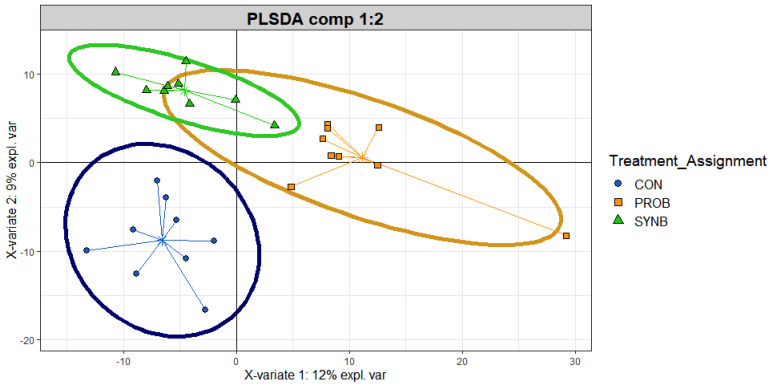
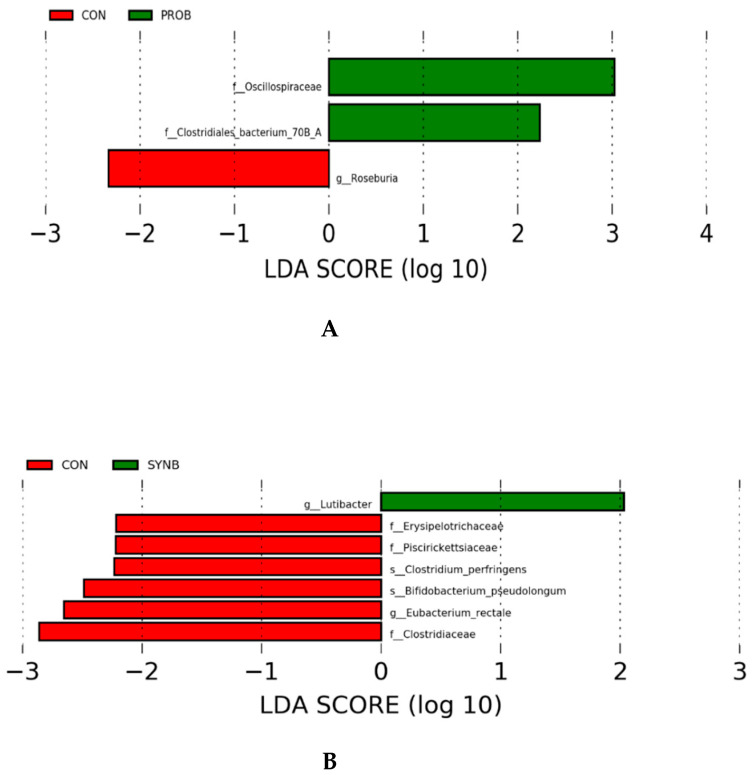
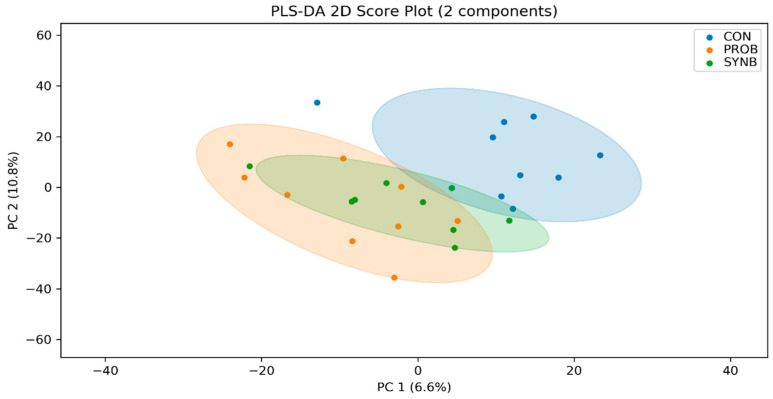
We examined the effects of two direct-fed microbial (DFM) products containing multiple microbial species and their fermentation products on ruminal metatranscriptome and carboxyl-metabolome of beef steers. Nine ruminally-cannulated Holstein steers were assigned to 3 treatments arranged in a 3 × 3 Latin square design with three 21-d periods. Dietary treatments were (1) Control (CON; basal diet without additive), (2) Commence (PROB; basal diet plus 19 g/d of Commence), and (3) RX3 (SYNB; basal diet plus 28 g/d of RX3). Commence and RX3 are both -based DFM products containing several microbial species and their fermentation products. Mixed ruminal contents collected multiple times after feeding on day 21 were used for metatranscriptome and carboxyl-metabolome analysis. Partial least squares discriminant analysis revealed a distinct transcriptionally active taxonomy profiles between CON and each of the PROB and SYNB samples. Compared to CON, the steers fed supplemental PROB had 3 differential (LDA ≥ 2.0; ≤ 0.05) transcriptionally active taxa, none of which were at the species level, and those fed SYNB had eight differential (LDA > 2.0, ≤ 0.05) transcriptionally active taxa, but there was no difference ( > 0.05) between PROB and SYNB. No functional microbial genes were differentially expressed among the treatments. Compared with CON, 3 metabolites (hydroxylpropionic acid and 2 isomers of propionic acid) were increased (FC ≥ 1.2, FDR ≤ 0.05), whereas 15 metabolites, including succinic acid and fatty acid peroxidation and amino acid degradation products were reduced (FC ≤ 0.83, FDR ≤ 0.05) by supplemental PROB. Compared with CON, 2 metabolites (2 isomers of propionic acid) were increased (FC ≥ 1.2, FDR ≤ 0.05), whereas 2 metabolites (succinic acid and pimelate) were reduced (FC ≤ 0.83, FDR ≤ 0.05) by supplemental SYNB. Compared to SYNB, supplemental PROB reduced (FC ≤ 0.83, FDR ≤ 0.05) the relative abundance of four fatty acid peroxidation products in the rumen. This study demonstrated that dietary supplementation with either PROB or SYNB altered the ruminal fermentation pattern. In addition, supplemental PROB reduced concentrations of metabolic products of fatty acid peroxidation and amino acid degradation. Future studies are needed to evaluate the significance of these alterations to ruminal fatty acid and amino acid metabolisms, and their influence on beef cattle performance.
我们研究了两种含有多种微生物及其发酵产物的直接投喂微生物(DFM)产品对肉牛瘤胃元转录组和羧基代谢组的影响。将9头安装了瘤胃瘘管的荷斯坦公牛分配到3种处理组,采用3×3拉丁方设计,共3个21天的周期。日粮处理分别为:(1)对照组(CON;基础日粮,无添加剂),(2)Commence组(PROB;基础日粮加19克/天的Commence),(3)RX3组(SYNB;基础日粮加28克/天的RX3)。Commence和RX3均为基于微生物的DFM产品,含有多种微生物及其发酵产物。在第21天饲喂后多次采集的混合瘤胃内容物用于元转录组和羧基代谢组分析。偏最小二乘判别分析显示,CON组与PROB组和SYNB组的每个样本之间存在明显不同的转录活性分类学图谱。与CON组相比,饲喂补充PROB的公牛有3个差异(线性判别分析≥2.0;P≤0.05)转录活性分类群,均未达到物种水平,饲喂SYNB的公牛有8个差异(线性判别分析>2.0,P≤0.05)转录活性分类群,但PROB组和SYNB组之间无差异(P>0.05)。各处理组之间没有差异表达的功能性微生物基因。与CON组相比,补充PROB使3种代谢物(羟基丙酸和2种丙酸异构体)增加(变化倍数≥1.2,错误发现率≤0.05),而包括琥珀酸、脂肪酸过氧化产物和氨基酸降解产物在内的15种代谢物减少(变化倍数≤0.83,错误发现率≤0.05)。与CON组相比,补充SYNB使2种代谢物(2种丙酸异构体)增加(变化倍数≥1.2,错误发现率≤0.05),而2种代谢物(琥珀酸和庚二酸)减少(变化倍数≤0.83,错误发现率≤0.05)。与SYNB组相比,补充PROB降低了瘤胃中4种脂肪酸过氧化产物的相对丰度(变化倍数≤0.83,错误发现率≤0.05)。本研究表明,日粮中添加PROB或SYNB均可改变瘤胃发酵模式。此外,补充PROB降低了脂肪酸过氧化和氨基酸降解代谢产物的浓度。未来需要开展研究,评估这些变化对瘤胃脂肪酸和氨基酸代谢的重要性及其对肉牛生产性能的影响。