Adeyemi James A, Peters Sunday O, De Donato Marcos, Cervantes Andres Pech, Ogunade Ibukun M
1College of Agriculture, Communities, and the Environment, Kentucky State University, Frankfort, KY 40601 USA.
2Department of Animal Science, Berry College, Mount Berry, GA 30149 USA.
J Anim Sci Biotechnol. 2020 Feb 17;11:14. doi: 10.1186/s40104-019-0419-5. eCollection 2020.
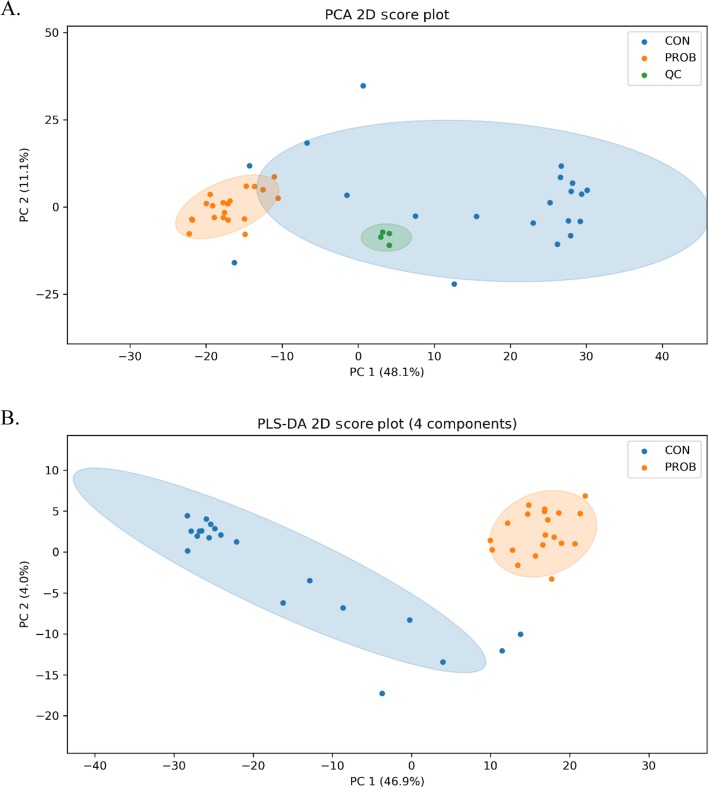
Previous studies have evaluated the metabolic status of animals fed direct-fed microbial (DFM) using enzyme-based assays which are time-consuming and limited to a few metabolites. In addition, little emphasis has been placed on investigating the effects of DFM on hindgut microbiota. We examined the effects of dietary supplementation of a blend of -based DFM and fermentation products on the plasma concentrations of carbonyl-containing metabolites via a metabolomics approach, and fecal bacterial community, via 16S rRNA gene sequencing, of beef steers during a 42-day receiving period. Forty newly weaned steers were randomly assigned to receive a basal diet with no additive (CON; = 20) or a basal diet supplemented with 19 g of Commence™ (PROB; = 20) for a 42-day period. Commence™ (PMI, Arden Hills, MN) is a blend of 6.2 10 cfu/g of , 3.5 × 10 cfu/g of a mixture of , and , and the fermentation products of these aforementioned microorganisms and those of and . On d 0 and 40, rectal fecal samples were collected randomly from 10 steers from each treatment group. On d 42, blood was collected for plasma preparation.
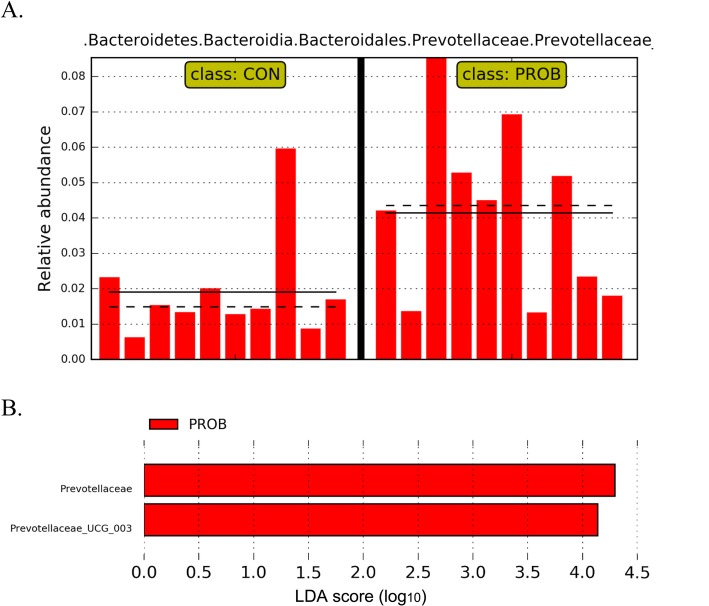
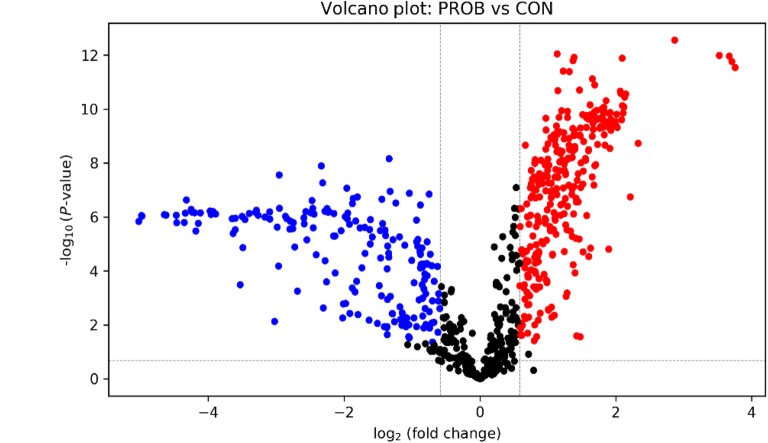
A total number of 812 plasma metabolites were detected. Up to 305 metabolites [fold change (FC) ≥ 1.5, FDR ≤ 0.01] including glucose, hippuric acid, and 5-hydroxykynurenamine were increased by PROB supplementation, whereas 199 metabolites (FC ≤ 0.63, FDR ≤ 0.01) including acetoacetate were reduced. Supplementation of PROB increased ( ≤ 0.05) the relative abundance of UCG-003, , , and . In contrast, the relative abundance of , , and uncultured bacterium belonging to family p-2534-18B5 gut group (phylum Bacteroidetes) were reduced ( ≤ 0.05).
The results of this study demonstrated that supplementation of PROB altered both the plasma carbonyl metabolome towards increased glucose concentration suggesting an improved energy status, and fecal bacterial community, suggesting an increased hindgut fermentation of the beef steers.
以往的研究使用基于酶的检测方法评估了直接投喂微生物(DFM)的动物的代谢状况,这些方法耗时且仅限于少数几种代谢物。此外,很少有人重视研究DFM对后肠微生物群的影响。我们通过代谢组学方法研究了日粮中添加基于-的DFM和发酵产物混合物对育肥牛血浆中含羰基代谢物浓度的影响,并通过16S rRNA基因测序研究了粪便细菌群落。40头刚断奶的育肥牛被随机分配,在42天的接收期内,一组接受不添加任何添加剂的基础日粮(CON;n = 20),另一组接受添加19 g Commence™(PROB;n = 20)的基础日粮。Commence™(PMI,明尼苏达州阿登希尔斯)是一种混合物,包含6.2×10⁹ cfu/g的[具体菌种1]、3.5×10⁸ cfu/g的[具体菌种2]和[具体菌种3]的混合物,以及上述微生物和[其他微生物]的发酵产物。在第0天和第40天,从每个处理组的10头育肥牛中随机采集直肠粪便样本。在第42天,采集血液用于制备血浆。
共检测到812种血浆代谢物。添加PROB后,多达305种代谢物[倍数变化(FC)≥1.5,错误发现率(FDR)≤0.01],包括葡萄糖、马尿酸和5-羟基犬尿胺增加,而199种代谢物(FC≤0.63,FDR≤0.01),包括乙酰乙酸减少。添加PROB增加了(P≤0.05)UCG-003、[具体菌属1]、[具体菌属2]、[具体菌属3]和[具体菌属4]的相对丰度。相反,[具体菌属5]、[具体菌属6]、[具体菌属7]和属于拟杆菌门p-2534-18B5肠道群的未培养细菌的相对丰度降低(P≤0.05)。
本研究结果表明,添加PROB改变了血浆羰基代谢组,使葡萄糖浓度升高,表明能量状态改善,同时也改变了粪便细菌群落,表明育肥牛后肠发酵增加。