Department of Orthopedic Surgery, Peking Union Medical College Hospital, Chinese Academy of Medical Science and Peking Union Medical College, Beijing, 100730, China.
BMC Musculoskelet Disord. 2021 Jan 5;22(1):13. doi: 10.1186/s12891-020-03869-z.
To assess the risk factors for blood transfusion in a great number of adolescent cases with different types of scoliosis who received scoliosis surgery.
Data of patients who were diagnosed as scoliosis and received one-stage posterior correction and spinal fusion from January 2014 to December 2017 were prospectively collected and retrospectively analyzed. Patients' demographic characteristics, segments of spinal fusion, Cobb angle of the major curve,osteotomy pattern, preoperative and postoperative levels of hemoglobin, and allogeneic blood transfusion (ABT) were recorded and analyzed.
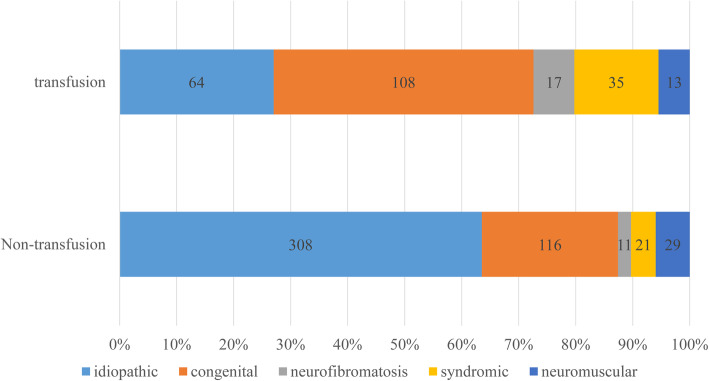
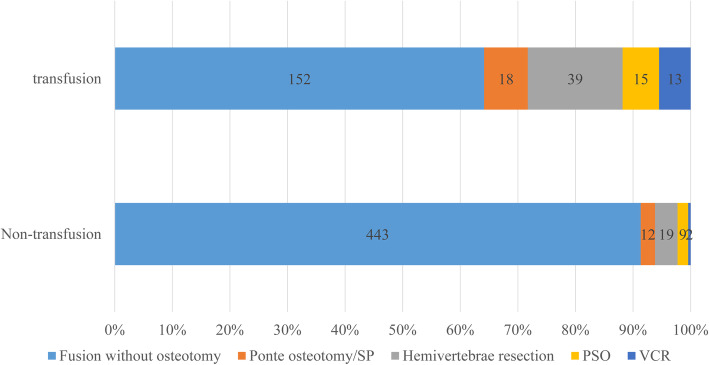
In this study, 722 cases with adolescent scoliosis were included, of whom 32.8% (237/722) received ABT. Risk factors included diagnosis: neurofibromatosis (OR = 5.592), syndromic (OR = 3.029),osteotomy: Ponte osteotomy (OR = 5.997), hemivertebrae resection (OR = 29.171), pedicle subtraction osteotomy (PSO)(OR = 8.712), vertebral column resection (VCR)(OR = 32.265);fusion segments (OR = 1.224) and intraoperative blood loss (OR = 1.004). In the subgroup analysis of cases with idiopathic scoliosis, Ponte osteotomy (OR = 6.086), length of segments of spinal fusion (OR = 1.293), and intraoperative blood loss (OR = 1.001) were found as risk factors for ABT. Results of receiver operating characteristic (ROC) curve analysis revealed that length of segments of spinal fusion equal to 11.5 vertebrae was the best cutoff value for cases with idiopathic scoliosis who did not receive osteotomy in both ABT group and non-ABT group. In the subgroup analysis of congenital scoliosis, Ponte osteotomy (OR = 5.087), hemivertebra resection (OR = 5.457), PSO (OR = 4.055), VCR (OR = 6.940), and intraoperative blood loss (OR = 1.004) were risk factors for ABT.
Method of diagnosis, osteotomy pattern, segments of spinal fusion, and intraoperative blood loss were risk factors for ABT in cases with adolescent scoliosis. In cases with idiopathic scoliosis, Ponte osteotomy and segments of spinal fusion longer than 11.5 vertebrae were risk factors for ABT. In cases with congenital scoliosis, osteotomy pattern was the main risk factor for ABT.
Level III.
评估大量不同类型脊柱侧弯青少年接受脊柱侧弯手术患者输血的风险因素。
前瞻性收集 2014 年 1 月至 2017 年 12 月期间诊断为脊柱侧弯并接受一期后路矫正和脊柱融合术的患者数据,回顾性分析患者的人口统计学特征、脊柱融合节段、主曲线 Cobb 角、截骨方式、术前和术后血红蛋白水平以及异体输血(ABT)情况,并进行记录和分析。
本研究纳入了 722 例青少年脊柱侧弯患者,其中 32.8%(237/722)接受了 ABT。风险因素包括诊断:神经纤维瘤病(OR=5.592)、综合征(OR=3.029)、截骨方式: Ponte 截骨(OR=5.997)、半椎体切除(OR=29.171)、经椎弓根截骨术(PSO)(OR=8.712)、脊柱切除术(VCR)(OR=32.265);融合节段(OR=1.224)和术中出血量(OR=1.004)。在特发性脊柱侧弯病例的亚组分析中,Ponte 截骨术(OR=6.086)、脊柱融合节段长度(OR=1.293)和术中出血量(OR=1.001)被认为是 ABT 的危险因素。受试者工作特征(ROC)曲线分析结果显示,对于未行截骨术的特发性脊柱侧弯患者,融合节段长度等于 11.5 个椎体是 ABT 的最佳截断值。在先天性脊柱侧弯亚组分析中,Ponte 截骨术(OR=5.087)、半椎体切除(OR=5.457)、PSO(OR=4.055)、VCR(OR=6.940)和术中出血量(OR=1.004)是 ABT 的危险因素。
诊断方法、截骨方式、脊柱融合节段和术中出血量是青少年脊柱侧弯患者 ABT 的危险因素。在特发性脊柱侧弯患者中,Ponte 截骨术和融合节段长度超过 11.5 个椎体是 ABT 的危险因素。在先天性脊柱侧弯患者中,截骨方式是 ABT 的主要危险因素。
III 级。