Department of Pediatric Rheumatology Willem-Alexander Children's Hospital, Leiden University Medical Center, Leiden, the Netherlands.
Centre for Human Drug Research, Leiden, the Netherlands.
Br J Clin Pharmacol. 2021 Aug;87(8):3162-3176. doi: 10.1111/bcp.14729. Epub 2021 Feb 2.
To evaluate feasibility of intradermal (i.d.) adalimumab administration using hollow microneedles, and to compare a single i.d. dose of adalimumab using a hollow microneedle with a single subcutaneous (s.c.) dose using a conventional needle.
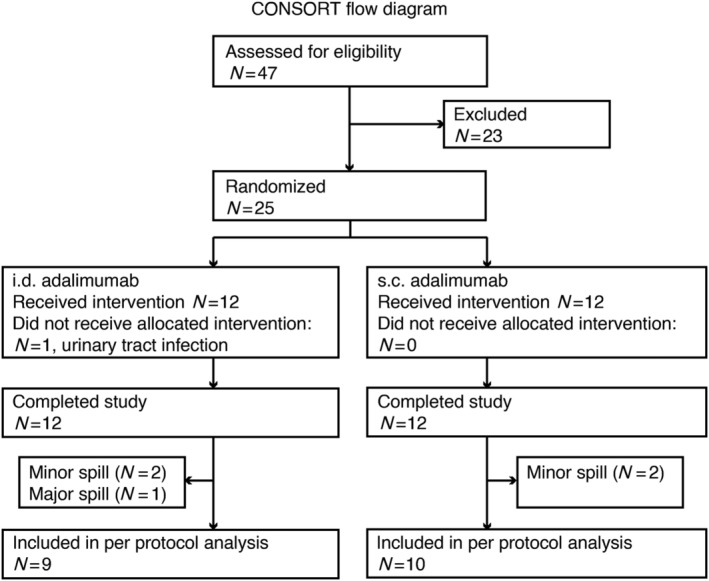
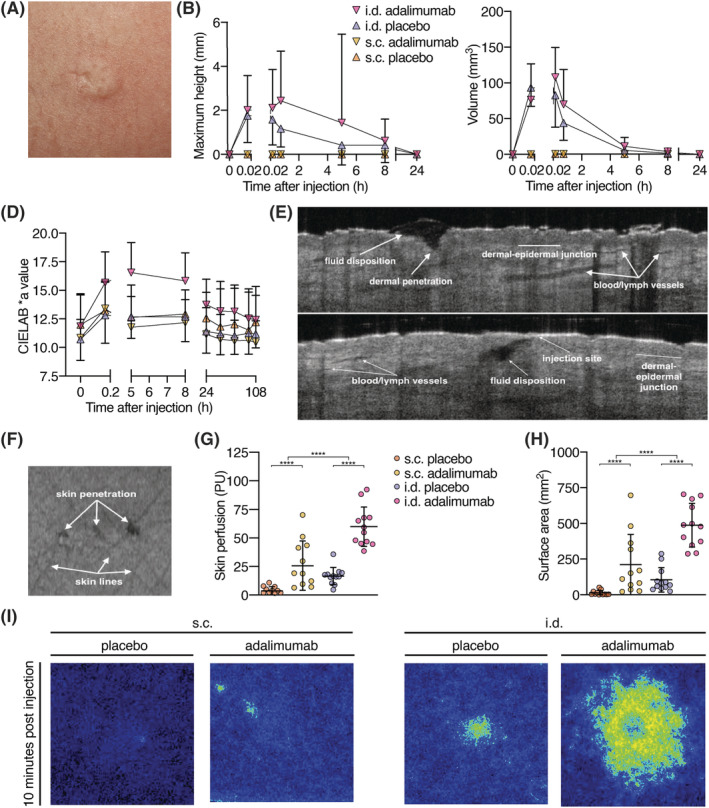
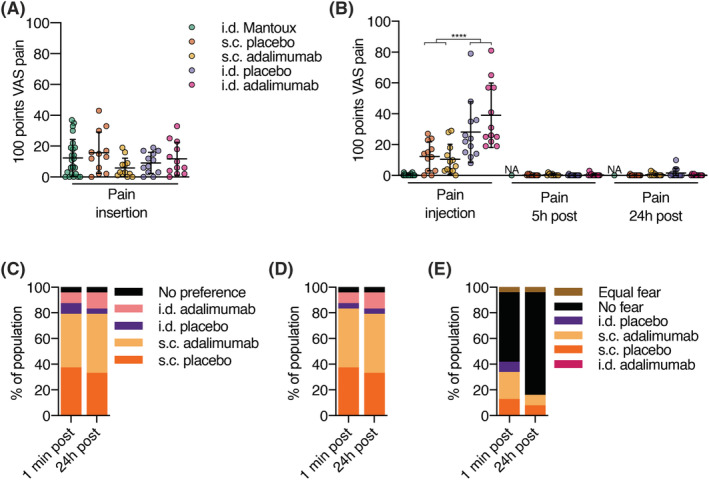
In this single-centre double-blind, placebo-controlled, double-dummy clinical trial in 24 healthy adults we compared 40 mg adalimumab (0.4 mL) administered i.d. using a hollow microneedle with a s.c. dose using a conventional needle. Primary parameters were pain, acceptability and local tolerability; secondary parameters safety, pharmacokinetics and immunogenicity. We explored usability of optical coherence tomography, clinical photography, thermal imaging, and laser speckle contrast imaging to evaluate skin reaction after i.d. injections. In vitro protein analysis was performed to assess compatibility of adalimumab with the hollow microneedle device.
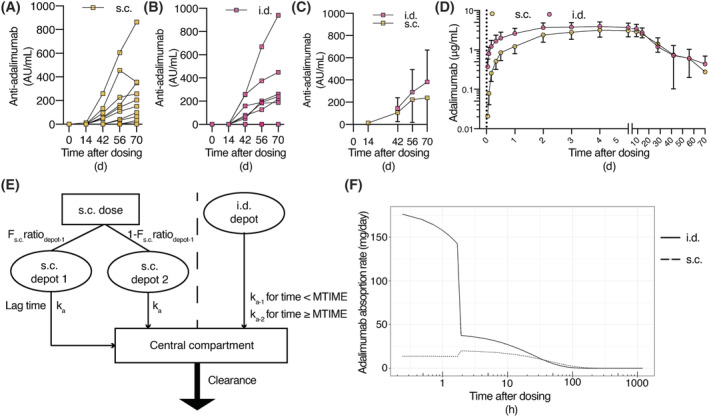
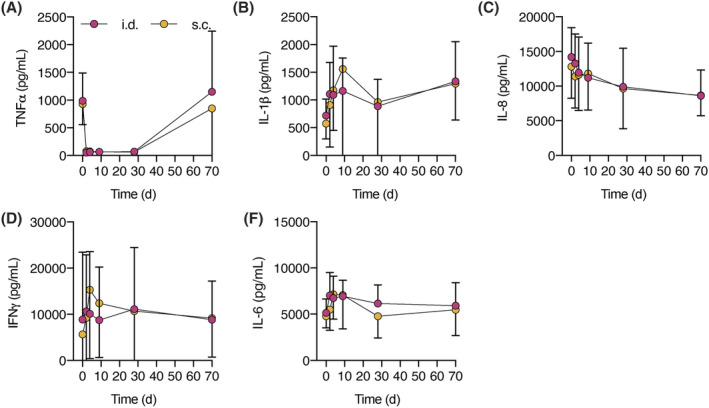
While feasible and safe, injection pain of i.d. adalimumab was higher compared to s.c. adalimumab (35.4 vs. 7.9 on a 100-point visual analogue scale). Initial absorption rate and relative bioavailability were higher after i.d. adalimumab (time to maximum plasma concentration = 95 h [47-120]; F = 129% [6.46%]) compared to s.c. adalimumab (time to maximum plasma concentration = 120 h [96-221]). Anti-adalimumab antibodies were detected in 50% and 83% of the subjects after i.d. and s.c. adalimumab, respectively. We observed statistically significantly more erythema and skin perfusion after i.d. adalimumab, compared to s.c. adalimumab and placebo injections (P < .0001). Cytokine secretion after whole blood lipopolysaccharide challenge was comparable between administration routes.
Intradermal injection of adalimumab using hollowing microneedles was perceived as more painful and less accepted than s.c. administration, but yields a higher relative bioavailability with similar safety and pharmacodynamic effects.
评估使用空心微针进行皮内(ID)阿达木单抗给药的可行性,并比较使用空心微针对 40mg 阿达木单抗(0.4ml)进行单次 ID 给药与使用传统针头进行单次皮下(SC)给药的效果。
在这项单中心、双盲、安慰剂对照、双盲临床试验中,我们比较了 24 名健康成年人中使用空心微针对 40mg 阿达木单抗(0.4ml)进行 ID 给药与使用传统针头进行 SC 剂量给药的效果。主要参数为疼痛、可接受性和局部耐受性;次要参数为安全性、药代动力学和免疫原性。我们探索了光学相干断层扫描、临床摄影、热成像和激光散斑对比成像在评估 ID 注射后皮肤反应中的应用。进行体外蛋白分析以评估阿达木单抗与空心微针装置的兼容性。
虽然可行且安全,但 ID 阿达木单抗注射的疼痛程度高于 SC 阿达木单抗(100 分视觉模拟量表上分别为 35.4 分和 7.9 分)。与 SC 阿达木单抗相比,ID 阿达木单抗的初始吸收速率和相对生物利用度更高(最大血浆浓度时间=95 小时[47-120];F=129%[6.46%])。与 SC 阿达木单抗相比,ID 阿达木单抗(最大血浆浓度时间=120 小时[96-221])。ID 和 SC 阿达木单抗给药后,分别有 50%和 83%的受试者检测到抗阿达木单抗抗体。与 SC 阿达木单抗和安慰剂注射相比,ID 阿达木单抗后观察到统计学上更多的红斑和皮肤灌注(P<0.0001)。两种给药途径的全血脂多糖刺激后细胞因子分泌无差异。
使用空心微针对阿达木单抗进行皮内注射比皮下注射疼痛程度更高,接受程度更低,但相对生物利用度更高,安全性和药效学效果相似。