Aging Research Center, Department of Neurobiology, Care Sciences and Society, Karolinska Institutet and Stockholm University, Stockholm, Sweden.
Department of Clinical and Experimental Sciences, University of Brescia, Brescia, Italy.
Alzheimers Dement. 2021 May;17(5):768-776. doi: 10.1002/alz.12237. Epub 2021 Jan 6.
We investigate dementia risk in older adults with different disease patterns and explore the role of inflammation and apolipoprotein E (APOE) genotype.
A total of 2,478 dementia-free participants with two or more chronic diseases (ie, multimorbidity) part of the Swedish National study on Aging and Care in Kungsholmen (SNAC-K) were grouped according to their multimorbidity patterns and followed to detect clinical dementia. The potential modifier effect of C-reactive protein (CRP) and apolipoprotein E (APOE) genotype was tested through stratified analyses.
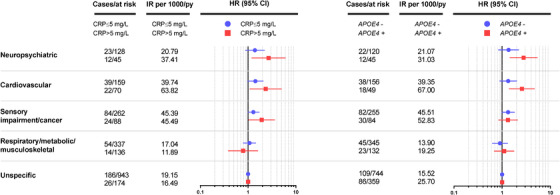
People with neuropsychiatric, cardiovascular, and sensory impairment/cancer multimorbidity had increased hazards for dementia compared to the unspecific (Hazard ration (HR) 1.66, 95% confidence interval [CI] 1.13-2.42; 1.61, 95% CI 1.17-2.29; 1.32, 95% CI 1.10-1.71, respectively). Despite the lack of statistically significant interaction, high CRP increased dementia risk within these patterns, and being APOE ε4 carriers heightened dementia risk for neuropsychiatric and cardiovascular multimorbidity.
Individuals with neuropsychiatric, cardiovascular, and sensory impairment/cancer patterns are at increased risk for dementia and APOE ε4, and inflammation may further increase the risk. Identifying such high-risk groups might allow tailored interventions for dementia prevention.
我们研究了具有不同疾病模式的老年人的痴呆风险,并探讨了炎症和载脂蛋白 E(APOE)基因型的作用。
共有 2478 名无痴呆症的参与者患有两种或两种以上的慢性疾病(即多种疾病),他们是瑞典 Kungsholmen 老龄化和护理国家研究(SNAC-K)的一部分,根据他们的多种疾病模式进行分组,并进行随访以检测临床痴呆症。通过分层分析测试了 C 反应蛋白(CRP)和载脂蛋白 E(APOE)基因型的潜在修饰作用。
与非特异性疾病(危险比(HR)1.66,95%置信区间[CI]1.13-2.42;1.61,95%CI1.17-2.29;1.32,95%CI1.10-1.71)相比,患有神经精神、心血管和感觉障碍/癌症多种疾病的人患痴呆症的风险更高。尽管没有统计学意义上的交互作用,但高 CRP 增加了这些模式下的痴呆风险,APOE ε4 携带者增加了神经精神和心血管多种疾病的痴呆风险。
具有神经精神、心血管和感觉障碍/癌症模式的个体患痴呆症的风险增加,APOE ε4 可能进一步增加风险。识别这些高风险群体可能有助于针对痴呆症预防进行有针对性的干预。