Department of Ophthalmology, Scheie Eye Institute, University of Pennsylvania, Philadelphia, Pennsylvania, United States of America.
Noveome Biotherapeutics, Inc., Pittsburgh, Pennsylvania, United States of America.
PLoS One. 2021 Jan 6;16(1):e0243862. doi: 10.1371/journal.pone.0243862. eCollection 2021.
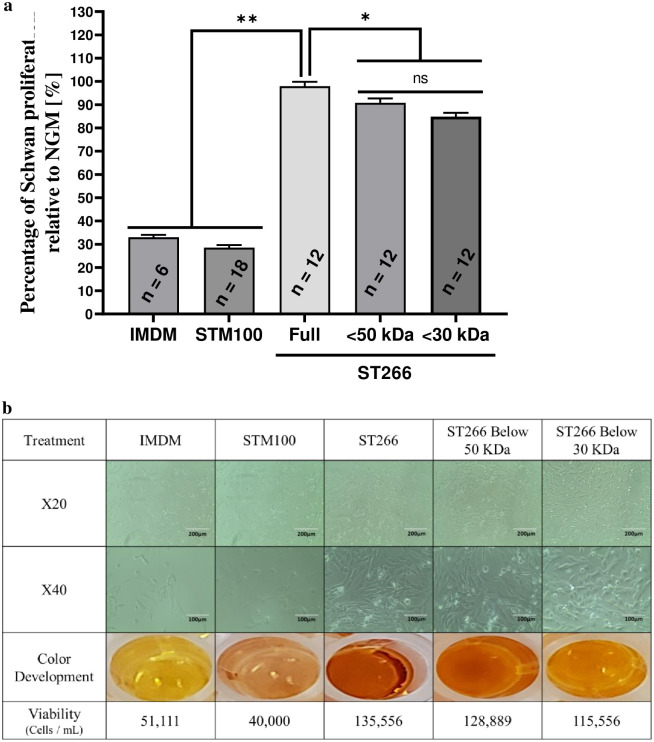
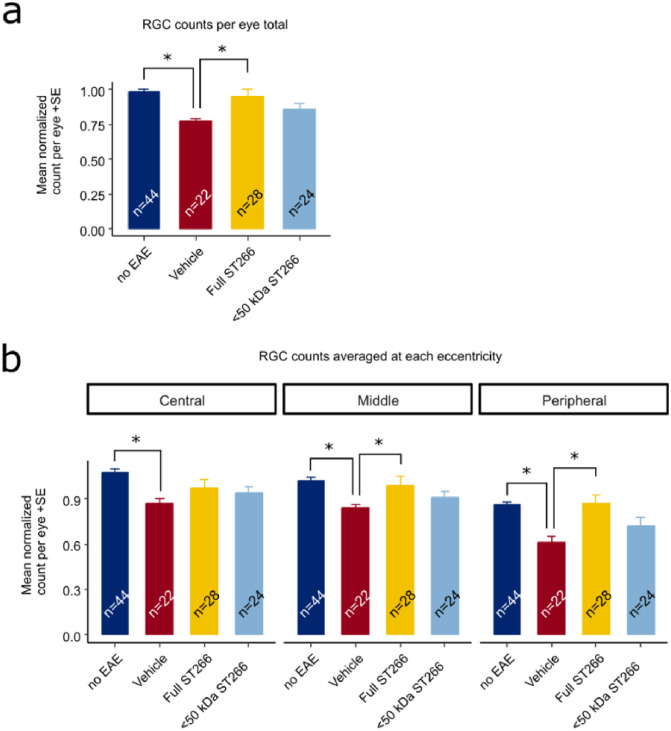
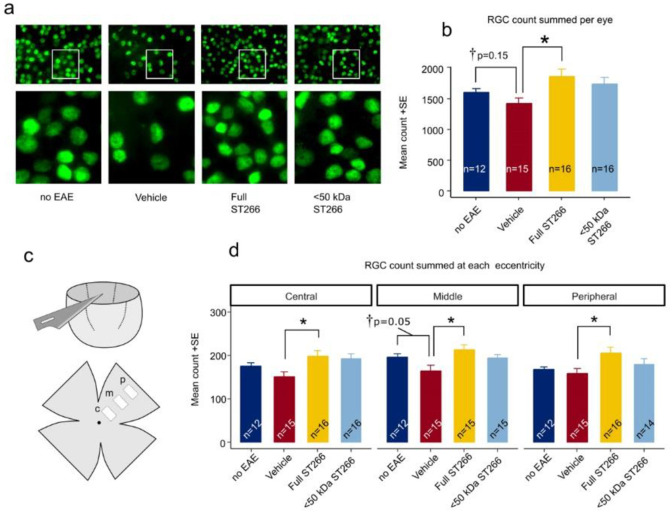
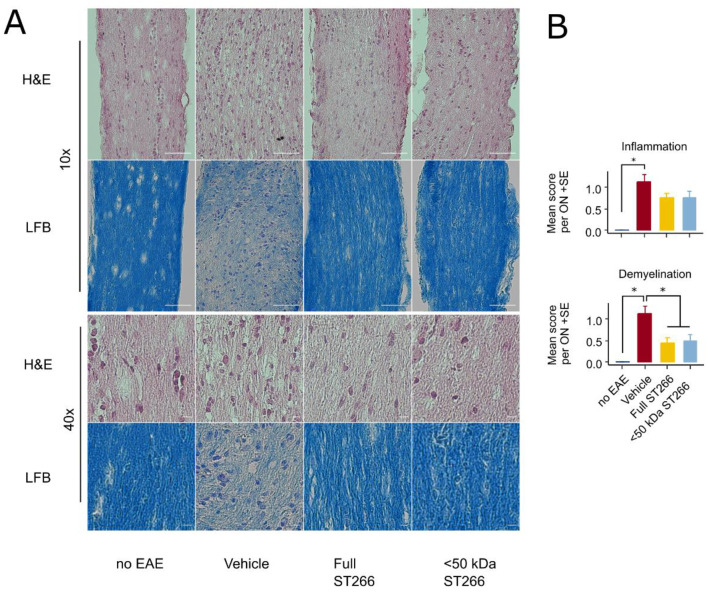
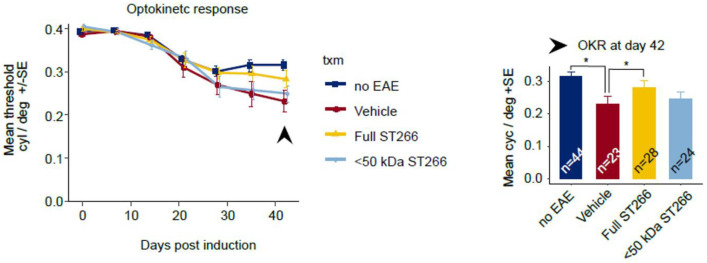
ST266 is the biological secretome of cultured Amnion-derived Multipotent Progenitor cells containing multiple growth factors and cytokines. While intranasally-administered ST266 improves the phenotype in experimental optic neuritis, specific ST266 components mediating these effects are not known. We compared the effects of ST266 with and without removal of large molecular weight proteins both in vitro and in the multiple sclerosis model experimental autoimmune encephalomyelitis (EAE) in C57BL/6J mice. Mice were treated daily with intranasal vehicle, ST266 or lower molecular weight fraction of ST266. Retinal ganglion cells were counted in isolated retinas, and optic nerves were assessed for inflammation and demyelination. ST266 treatment significantly improved retinal ganglion cell survival and reduced optic nerve demyelination in EAE mice. The lower molecular weight ST266 fraction significantly improved optic nerve demyelination, but only showed a trend towards improved retinal ganglion cell survival. ST266 fractions below 50kDa increased Schwann cell proliferation in vitro, but were less effective than non-fractionated ST266. Demyelination attenuation was partially associated with the lower molecular weight ST266 fraction, but removal of higher molecular weight biomolecules from ST266 diminishes its neuroprotective effects, suggesting at least some high molecular weight proteins play a role in ST266-mediated neuroprotection.
ST266 是培养的羊膜衍生多能祖细胞的生物分泌组,含有多种生长因子和细胞因子。虽然经鼻腔给予 ST266 可改善实验性视神经炎的表型,但介导这些作用的特定 ST266 成分尚不清楚。我们比较了 ST266 及其去除大分子量蛋白前后在体外和 C57BL/6J 小鼠多发性硬化症实验性自身免疫性脑脊髓炎(EAE)模型中的作用。用鼻腔载体、ST266 或 ST266 的低分子量部分每日治疗小鼠。在分离的视网膜中计数视网膜神经节细胞,并评估视神经的炎症和脱髓鞘。ST266 治疗可显著改善 EAE 小鼠的视网膜神经节细胞存活并减少视神经脱髓鞘。低分子量 ST266 部分可显著改善视神经脱髓鞘,但仅显示出改善视网膜神经节细胞存活的趋势。体外,低于 50kDa 的 ST266 部分增加施万细胞增殖,但不如非分级 ST266 有效。脱髓鞘衰减部分与低分子量 ST266 部分相关,但从 ST266 中去除高分子量生物分子会降低其神经保护作用,表明至少一些高分子量蛋白在 ST266 介导的神经保护中发挥作用。