Instituto de Agroquímica y Tecnología de Alimentos (IATA-CSIC), Avda. Agustín Escardino 7, 46980 Paterna, Valencia, Spain.
Molecules. 2021 Jan 4;26(1):223. doi: 10.3390/molecules26010223.
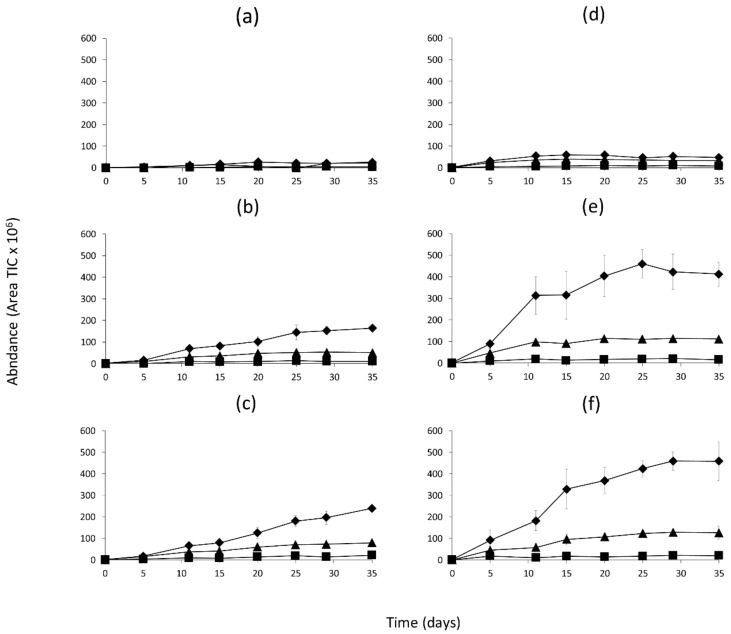
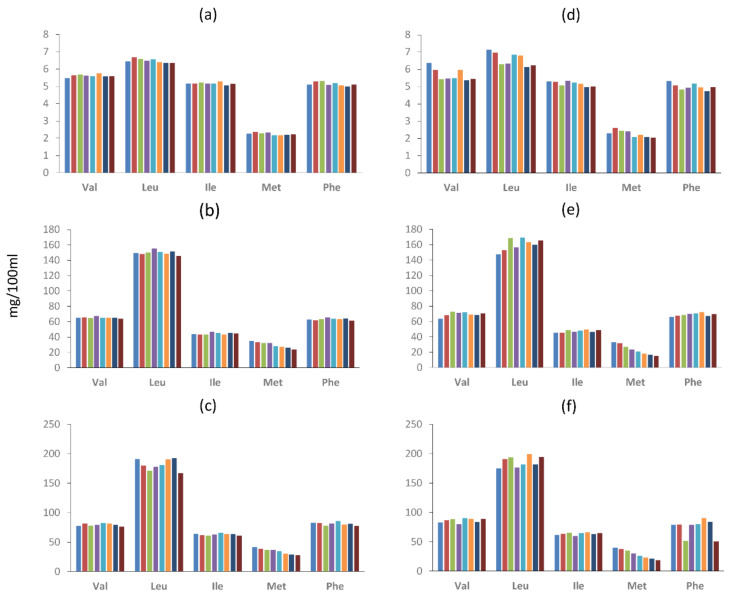
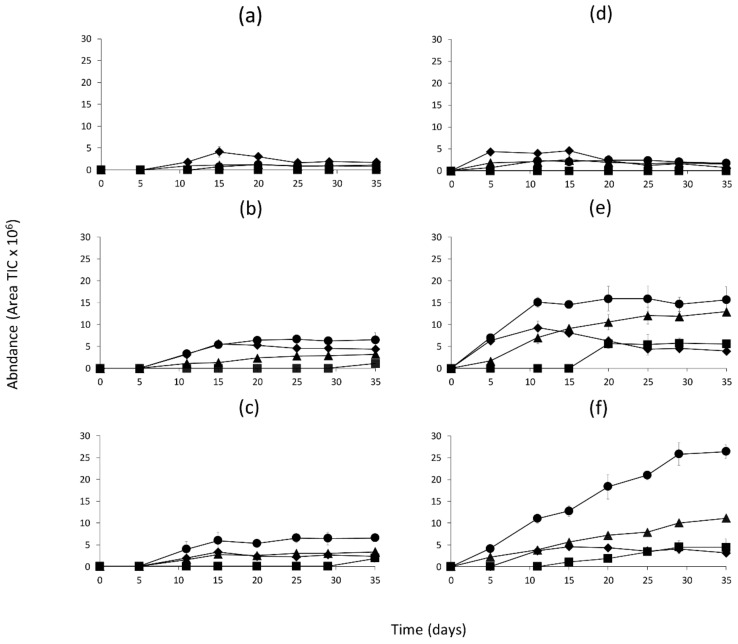
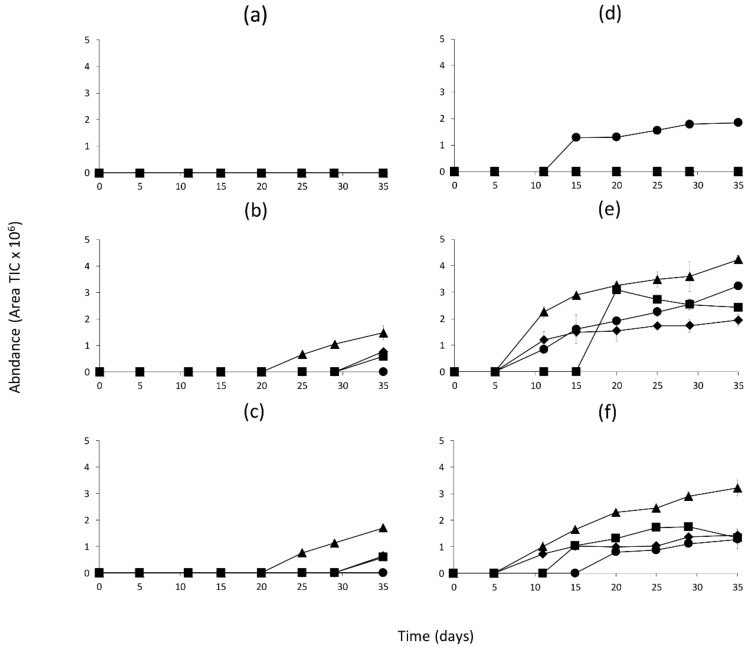
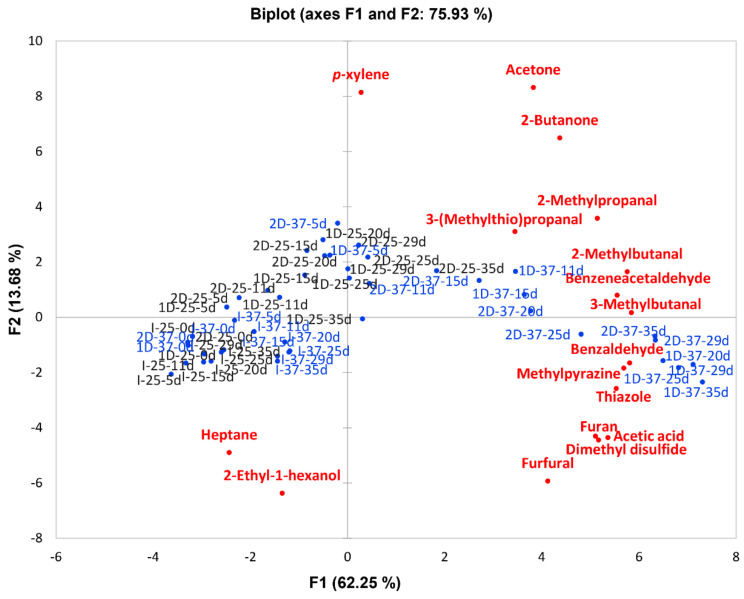
Flavor is amongst the major personal satisfaction indicators for meat products. The aroma of dry cured meat products is generated under specific conditions such as long ripening periods and mild temperatures. In these conditions, the contribution of Maillard reactions to the generation of the dry cured flavor is unknown. The main purpose of this study was to examine mild curing conditions such as temperature, pH and a for the generation of volatile compounds responsible for the cured meat aroma in model systems simulating dry fermented sausages. The different conditions were tested in model systems resembling dry fermented sausages at different stages of production. Three conditions of model system, labeled initial (I), 1st drying (1D) and 2nd drying (2D) and containing different concentrations of amino acid and curing additives, as well as different pH and a values, were incubated at different temperatures. Changes in the profile of the volatile compounds were investigated by solid phase microextraction and gas chromatography mass spectrometry (SPME-GS-MS) as well as the amino acid content. Seventeen volatile compounds were identified and quantified in the model systems. A significant production of branched chain volatile compounds, sulfur, furans, pyrazines and heterocyclic volatile compounds were detected in the model systems. At the drying stages, temperature was the main factor affecting volatile production, followed by amino acid concentration and a. This research demonstrates that at the mild curing conditions used to produce dry cured meat product volatile compounds are generated via the Maillard reaction from free amino acids. Moreover, in these conditions a plays an important role promoting formation of flavor compounds.
风味是肉类产品主要的个人满意度指标之一。干腌肉制品的香气是在特定条件下产生的,例如长时间的成熟过程和温和的温度。在这些条件下,美拉德反应对干腌风味的产生的贡献尚不清楚。本研究的主要目的是在模拟干发酵香肠的模型系统中,研究温和的腌制条件(如温度、pH 值和 a 值)对生成挥发性化合物的影响,这些化合物负责产生腌制肉的香气。在不同的生产阶段,在模拟系统中测试了不同的条件,这些模拟系统分别标记为初始(I)、第一次干燥(1D)和第二次干燥(2D),并含有不同浓度的氨基酸和腌制添加剂,以及不同的 pH 值和 a 值。通过固相微萃取和气相色谱质谱联用(SPME-GS-MS)以及氨基酸含量来研究挥发性化合物的变化。在模型系统中鉴定和定量了 17 种挥发性化合物。在模型系统中检测到支链挥发性化合物、硫、呋喃、吡嗪和杂环挥发性化合物的大量生成。在干燥阶段,温度是影响挥发性化合物产生的主要因素,其次是氨基酸浓度和 a 值。本研究表明,在温和的腌制条件下,通过游离氨基酸的美拉德反应产生了挥发性化合物。此外,在这些条件下,a 值起到了促进风味化合物形成的重要作用。