Park Min Kyung, Choi Yun-Sang
Food Processing Research Group, Korea Food Research Institute, Wanju 55365, Korea.
Food Sci Anim Resour. 2025 Jan;45(1):165-184. doi: 10.5851/kosfa.2024.e124. Epub 2025 Jan 1.
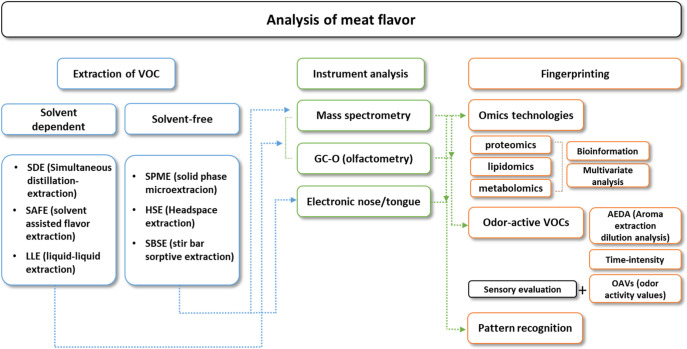
This review provides an effective strategy for understanding meat flavor. Understanding the taste of meat is essential for improving meat quality, and the taste should be analyzed based on complex chemical research to identify various factors that impact the composition, formation, and development of meat. To address flavor chemistry in meat, the discussion focuses on the major compounds responsible for the characteristic flavors of different meats, such as lipids, proteins, and Maillard reaction products. Meat flavor is largely based on heat-induced chemical reactions that convert flavor precursors, such as sugars, proteins, and lipids, into volatile compounds. The flavor of meat is influenced by animal species, sex, age, feed, and processing, and in this respect, flavor is one of the representative quality indicators of meat. Research on meat flavor uses omics technology to study the molecular mechanisms that affect meat quality, including flavor, tenderness, and fat composition. Therefore, this review provides a comprehensive understanding of the complex processes governing meat flavor and provides avenues for further research and industrial applications to advance the meat industry.
本综述提供了一种理解肉类风味的有效策略。了解肉类的味道对于提高肉质至关重要,并且应该基于复杂的化学研究来分析味道,以识别影响肉类成分、形成和发展的各种因素。为了探讨肉类中的风味化学,讨论集中在负责不同肉类特征风味的主要化合物上,如脂质、蛋白质和美拉德反应产物。肉类风味很大程度上基于热诱导的化学反应,这些反应将风味前体,如糖、蛋白质和脂质,转化为挥发性化合物。肉的风味受动物种类、性别、年龄、饲料和加工的影响,在这方面,风味是肉类代表性的质量指标之一。肉类风味研究利用组学技术来研究影响肉质的分子机制,包括风味、嫩度和脂肪组成。因此,本综述全面理解了控制肉类风味的复杂过程,并为进一步研究和工业应用提供了途径,以推动肉类行业的发展。