Institute of Crop Science, National Agriculture and Food Research Organization (NARO), Kannondai 3-1-3, Tsukuba, Ibaraki, 305-8518, Japan.
Graduate School of Agriculture, Kyoto University, Kitasirakawa Oiwake-Cho, Sakyou-ku, Kyoto, 606-8501, Japan.
BMC Plant Biol. 2021 Jan 6;21(1):18. doi: 10.1186/s12870-020-02790-w.
Common buckwheat (2n = 2x = 16) is an outcrossing pseudocereal whose seeds contain abundant nutrients and potential antioxidants. As these beneficial compounds are damaged by preharvest sprouting (PHS) and PHS is likely to increase with global warming, it is important to find efficient ways to develop new PHS-tolerant lines. However, genetic loci and selection markers associated with PHS in buckwheat have not been reported.
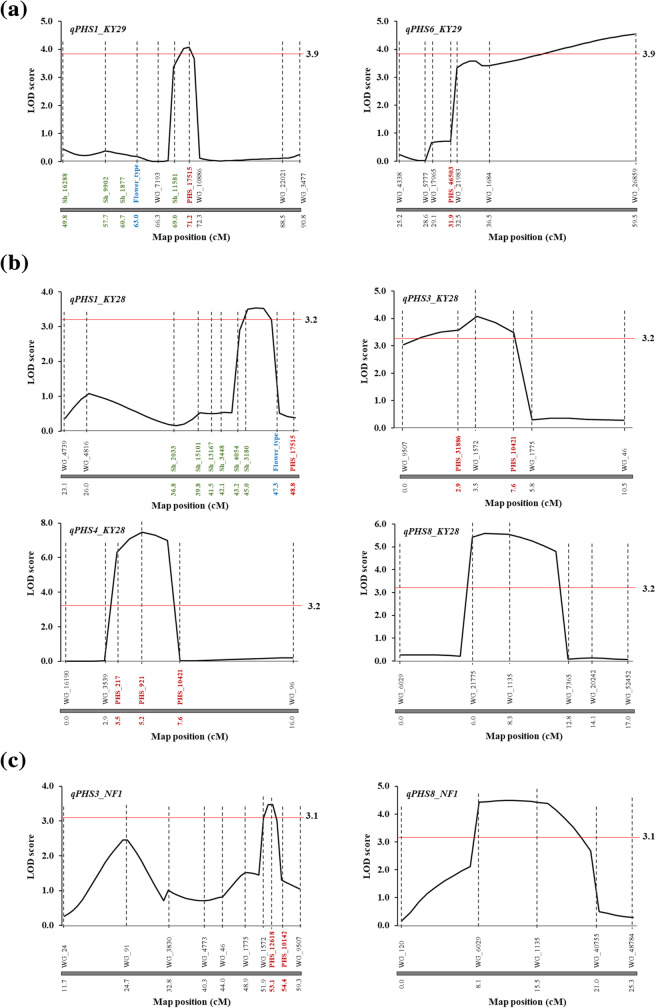
By next-generation sequencing (NGS) of whole-genome of parental lines, we developed a genome-wide set of 300 markers. By NGS- based bulked segregant analysis (NGS-BSA), we developed 100 markers linked to PHS tolerance. To confirm the effectiveness of marker development from NGS-BSA data, we developed 100 markers linked to the self-compatibility (SC) trait from previous NGS-BSA data. Using these markers, we developed genetic maps with AmpliSeq technology, which can quickly detect polymorphisms by amplicon-based multiplex targeted NGS, and performed quantitative trait locus (QTL) analysis for PHS tolerance in combination with NGS-BSA. QTL analysis detected two major and two minor QTLs for PHS tolerance in a segregating population developed from a cross between the PHS-tolerant 'Kyukei 29' and the self-compatible susceptible 'Kyukei SC7'. We found different major and minor QTLs in other segregating populations developed from the PHS-tolerant lines 'Kyukei 28' and 'NARO-FE-1'. Candidate markers linked to PHS developed by NGS-BSA were located near these QTL regions. We also investigated the effectiveness of markers linked to these QTLs for selection of PHS-tolerant lines among other segregating populations.
We efficiently developed genetic maps using a method combined with AmpliSeq technology and NGS-BSA, and detected QTLs associated with preharvest sprouting tolerance in common buckwheat. This is the first report to identify QTLs for PHS tolerance in buckwheat. Our marker development system will accelerate genetic research and breeding in common buckwheat.
普通荞麦(2n=2x=16)是一种异花授粉的伪谷物,其种子含有丰富的营养成分和潜在的抗氧化剂。由于这些有益化合物会受到收获前发芽(PHS)的破坏,而且 PHS 随着全球变暖很可能会增加,因此找到开发新的 PHS 耐受品系的有效方法非常重要。然而,荞麦中与 PHS 相关的遗传基因座和选择标记尚未报道。
通过对亲本品系的全基因组进行下一代测序(NGS),我们开发了一套 300 个标记的全基因组标记。通过基于 NGS 的混池分离分析(NGS-BSA),我们开发了 100 个与 PHS 耐受性相关的标记。为了确认从 NGS-BSA 数据中开发标记的有效性,我们从以前的 NGS-BSA 数据中开发了与自交亲和性(SC)性状相关的 100 个标记。利用这些标记,我们利用 AmpliSeq 技术开发了遗传图谱,该技术可以通过基于扩增子的多重靶向 NGS 快速检测多态性,并结合 NGS-BSA 进行 PHS 耐受性的数量性状位点(QTL)分析。QTL 分析在一个由 PHS 耐受品系‘Kyukei 29’和自交亲和敏感品系‘Kyukei SC7’杂交产生的分离群体中检测到两个主要和两个次要的 PHS 耐受性 QTL。我们在由 PHS 耐受品系‘Kyukei 28’和‘NARO-FE-1’产生的其他分离群体中发现了不同的主要和次要 QTL。通过 NGS-BSA 开发的与 PHS 相关的候选标记位于这些 QTL 区域附近。我们还研究了与这些 QTL 相关的标记在其他分离群体中选择 PHS 耐受品系的有效性。
我们利用结合了 AmpliSeq 技术和 NGS-BSA 的方法高效地开发了遗传图谱,并在普通荞麦中检测到与收获前发芽耐受性相关的 QTL。这是首次报道荞麦中 PHS 耐受 QTL。我们的标记开发系统将加速普通荞麦的遗传研究和育种。