
苏丹国家医疗保险基金中用于监测不让任何人掉队的地区划分行政分解数据框架:实现2030年可持续发展目标
District division administrative disaggregation data framework for monitoring leaving no one behind in the National Health Insurance Fund of Sudan: achieving sustainable development goals in 2030.
作者信息
Mansour Ashraf, Sirichotiratana Nithat, Viwatwongkasem Chukiat, Khan Mahmud, Srithamrongsawat Samrit
机构信息
Department of Public Health Administration, Faculty of Public Health, Mahidol University, Bangkok, 10400, Thailand.
Department of Biostatistics, Faculty of Public Health, Mahidol University, Bangkok, Thailand.
出版信息
Int J Equity Health. 2021 Jan 6;20(1):5. doi: 10.1186/s12939-020-01338-6.
BACKGROUND
The aim of this study is to monitor the concept of 'leaving no one behind' in the Sustainable Development Goals (SDGs) to track the implications of the mobilization of health care resources by the National Health Insurance Fund (NHIF) of Sudan.
METHODS
A cross-sectional study was used to monitor 'leaving no one behind' in NHIF by analyzing the secondary data of the information system for the year 2016. The study categorized the catchment areas of health care centers (HCCS) according to district administrative divisions, which are neighborhood, subdistrict, district, and zero. The District Division Administrative Disaggregation Data (DDADD) framework was developed and investigated with the use of descriptive statistics, maps of Sudan, the Mann-Whitney test, the Kruskal-Wallis test and health equity catchment indicators. SPSS ver. 18 and EndNote X8 were also used.
RESULTS
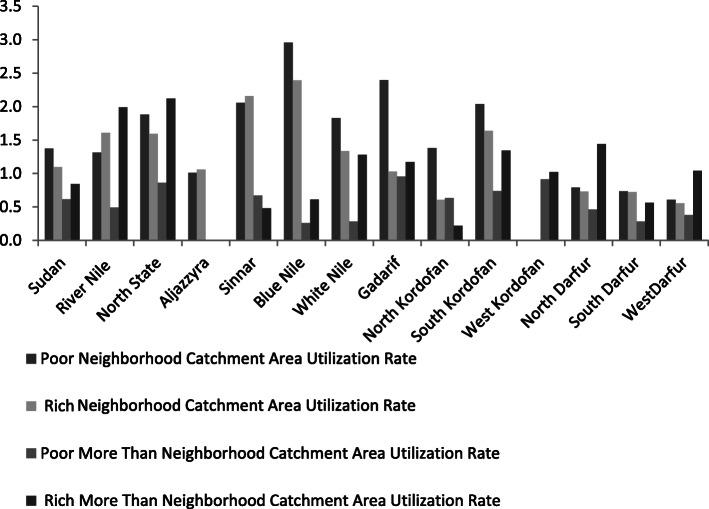
The findings show that the NHIF has mobilized HCCs according to coverage of the insured population. This mobilization protected the insured poor in high-coverage insured population districts and left those living in very low-coverage districts behind. The Mann-Whitney test presented a significant median difference in the utilization rate between catchment areas (P value < 0.001). The results showed that the utilization rate of the insured poor who accessed health care centers by neighborhood was higher than that of the insured poor who accessed by more than neighborhood in each state. The Kruskal-Wallis test of the cost of health care services per capita in each catchment area showed a difference (P value < 0.001) in the median between neighborhoods. The cost of health care services in low-coverage insured population districts was higher than that in high-coverage insured population districts.
CONCLUSION
The DDADD framework identified the inequitable distribution of health care services in low-density population districts leaves insured poor behind. Policymakers should restructure the equation of health insurance schemes based on equity and probability of illness, to distribute health care services according to needs and equity, and to remobilize resources towards districts left behind.
背景
本研究旨在监测可持续发展目标中“不让任何一个人掉队”的理念,以追踪苏丹国家健康保险基金(NHIF)调动医疗保健资源所产生的影响。
方法
采用横断面研究方法,通过分析2016年信息系统的二手数据来监测NHIF中的“不让任何一个人掉队”情况。该研究根据地区行政区划对医疗保健中心(HCCS)的服务区域进行了分类,包括社区、分区、地区和零级。利用描述性统计、苏丹地图、曼-惠特尼检验、克鲁斯卡尔-沃利斯检验和健康公平服务区域指标,开发并研究了地区部门行政分类数据(DDADD)框架。还使用了SPSS 18版和EndNote X8。
结果
研究结果表明,NHIF已根据参保人群的覆盖情况调动了医疗保健中心。这种调动保护了高参保人群覆盖地区的贫困参保人员,而将生活在极低覆盖地区的人员抛在了后面。曼-惠特尼检验显示,各服务区域之间的利用率中位数存在显著差异(P值<0.001)。结果表明,在每个州,通过社区获得医疗保健中心服务的贫困参保人员的利用率高于通过社区以上层级获得服务的贫困参保人员。对每个服务区域人均医疗保健服务成本进行的克鲁斯卡尔-沃利斯检验显示,各社区之间的中位数存在差异(P值<0.001)。低参保人群覆盖地区的医疗保健服务成本高于高参保人群覆盖地区。
结论
DDADD框架表明,低密度人口地区医疗保健服务的不公平分配使贫困参保人员被边缘化。政策制定者应根据公平性和患病概率重新构建医疗保险计划的等式,以便根据需求和公平性分配医疗保健服务,并将资源重新调配到被边缘化的地区。




 Zotero 插件