Department of Histocompatibility, Établissement Français du Sang PACA-Corse, 149 Bd Baille, 13005, Marseille, France.
Department of Immunohematology, Établissement Français du Sang PACA-Corse, 149 Bd Baille, 13005, Marseille, France.
J Transl Med. 2021 Jan 6;19(1):15. doi: 10.1186/s12967-020-02671-8.
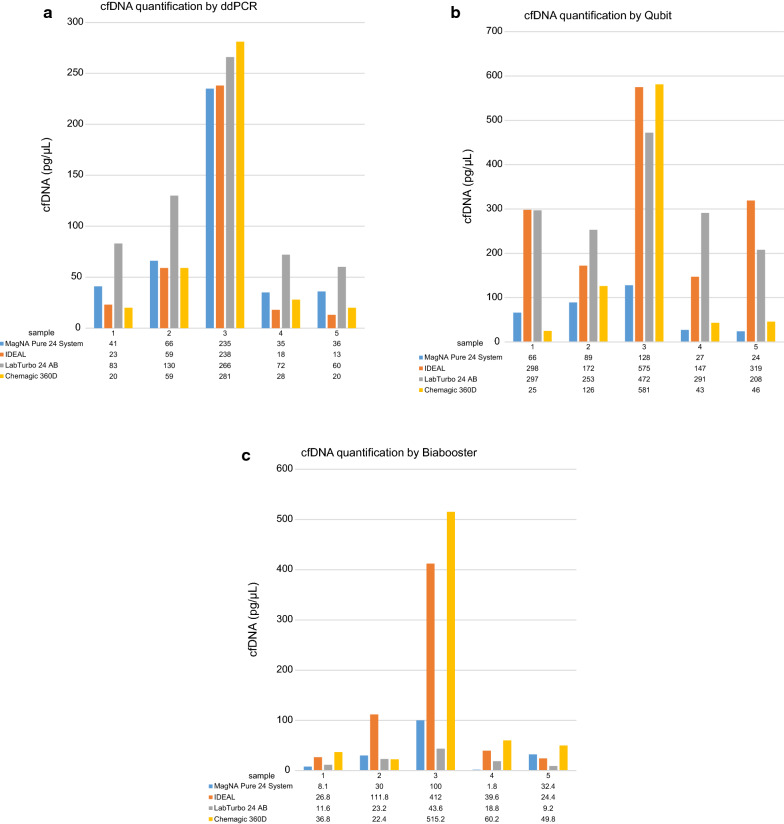
Non-invasive molecular analysis of cell-free DNA (cfDNA) became a sensitive biomarker for monitoring organ transplantation or for detection of fetal DNA (cffDNA) in noninvasive prenatal test. In this study, we compared the efficiencies of four (semi)-automated cfDNA isolation instruments using their respective isolation kit: MagNA Pure 24 (Roche®), IDEAL (IDSolution®), LABTurbo 24 (Taigen®) and Chemagic 360 (Perkin Elmer®). The cfDNA was isolated from 5 plasma samples and the Rhesus D (RhD)-cffDNA from 5 maternal plasmas. The cfDNA were quantified by digital droplet PCR (ddPCR), BIABooster system and QUBIT fluorometer. The cfDNA fragment size profiles were assessed by BIABooster system. Chimerism were quantified by home-made ddPCR and Devyser NGS kit. RhD-cffDNA in maternal plasma were detected between weeks 14 and 24 of amenorrhea using free DNA Fetal RHD Kit® (Biorad®).
Statistical tests have shown differences in DNA yield depending on the isolation procedure and quantification method used. Magna Pure isolates smaller cfDNA fragment size than other extraction methods (90% ± 9% vs. 74% ± 8%; p = 0.009). Chimerism was only reliable from LABTurbo 24 extractions using the NGS but not with ddPCR whatever extraction methods. RhD-cffDNA were detected by all isolation methods, although IDEAL and LABTurbo 24 systems seemed more efficient.
This comparative study showed a dependency of cfDNA yield depending on isolation procedure and quantification method used. In total, these results suggest that the choice of pre-analytical isolation systems needs to be carefully validated in routine clinical practice.
游离 DNA(cfDNA)的非侵入性分子分析已成为监测器官移植或非侵入性产前检测中胎儿 DNA(cffDNA)的敏感生物标志物。在这项研究中,我们比较了四种(半)自动化 cfDNA 分离仪器使用各自的分离试剂盒的效率:MagNA Pure 24(罗氏®)、IDESOLUTION(IDSolution®)、LABTurbo 24(Taigen®)和 Chemagic 360(Perkin Elmer®)。从 5 份血浆样本中分离 cfDNA,从 5 份孕妇血浆中分离 RhD-cffDNA。cfDNA 用数字液滴 PCR(ddPCR)、BIABooster 系统和 QUBIT 荧光计定量。cfDNA 片段大小谱通过 BIABooster 系统评估。嵌合体通过自制 ddPCR 和 Devyser NGS 试剂盒定量。使用游离 DNA 胎儿 RHD 试剂盒(Biorad®)在闭经 14 至 24 周期间检测母体血浆中的 RhD-cffDNA。
统计检验表明,DNA 产量取决于使用的分离程序和定量方法。Magna Pure 分离的 cfDNA 片段大小小于其他提取方法(90%±9%比 74%±8%;p=0.009)。无论使用何种提取方法,只有使用 NGS 从 LABTurbo 24 提取才能可靠地检测嵌合体,但使用 ddPCR 则不行。所有分离方法均能检测到 RhD-cffDNA,尽管 IDEAL 和 LABTurbo 24 系统似乎更有效。
这项比较研究表明,cfDNA 产量取决于使用的分离程序和定量方法。总的来说,这些结果表明,在常规临床实践中,需要仔细验证分析前分离系统的选择。