Department of Pediatrics, Division of Rheumatology, Children's Hospital of Philadelphia, Philadelphia, USA.
Center for Pediatric Clinical Effectiveness, Children's Hospital of Philadelphia, Philadelphia, USA.
Pediatr Rheumatol Online J. 2021 Jan 6;19(1):3. doi: 10.1186/s12969-020-00487-w.
To characterize suicidality among youth with juvenile fibromyalgia syndrome (JFMS) receiving treatment from pediatric rheumatologists at a tertiary care center in order to determine the prevalence of suicidality in JFMS and to explore risk factors for persistent suicidal ideation.
We performed a cross-sectional cohort study of children 12-17 years old with JFMS seen in a specialty pediatric rheumatology pain clinic from 7/2017-9/2019. All subjects completed patient-reported outcomes measures, complemented by retrospective chart review. Subjects who endorsed item 8 on the Children's Depression Inventory, 2nd Edition (CDI-2) were categorized as endorsing suicidal ideation. We assessed for differences between the suicidal and non-suicidal patients using Wilcoxon-rank sum test. Logistic regression modeling was performed to identify psychosocial factors associated with suicidality.
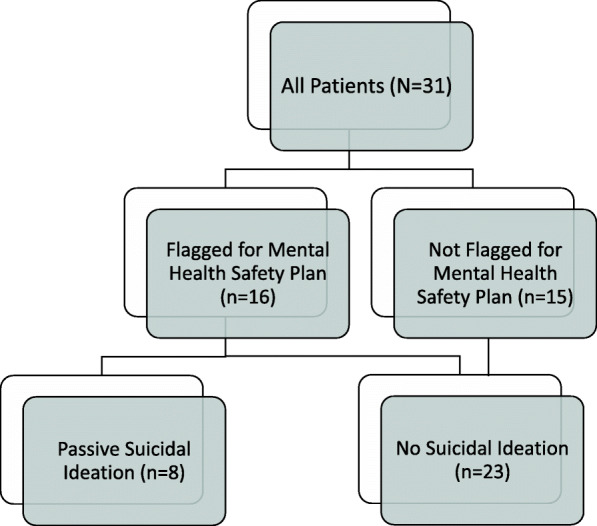
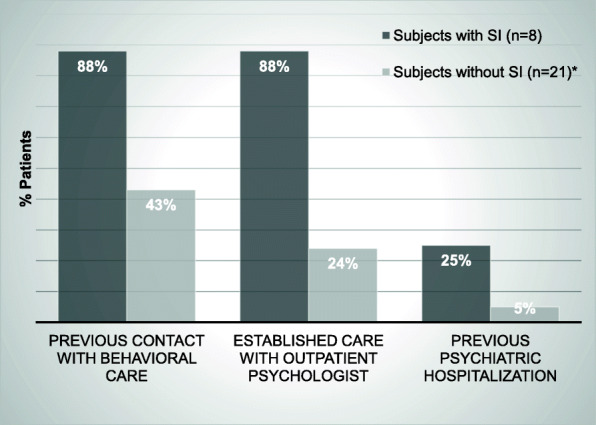
Of the 31 subjects, more than one-quarter endorsed suicidality. Nearly 90% of teens with suicidal ideation were established in outpatient counseling. In bivariate analyses, suicidality was associated with lower resilience and greater depression and anxiety (all p < 0.05). Pain intensity trended towards a statistically significant positive association (OR: 1.16 [0.99-1.37]; p = 0.06). Lower resilience was independently associated with suicidality (OR: 0.90 [95% CI: 0.82-0.98]; p < 0.02).
Suicidality was prevalent among youth with JFMS and persistent despite concurrent receipt of mental health services. Higher patient-level resilience was independently associated with a reduced odds of suicidality. Future work should examine the role of resilience training on reducing psychological distress and mitigating the risk of suicidality in JFMS.
为了描述在三级护理中心接受儿科风湿病学家治疗的青少年纤维肌痛综合征(JFMS)患者中的自杀倾向,以确定 JFMS 中的自杀倾向发生率,并探讨持续性自杀意念的风险因素。
我们对 2017 年 7 月至 2019 年 9 月在一家专业儿科风湿病学疼痛诊所就诊的 12-17 岁 JFMS 患儿进行了横断面队列研究。所有患者均完成了患者报告的结局测量,并辅以回顾性图表审查。在儿童抑郁量表第二版(CDI-2)中,对项目 8 表示赞同的患者被归类为表示自杀意念。我们使用 Wilcoxon 秩和检验比较了自杀患者和非自杀患者之间的差异。使用逻辑回归模型来确定与自杀倾向相关的心理社会因素。
在 31 名患者中,超过四分之一的患者表示存在自杀倾向。近 90%的有自杀意念的青少年已经接受了门诊咨询。在单变量分析中,自杀倾向与较低的适应力以及更高的抑郁和焦虑相关(均 p < 0.05)。疼痛强度与统计学上显著的正相关趋势(OR:1.16 [0.99-1.37];p = 0.06)。较低的适应力与自杀倾向独立相关(OR:0.90 [95%CI:0.82-0.98];p < 0.02)。
JFMS 患儿自杀倾向普遍存在,尽管同时接受心理健康服务,但仍持续存在。较高的患者水平适应力与自杀倾向的可能性降低独立相关。未来的工作应研究适应力训练在降低 JFMS 患者心理困扰和降低自杀风险方面的作用。