Faculty of Medicine, Norwegian University of Science and Technology, NTNU, Trondheim, Norway.
Department of Public Health and Nursing, Norwegian University of Science and Technology, NTNU, Trondheim, Norway.
Int Breastfeed J. 2021 Jan 6;16(1):5. doi: 10.1186/s13006-020-00352-2.
The influences of breastfeeding and infant diet in the prevention of allergy-related diseases are uncertain and many of the studies conducted on the topic are limited by methodological challenges. Our aim was to assess whether the duration of breastfeeding and age at complementary food introduction affected the prevalence of asthma, wheeze, allergic rhinoconjunctivitis (ARC) and eczema at two and six years of age.
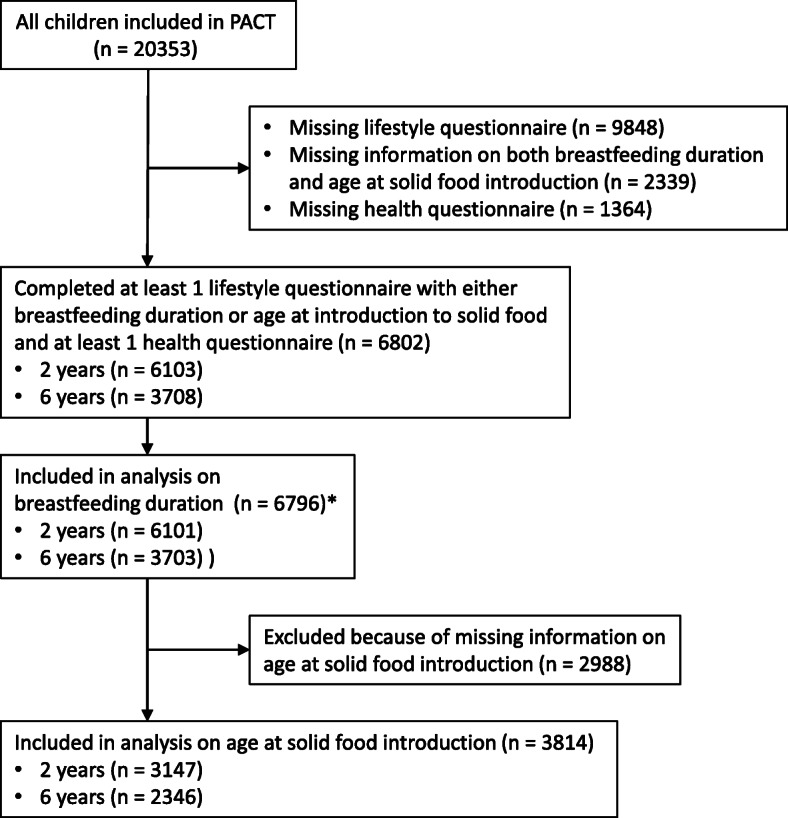
We used information gathered between 2000 and 2014 through questionnaires in the Prevention of Allergy among Children in Trondheim (PACT) study, a prospective cohort study in Trondheim, Norway. The current study includes 6802 children who submitted questionnaires detailing breastfeeding duration and or age at introduction to complementary foods, as well as at least one of the child health questionnaires completed at two and six years of age. Adjusted odds ratios (aORs) were calculated for each combination of exposure and outcomes and sensitivity analyses were performed to assess the possible influence of recall bias and reverse causality.
The mean duration of breastfeeding was 11 months (SD 5.6) in this study population and 5695 of 6796 (84%) infants had been breastfed for at least 6 months. We did not find any conclusive preventative effect of longer breastfeeding on parental reported doctor-diagnosed asthma, aOR 0.79 (95% CI 0.51, 1.21). However, at 6 years of age we observed a reduction in the less strictly defined outcome wheeze, aOR 0.71 (95% CI 0.53, 0.95). Longer breastfeeding was associated with a reduced risk of ARC at 2 years, aOR 0.65 (95% CI 0.49, 0.86), with a continued protective trend at 6 years, aOR 0.77 (95% CI 0.58, 1.04).
Longer breastfeeding resulted in a reduced risk of wheeze and a trend towards a protective effect on ARC up until school age. No conclusive associations were seen between the duration of breastfeeding or age at introduction to complementary foods and prevention of asthma, wheeze, ARC and eczema.
The trial is registered in Current Controlled Trials as ISRCTN28090297 .
母乳喂养和婴儿饮食在预防过敏相关疾病方面的影响尚不确定,许多关于该主题的研究受到方法学挑战的限制。我们的目的是评估母乳喂养的持续时间和引入补充食物的年龄是否会影响两岁和六岁时哮喘、喘息、过敏性鼻结膜炎(ARC)和特应性皮炎的患病率。
我们使用了 2000 年至 2014 年期间在挪威特隆赫姆进行的预防儿童过敏(PACT)研究中通过问卷收集的信息,这是一项前瞻性队列研究。目前的研究包括 6802 名儿童,他们提交了详细说明母乳喂养持续时间和/或引入补充食物年龄的问卷,以及至少一份在两岁和六岁时完成的儿童健康问卷。为每个暴露和结局的组合计算了调整后的优势比(aOR),并进行了敏感性分析,以评估回忆偏倚和反向因果关系的可能影响。
在该研究人群中,母乳喂养的平均持续时间为 11 个月(SD 5.6),6796 名婴儿中有 5695 名(84%)至少母乳喂养了 6 个月。我们没有发现母乳喂养时间较长对父母报告的医生诊断的哮喘有任何明确的预防作用,aOR 为 0.79(95%CI 0.51,1.21)。然而,我们在 6 岁时观察到不太严格定义的喘息结局减少,aOR 为 0.71(95%CI 0.53,0.95)。较长的母乳喂养与 2 岁时 ARC 风险降低相关,aOR 为 0.65(95%CI 0.49,0.86),6 岁时仍呈保护趋势,aOR 为 0.77(95%CI 0.58,1.04)。
较长的母乳喂养可降低喘息风险,并呈现出对 ARC 的保护作用,直至学龄期。母乳喂养的持续时间或引入补充食物的年龄与预防哮喘、喘息、ARC 和特应性皮炎之间没有明确的关联。
该试验在当前对照试验中注册为 ISRCTN28090297。