Division of Rheumatology, Department of Internal Medicine, Faculty of Medicine, Toho University, 2-22-36, Ohashi, Meguro-ku, Tokyo, 153-8515, Japan.
Keio University School of Medicine, 2 Chome-15-45 Mita, Minato City, Tokyo, 108-8345, Japan.
Arthritis Res Ther. 2021 Jan 6;23(1):9. doi: 10.1186/s13075-020-02387-6.
The objective of the study was to evaluate the efficacy and safety of upadacitinib over 84 weeks in Japanese patients with active rheumatoid arthritis (RA) and an inadequate response to conventional synthetic disease-modifying anti-rheumatic drugs.
All patients completing a 12-week, randomized, double-blind treatment period entered a blinded extension and continued upadacitinib 7.5, 15, or 30 mg once daily (QD), or were switched from placebo to upadacitinib 7.5, 15, or 30 mg QD. Efficacy and safety were assessed over 84 weeks.
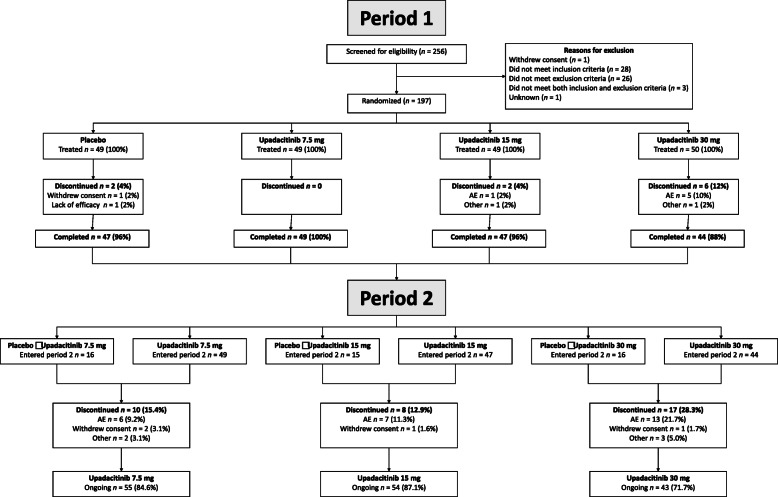
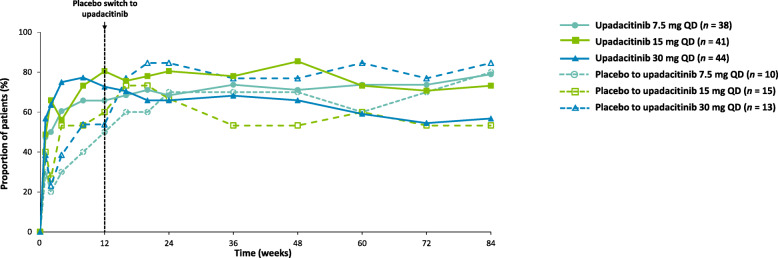
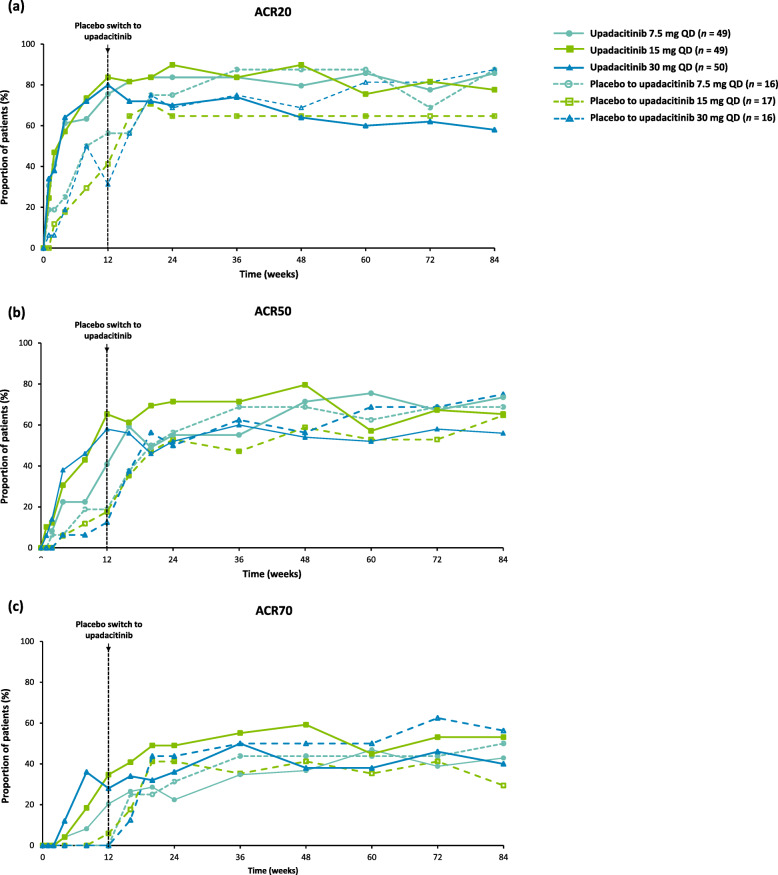
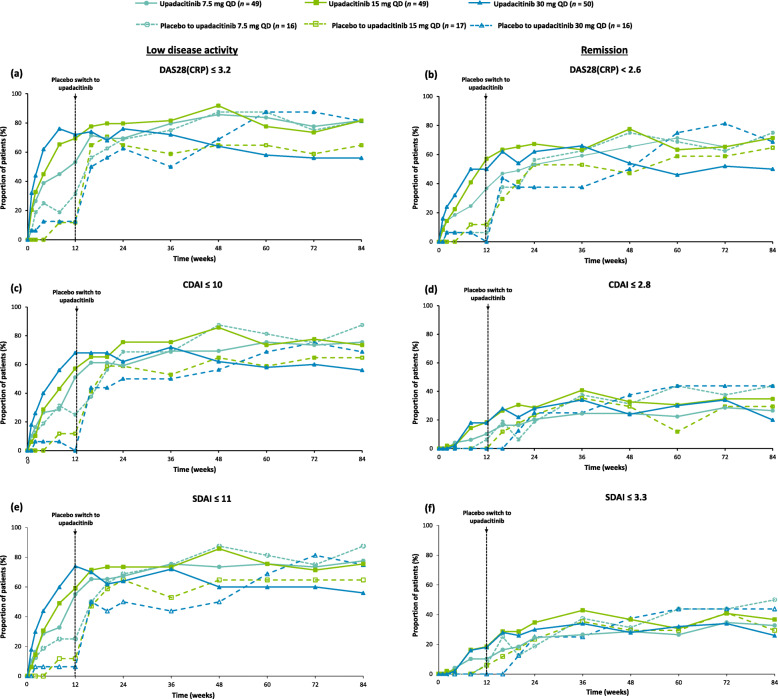
Of 197 randomized patients, 187 (94.9%) completed the 12-week period and entered the blinded extension; 152 (77.2%) patients were ongoing at week 84. At week 84, the proportions of patients achieving a 20% improvement in American College of Rheumatology criteria (ACR20) were 85.7%, 77.6%, and 58.0% with continued upadacitinib 7.5, 15, and 30 mg, respectively (nonresponder imputation), and were similar in patients who had switched from placebo. Favorable response rates were also observed for more stringent measures of response (ACR50/70) and remission (defined by the Disease Activity Score of 28 joints with C-reactive protein, Clinical Disease Activity Index, or Simplified Disease Activity Index). The 15 mg and 30 mg doses of upadacitinib were associated with more rapid and numerically higher initial responses for some measures of disease activity and remission compared with the 7.5 mg dose. Rates of adverse events, infection, opportunistic infection, serious infection, and herpes zoster were lower with upadacitinib 7.5 and 15 mg versus 30 mg.
Upadacitinib demonstrated sustained efficacy and was well tolerated over 84 weeks in Japanese patients with RA, with upadacitinib 15 mg offering the most favorable benefit-risk profile.
ClinicalTrials.gov NCT02720523 . Registered on March 22, 2016.
本研究旨在评估乌帕替尼在治疗对常规合成疾病修饰抗风湿药物应答不足的日本活动性类风湿关节炎(RA)患者中的疗效和安全性,疗程为 84 周。
所有完成 12 周随机、双盲治疗期的患者进入双盲扩展期,并继续接受乌帕替尼 7.5、15 或 30mg 每日一次(QD)治疗,或从安慰剂转换为乌帕替尼 7.5、15 或 30mg QD。在 84 周时评估疗效和安全性。
在 197 名随机患者中,187 名(94.9%)完成 12 周治疗期并进入双盲扩展期;152 名(77.2%)患者在第 84 周仍在接受治疗。第 84 周时,继续接受乌帕替尼 7.5、15 和 30mg 治疗的患者中分别有 85.7%、77.6%和 58.0%达到美国风湿病学会(ACR)20 缓解标准(非应答者推断),且从安慰剂转换的患者中也观察到类似的应答率。对于更严格的应答标准(ACR50/70)和缓解标准(定义为 28 关节疾病活动度评分、临床疾病活动指数或简化疾病活动指数的 C 反应蛋白),也观察到有利的应答率。与 7.5mg 剂量相比,乌帕替尼 15mg 和 30mg 剂量与一些疾病活动和缓解指标的更快和数值更高的初始应答相关。乌帕替尼 7.5mg 和 15mg 与 30mg 相比,不良反应、感染、机会性感染、严重感染和带状疱疹的发生率较低。
乌帕替尼在日本 RA 患者中显示出持续的疗效,且在 84 周内耐受性良好,乌帕替尼 15mg 具有最佳的获益风险比。
ClinicalTrials.gov NCT02720523。于 2016 年 3 月 22 日注册。