Department of Internal Medicine, Toho University, Tokyo, Japan.
Department of Internal Medicine, Keio University School of Medicine, Tokyo, Japan.
Rheumatology (Oxford). 2020 Nov 1;59(11):3303-3313. doi: 10.1093/rheumatology/keaa084.
To evaluate upadacitinib efficacy and safety dose response in Japanese patients with active RA and an inadequate response to conventional synthetic DMARDs (csDMARDs).
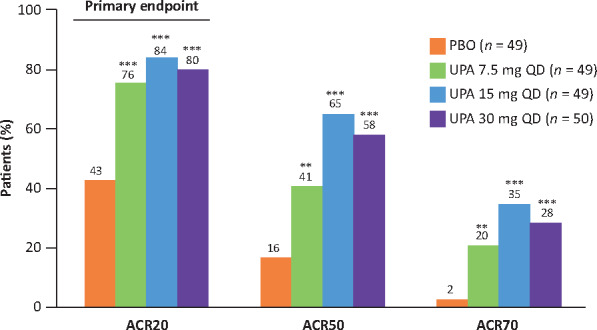
This was a multicentre, phase IIb/III, dose-ranging study conducted in Japan, in which patients on previously stable csDMARDs were randomized to receive upadacitinib 7.5, 15 or 30 mg once daily or matching placebo for a 12-week double-blind period. The primary endpoint was a 20% improvement in ACR criteria (ACR20) response at week 12 using non-responder imputation. Key secondary endpoints included ACR50, ACR70 and 28-joint DAS with CRP (DAS28-CRP) remission and low disease activity. Adverse events were also assessed.
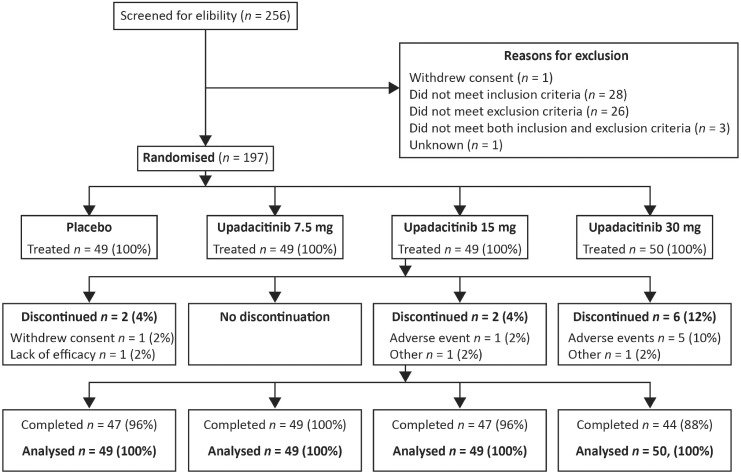
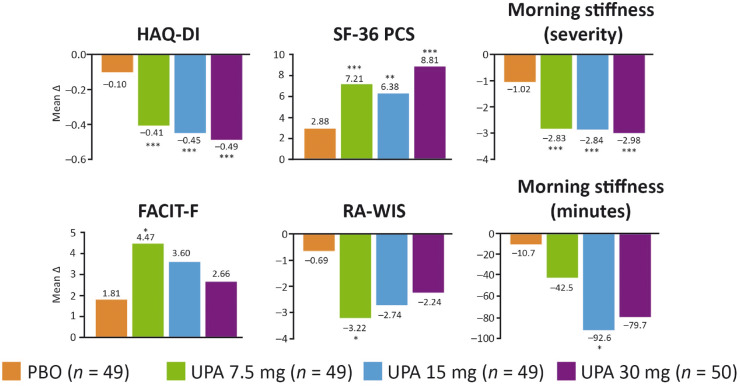
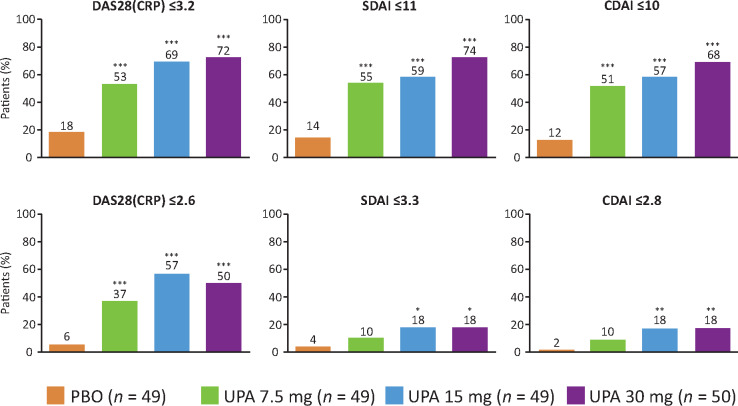
Of 197 patients treated, 187 completed the double-blind period. At week 12, more patients receiving upadacitinib 7.5, 15 or 30 mg vs placebo met the ACR20 response (75.5%, 83.7%, 80.0% vs 42.9%; P < 0.001), with significant differences observed as early as week 1. Stringent responses, including ACR50, ACR70 and DAS28-CRP <2.6, were achieved by significantly higher proportions of patients on upadacitinib than placebo and by numerically higher proportions on upadacitinib 15 or 30 mg vs upadacitinib 7.5 mg. Adverse events and infections (serious infections, opportunistic infections and herpes zoster) were more common with upadacitinib vs placebo and numerically highest with upadacitinib 30 mg. There were no venous thromboembolic events reported.
Efficacy of upadacitinib was demonstrated in this population of Japanese patients with RA and an inadequate response to csDMARDs. Safety and tolerability were consistent with other upadacitinib RA studies. The 15 mg dose of upadacitinib showed the most favourable benefit-risk profile.
ClinicalTrials.gov, https://clinicaltrials.gov/ct2/show/NCT02720523.
评估乌帕替尼在日本对常规合成改善病情抗风湿药(csDMARDs)应答不足的活动性 RA 患者中的疗效和安全性剂量反应。
这是一项在日本进行的多中心、IIb 期/III 期、剂量范围研究,在该研究中,接受稳定 csDMARDs 治疗的患者被随机分配接受乌帕替尼 7.5、15 或 30mg 每日一次或匹配安慰剂治疗 12 周的双盲期。主要终点是在第 12 周使用非应答者推断的 ACR 标准(ACR20)应答 20%的改善。关键次要终点包括 ACR50、ACR70 和 28 关节疾病活动度与 CRP(DAS28-CRP)缓解和低疾病活动度。还评估了不良事件。
在接受治疗的 197 例患者中,187 例完成了双盲期。在第 12 周时,与安慰剂相比,更多接受乌帕替尼 7.5、15 或 30mg 治疗的患者达到 ACR20 应答(75.5%、83.7%、80.0% vs. 42.9%;P<0.001),并且早在第 1 周就观察到了显著差异。与安慰剂相比,接受乌帕替尼治疗的患者实现了更严格的应答,包括 ACR50、ACR70 和 DAS28-CRP<2.6,并且乌帕替尼 15 或 30mg 与乌帕替尼 7.5mg 相比,实现了更高比例的患者达到更严格的应答。与安慰剂相比,乌帕替尼治疗的患者发生不良事件和感染(严重感染、机会性感染和带状疱疹)更为常见,而乌帕替尼 30mg 治疗的患者发生率最高。未报告静脉血栓栓塞事件。
在对 csDMARDs 应答不足的日本 RA 患者中,乌帕替尼的疗效得到了证实。安全性和耐受性与其他乌帕替尼 RA 研究一致。乌帕替尼 15mg 剂量显示出最有利的获益-风险特征。
ClinicalTrials.gov,https://clinicaltrials.gov/ct2/show/NCT02720523。