Xiao Zhuangzhuang, Lei Tong, Liu Yanyan, Yang Yanjie, Bi Wangyu, Du Hongwu
112 Lab, School of Chemistry and Biological Engineering, University of Science and Technology Beijing, 30 XueYuan Road, Haidian District, Beijing, 100083, China.
Kangyanbao (Beijing) Stem Cell Technology Co., Ltd, Beijing, 102600, China.
Stem Cell Res Ther. 2021 Jan 6;12(1):5. doi: 10.1186/s13287-020-01957-4.
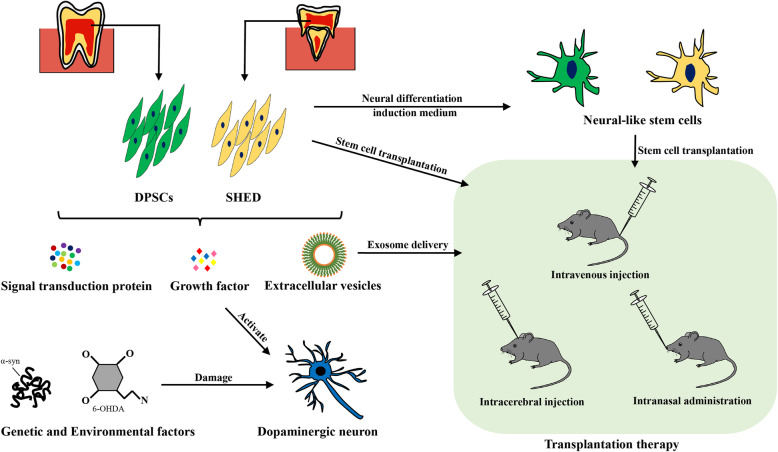
Parkinson's disease (PD), the second most common neurodegenerative disease worldwide, is caused by the loss of dopaminergic (DAergic) neurons in the substantia nigra resulting in a series of motor or non-motor disorders. Current treatment methods are unable to stop the progression of PD and may bring certain side effects. Cell replacement therapy has brought new hope for the treatment of PD. Recently, human dental tissue-derived mesenchymal stem cells have received extensive attention. Currently, dental pulp stem cells (DPSCs) and stem cells from human exfoliated deciduous teeth (SHED) are considered to have strong potential for the treatment of these neurodegenerative diseases. These cells are considered to be ideal cell sources for the treatment of PD on account of their unique characteristics, such as neural crest origin, immune rejection, and lack of ethical issues. In this review, we briefly describe the research investigating cell therapy for PD and discuss the application and progress of DPSCs and SHED in the treatment of PD. This review offers significant and comprehensive guidance for further clinical research on PD.
帕金森病(PD)是全球第二常见的神经退行性疾病,由黑质中多巴胺能(DAergic)神经元的丧失引起,导致一系列运动或非运动障碍。目前的治疗方法无法阻止PD的进展,且可能带来某些副作用。细胞替代疗法为PD的治疗带来了新希望。最近,人牙组织来源的间充质干细胞受到了广泛关注。目前,牙髓干细胞(DPSCs)和人脱落乳牙干细胞(SHED)被认为在治疗这些神经退行性疾病方面具有强大潜力。由于这些细胞具有独特的特性,如神经嵴起源、免疫排斥以及不存在伦理问题,它们被认为是治疗PD的理想细胞来源。在本综述中,我们简要描述了针对PD的细胞治疗研究,并讨论了DPSCs和SHED在PD治疗中的应用及进展。本综述为PD的进一步临床研究提供了重要而全面的指导。