Department of Medicine, Peking Union Medical College Hospital, Peking Union Medical College and Chinese Academy of Medical Sciences, Beijing, China.
Department of Physiotherapy, Peking Union Medical College Hospital, Peking Union Medical College and Chinese Academy of Medical Sciences, Beijing, China.
BMJ Open. 2021 Jan 6;11(1):e039745. doi: 10.1136/bmjopen-2020-039745.
Our work aimed at exploring the relationship between cold spells and acute exacerbation of chronic obstructive pulmonary disease (AECOPD) hospitalisations in Beijing, China, and assessing the moderating effects of the intensities and the durations of cold spells, as well as identifying the vulnerable.
A time-series study.
We obtained time-series data of AECOPD hospitalisations, meteorological variables and air quality index in Beijing, China during 2012-2016.
All AECOPD hospitalisations among permanent residents in Beijing, China during the cold seasons (November-March) of 2012-2016 were included (n=84 571).
A quasi-Poisson regression with a distributed lag model was fitted to investigate the short-term effects of cold spells on AECOPD hospitalisations by comparing the counts of AECOPD admissions during cold spell days with those during non-cold spell days.
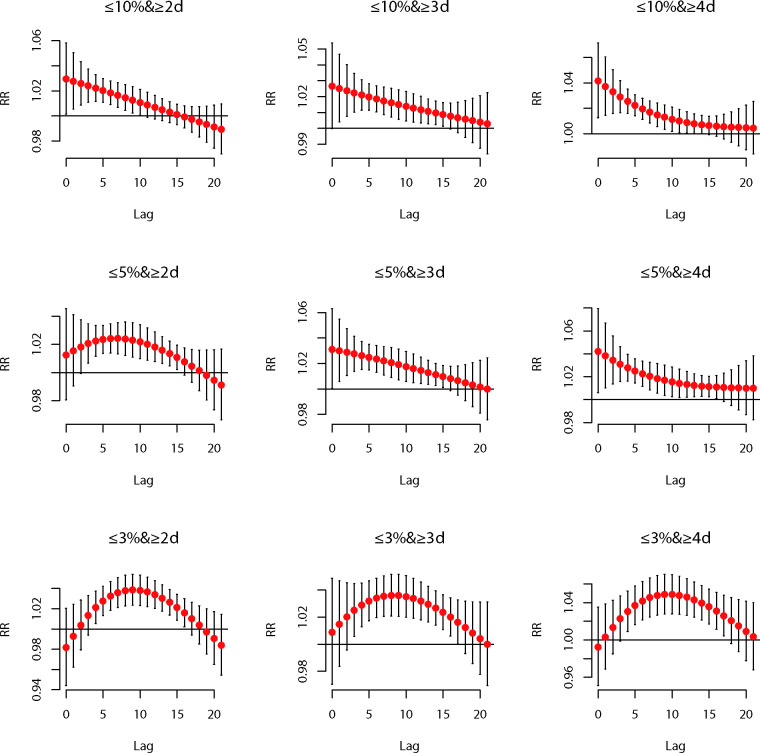
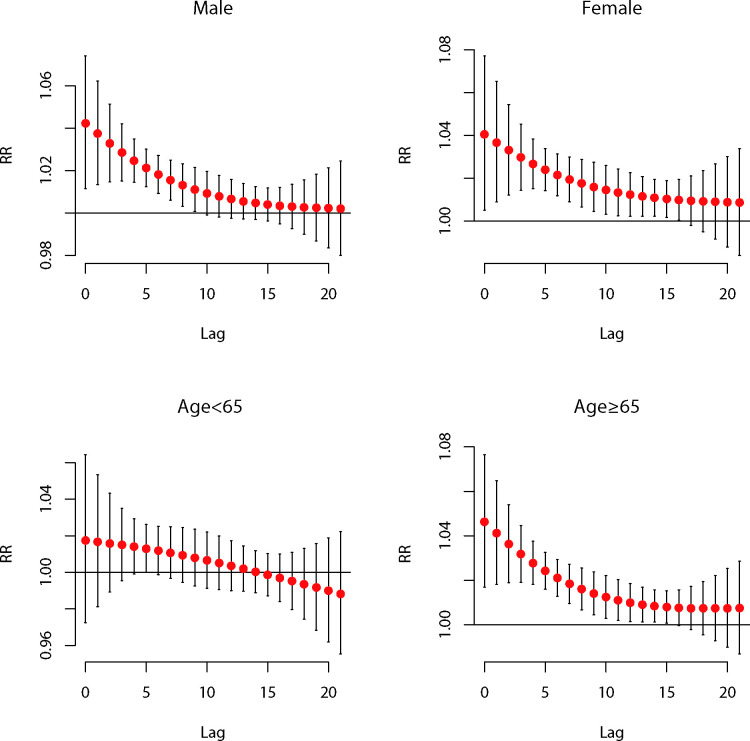
Cold spells under different definitions were associated with increased risk of AECOPD hospitalisations, with the maximum cumulative relative risk (CRR) over 3 weeks (lag0-21). The cumulative effects at lag0-21 increased with the intensities and the durations of cold spells. Under the optimal definition, the most significant single-day relative risk (RR) was found on the days of cold spells (lag0) with an RR of 1.042 (95% CI 1.013 to 1.072), and the CRR at lag0-21 was 1.394 (95% CI 1.193 to 1.630). The elderly (aged ≥65) were more vulnerable to the effects of cold spells on AECOPD hospitalisations.
Cold spells are associated with increased AECOPD hospitalisations in Beijing, with the cumulative effects increased with intensities and durations. The elderly are at particular risk of AECOPD hospitalisations triggered by cold spells.
本研究旨在探讨中国北京地区寒冷天气与慢性阻塞性肺疾病急性加重(AECOPD)住院之间的关系,并评估寒冷天气强度和持续时间的调节作用,以及确定易感性人群。
时间序列研究。
我们获取了中国北京地区 2012-2016 年 AECOPD 住院、气象变量和空气质量指数的时间序列数据。
纳入了中国北京地区 2012-2016 年寒冷季节(11 月至 3 月)期间所有常住居民的 AECOPD 住院病例(n=84571)。
采用分布滞后模型的拟泊松回归分析,通过比较寒冷天气期间与非寒冷天气期间的 AECOPD 入院人数,来研究寒冷天气对 AECOPD 住院的短期影响。
不同定义下的寒冷天气与 AECOPD 住院风险增加相关,在 3 周(lag0-21)内累积相对风险(CRR)最大。在 lag0-21 时,累积效应随寒冷天气强度和持续时间的增加而增加。在最佳定义下,寒冷天气当天(lag0)的单日相对风险(RR)最大,RR 为 1.042(95%CI 1.013 至 1.072),lag0-21 时的 CRR 为 1.394(95%CI 1.193 至 1.630)。老年人(年龄≥65 岁)对寒冷天气导致的 AECOPD 住院的影响更为敏感。
寒冷天气与北京地区 AECOPD 住院增加相关,累积效应随强度和持续时间的增加而增加。老年人特别容易受到寒冷天气引发的 AECOPD 住院的影响。