Nuffield Department of Medicine, University of Oxford, Oxford, United Kingdom.
Nuffield Department of Medicine, University of Oxford, Oxford, United Kingdom
mSphere. 2021 Jan 6;6(1):e01138-20. doi: 10.1128/mSphere.01138-20.
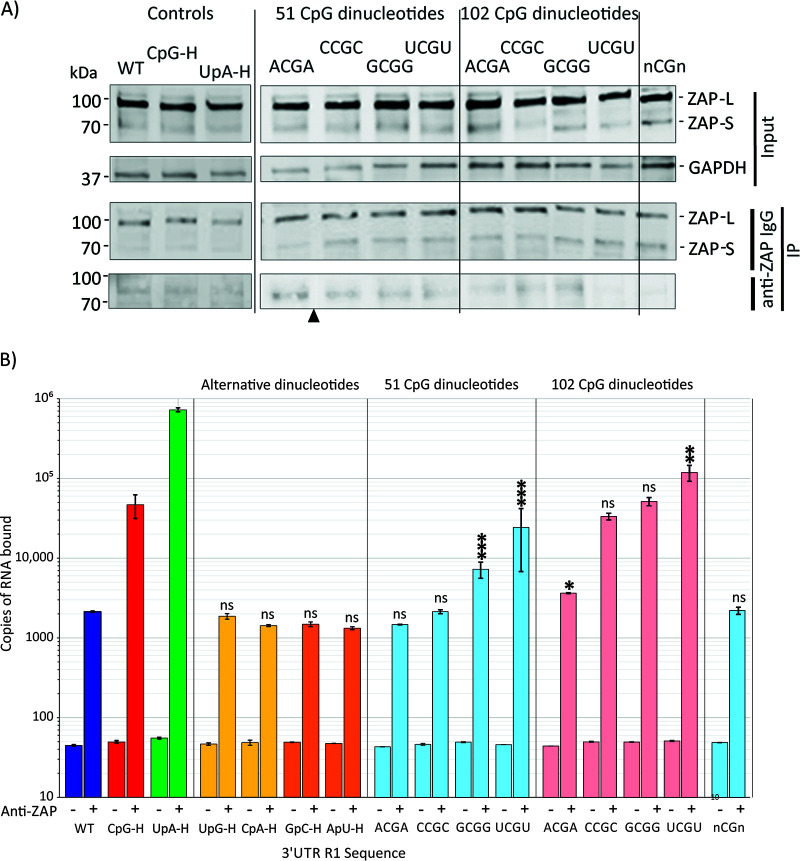
Previous studies have implicated both zinc finger antiviral protein (ZAP) and oligoadenylate synthetase 3 (OAS3)/RNase L in the attenuation of RNA viruses with elevated CpG and UpA dinucleotides. Mechanisms and interrelationships between these two pathways were investigated using an echovirus 7 (E7) replicon with compositionally modified sequences inserted into the 3' untranslated region. ZAP and OAS3 immunoprecipitation (IP) assays provided complementary data on dinucleotide composition effects on binding. Elevated frequencies of alternative pyrimidine/purine (CpA and UpG) and reversed (GpC and ApU) dinucleotides showed no attenuating effect on replication or specific binding to ZAP by IP. However, the bases 3' and 5' of CpG motifs influenced replication and ZAP binding; UCGU enhanced CpG-mediated attenuation and ZAP binding, while A residues shielded CpGs from ZAP recognition. Attenuating effects of elevated frequencies of UpA on replication occurred independently of CpG dinucleotides and bound noncompetitively with CpG-enriched RNA, consistent with a separate recognition site from CpG. Remarkably, immunoprecipitation with OAS3 antibody reproduced the specific binding to CpG- and UpA-enriched RNA sequences. However, OAS3 and ZAP were coimmunoprecipitated in both ZAP and OAS3 IP and colocalized with E7 and stress granules (SGs) by confocal microscopy analysis of infected cells. ZAP's association with larger cellular complexes may mediate the recruitment of OAS3/RNase L, KHNYN, and other RNA degradation pathways. We recently discovered that the OAS3/RNase L antiviral pathway is essential for restriction of CpG- and UpA-enriched viruses, in addition to the requirement for zinc finger antiviral protein (ZAP). The current study provides evidence for the specific dinucleotide and wider recognition contexts associated with virus recognition and attenuation. It further documents the association of ZAP and OAS3 and association with stress granules and a wider protein interactome that may mediate antiviral effects in different cellular compartments. The study provides a striking reconceptualization of the pathways associated with this aspect of antiviral defense.
先前的研究表明,锌指抗病毒蛋白(ZAP)和寡聚腺苷酸合成酶 3(OAS3)/核糖核酸酶 L 都参与了富含 CpG 和 UpA 二核苷酸的 RNA 病毒的衰减。本研究使用含有插入 3'非翻译区的组成修饰序列的肠道病毒 7(E7)复制子,研究了这两种途径之间的机制和相互关系。ZAP 和 OAS3 免疫沉淀(IP)实验提供了关于二核苷酸组成对结合影响的互补数据。替代嘧啶/嘌呤(CpA 和 UpG)和反向(GpC 和 ApU)二核苷酸的高频率显示对复制或通过 IP 与 ZAP 的特异性结合没有减弱作用。然而,CpG 基序的 3'和 5'位碱基影响复制和 ZAP 结合;UCGU 增强了 CpG 介导的衰减和 ZAP 结合,而 A 残基则使 CpG 免受 ZAP 识别。UpA 频率升高对复制的减弱作用独立于 CpG 二核苷酸发生,与富含 CpG 的 RNA 非竞争性结合,这与 CpG 之外的另一个识别位点一致。值得注意的是,用 OAS3 抗体进行免疫沉淀重现了对富含 CpG 和 UpA 的 RNA 序列的特异性结合。然而,在 ZAP 和 OAS3 IP 中,OAS3 和 ZAP 被共同免疫沉淀,并通过共聚焦显微镜分析感染细胞发现它们与 E7 和应激颗粒(SGs)共定位。ZAP 与较大细胞复合物的关联可能介导 OAS3/RNase L、KHNYN 和其他 RNA 降解途径的募集。我们最近发现,除了需要锌指抗病毒蛋白(ZAP)之外,OAS3/RNase L 抗病毒途径对于限制富含 CpG 和 UpA 的病毒是必需的。本研究提供了与病毒识别和衰减相关的特定二核苷酸和更广泛的识别上下文的证据。它进一步记录了 ZAP 和 OAS3 的关联以及与应激颗粒和更广泛的蛋白质相互作用组的关联,这可能介导了不同细胞区室中的抗病毒作用。该研究对与抗病毒防御相关的这一方面的途径进行了引人注目的重新概念化。