Department of Psychiatry, Yale University School of Medicine, New Haven, CT, 06520, USA.
Department of Neuroscience, Yale University School of Medicine, New Haven, CT, 06520, USA.
Neuropsychopharmacology. 2021 Mar;46(4):851-859. doi: 10.1038/s41386-020-00937-9. Epub 2021 Jan 6.
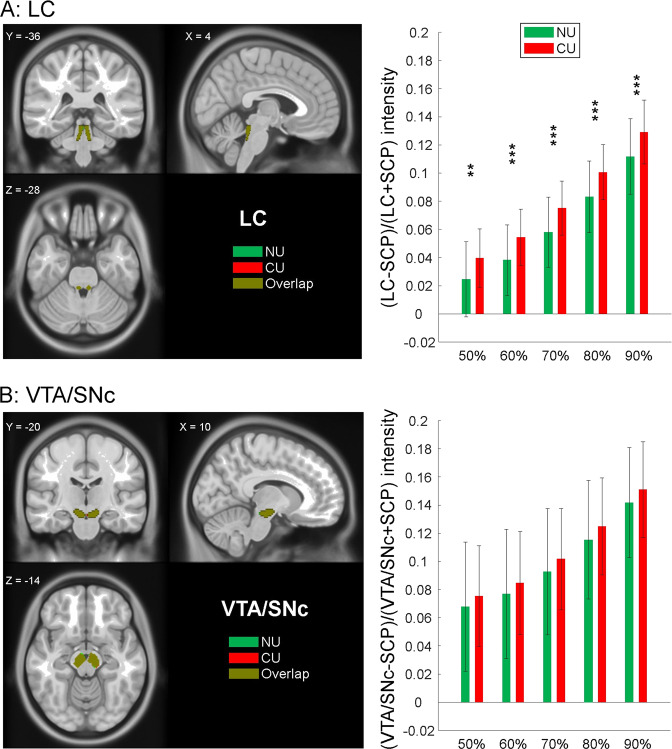
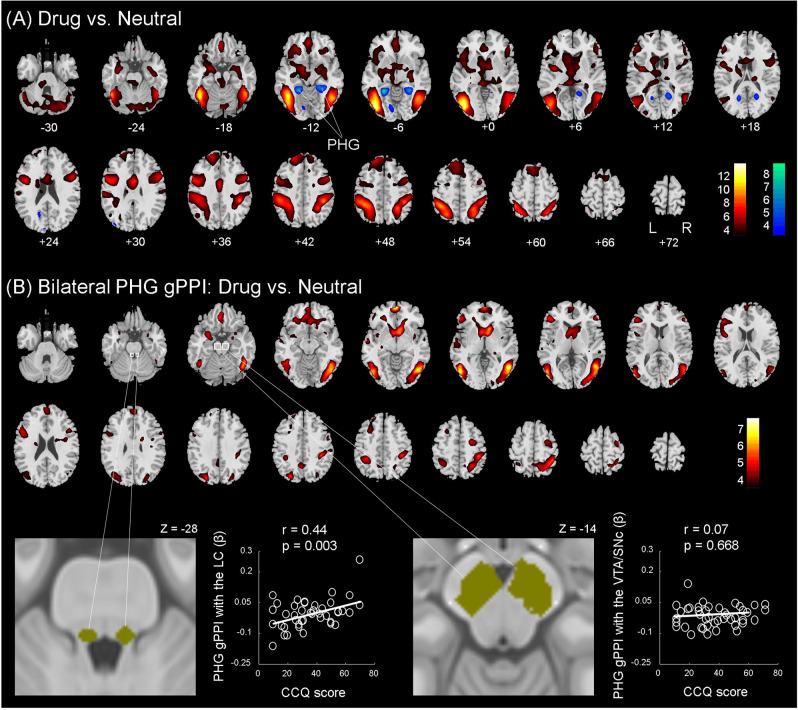
Preclinical studies have implicated noradrenergic (NA) dysfunction in cocaine addiction. In particular, the NA system plays a central role in motivated behavior and may partake in the regulation of craving and drug use. Yet, human studies of the NA system are scarce, likely hampered by the difficulty in precisely localizing the locus coeruleus (LC). Here, we used neuromelanin imaging to localize the LC and quantified LC neuromelanin signal (NMS) intensity in 44 current cocaine users (CU; 37 men) and 59 nondrug users (NU; 44 men). We also employed fMRI to investigate cue-induced regional responses and LC functional connectivities, as quantified by generalized psychophysiological interaction (gPPI), in CU. Imaging data were processed by published routines and the findings were evaluated with a corrected threshold. We examined how these neural measures were associated with chronic cocaine craving, as assessed by the Cocaine Craving Questionnaire (CCQ). Compared to NU, CU demonstrated higher LC NMS for all probabilistic thresholds defined of 50-90% of the peak. In contrast, NMS of the ventral tegmental area/substantia nigra (VTA/SN) did not show significant group differences. Drug as compared to neutral cues elicited higher activations of many cortical and subcortical regions, none of which were significantly correlated with CCQ score. Drug vs. neutral cues also elicited "deactivation" of bilateral parahippocampal gyri (PHG) and PHG gPPI with a wide array of cortical and subcortical regions, including the ventral striatum and, with small volume correction, the LC. Less deactivation of the PHG (r = 0.40, p = 0.008) and higher PHG-LC gPPI (r = 0.44, p = 0.003) were positively correlated with the CCQ score. In contrast, PHG-VTA/SN connectivity did not correlate with the CCQ score. Together, chronic cocaine exposure may induce higher NMS intensity, suggesting neurotoxic effects on the LC. The correlation of cue-elicited PHG LC connectivity with CCQ score suggests a noradrenergic correlate of chronic cocaine craving. Potentially compensating for memory functions as in neurodegenerative conditions, cue-elicited PHG LC circuit connectivity plays an ill-adaptive role in supporting cocaine craving.
临床前研究表明去甲肾上腺素(NA)功能障碍与可卡因成瘾有关。特别是,NA 系统在动机行为中起着核心作用,可能参与调节渴望和药物使用。然而,人类对 NA 系统的研究很少,这可能是由于精确定位蓝斑(LC)的难度所致。在这里,我们使用神经黑色素成像来定位 LC,并在 44 名当前可卡因使用者(CU;37 名男性)和 59 名非药物使用者(NU;44 名男性)中量化 LC 神经黑色素信号(NMS)强度。我们还使用 fMRI 来研究线索诱导的区域反应和 LC 功能连接,通过广义心理生理相互作用(gPPI)来量化,在 CU 中。通过发表的例程处理成像数据,并使用校正后的阈值评估发现。我们检查了这些神经测量值如何与慢性可卡因渴望相关,通过可卡因渴望问卷(CCQ)进行评估。与 NU 相比,CU 对于所有概率阈值(定义为峰的 50-90%)的 LC NMS 均较高。相比之下,腹侧被盖区/黑质(VTA/SN)的 NMS 没有显示出显著的组间差异。与中性线索相比,药物线索引起了许多皮质和皮质下区域的更高激活,其中没有一个与 CCQ 评分有显著相关性。与中性线索相比,药物线索还引起双侧海马旁回(PHG)和 PHG gPPI 的“去激活”,与广泛的皮质和皮质下区域相关,包括腹侧纹状体,并且在小体积校正后,与 LC 相关。PHG 的去激活程度较低(r=0.40,p=0.008)和 PHG-LC gPPI 较高(r=0.44,p=0.003)与 CCQ 评分呈正相关。相比之下,PHG-VTA/SN 连接与 CCQ 评分无关。总之,慢性可卡因暴露可能会引起更高的 NMS 强度,表明对 LC 的神经毒性作用。线索诱导的 PHG-LC 连接与 CCQ 评分的相关性表明,慢性可卡因渴望的去甲肾上腺素相关。在神经退行性疾病等情况下,可能补偿记忆功能,线索诱导的 PHG-LC 回路连接在支持可卡因渴望方面起着适应不良的作用。