Department of Psychiatry, Yale University School of Medicine, New Haven, Connecticut.
Department of Neuroscience, Yale University School of Medicine, New Haven, Connecticut.
Addict Biol. 2020 Jan;25(1):e12682. doi: 10.1111/adb.12682. Epub 2018 Oct 8.
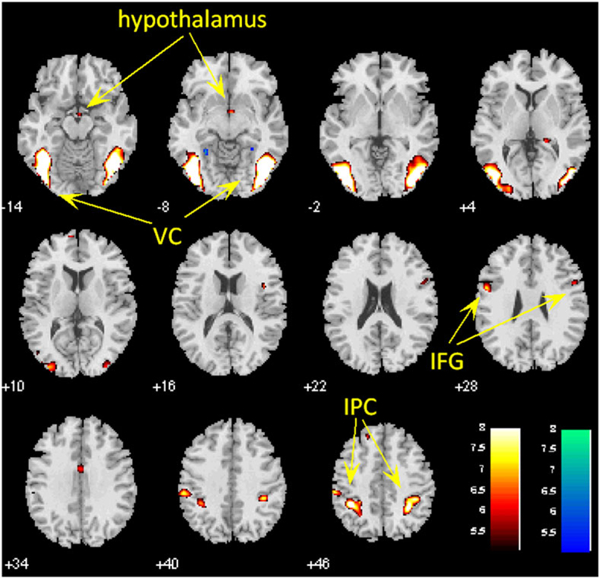
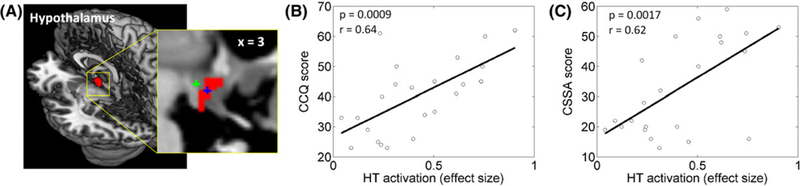
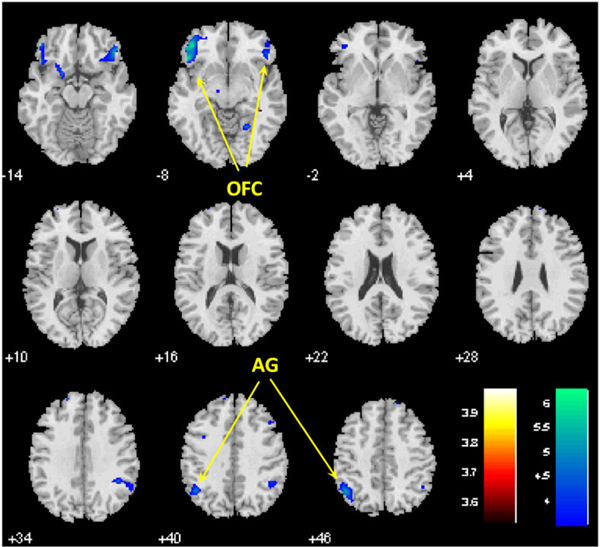
The dopaminergic motive system is compromised in cocaine addiction. Abundant research has examined the roles of the dopaminergic midbrain and ventral striatum (VS) in cue-induced craving and habitual drug consumption. Interconnected with the dopaminergic circuits, the hypothalamus is widely implicated in motivated behavior, including food and drug seeking. However, very few studies have investigated how the hypothalamus responds to drug cues and whether hypothalamic responses are related to clinical features such as craving and addiction severity. Here, in 23 cocaine-dependent individuals (CD) exposed to cocaine vs neutral cues during functional magnetic resonance imaging (fMRI), we examined regional responses using established routines. At a corrected threshold, CD demonstrated increased activation to cocaine vs neutral cues in bilateral visual cortex, inferior parietal and middle frontal gyri, and the hypothalamus. The extent of hypothalamus but not other regional response was correlated with craving and cocaine addiction severity, each as assessed by the Cocaine Craving Questionnaire (CCQ) and Cocaine Selective Severity Assessment (CSSA). In contrast, subjective "acute" craving as elicited by cocaine cues during fMRI involved deactivation of bilateral orbitofrontal cortex (OFC) and angular gyri (AG), and the OFC and AG responses were not related to CCQ or CSSA score. These findings distinguished tonic craving as a critical factor in capturing cocaine addiction severity and substantiated a role of the hypothalamus in motivational dysfunction in cocaine addiction.
多巴胺能动机系统在可卡因成瘾中受损。大量研究已经研究了中脑多巴胺能和腹侧纹状体 (VS) 在线索诱导的渴望和习惯性药物消费中的作用。与多巴胺能回路相互连接,下丘脑广泛参与动机行为,包括食物和药物的寻找。然而,很少有研究调查下丘脑对药物线索的反应,以及下丘脑反应是否与渴望和成瘾严重程度等临床特征有关。在这里,在 23 名可卡因依赖个体 (CD) 在功能磁共振成像 (fMRI) 期间暴露于可卡因与中性线索下,我们使用已建立的例程检查了区域反应。在纠正的阈值下,CD 在双侧视觉皮层、下顶叶和中额叶回以及下丘脑显示出对可卡因与中性线索的激活增加。与渴望和可卡因成瘾严重程度相关的是下丘脑的反应程度,而不是其他区域的反应程度,这两个指标分别由可卡因渴望问卷 (CCQ) 和可卡因选择性严重程度评估 (CSSA) 评估。相比之下,在 fMRI 期间由可卡因线索引起的主观“急性”渴望涉及双侧眶额皮层 (OFC) 和角回 (AG) 的去激活,并且 OFC 和 AG 的反应与 CCQ 或 CSSA 分数无关。这些发现区分了作为捕捉可卡因成瘾严重程度的关键因素的持续渴望,并证实了下丘脑在可卡因成瘾中的动机功能障碍中的作用。