Key Laboratory of Plant Resources Conservation and Sustainable Utilization, South China Botanical Garden, Chinese Academy of Sciences, Guangzhou, 510650, China.
Division of Ecology & Biodiversity, School of Biological Sciences, The University of Hong Kong, Pokfulam Road, Hong Kong, China.
ISME J. 2021 Jun;15(6):1614-1627. doi: 10.1038/s41396-020-00874-x. Epub 2021 Jan 6.
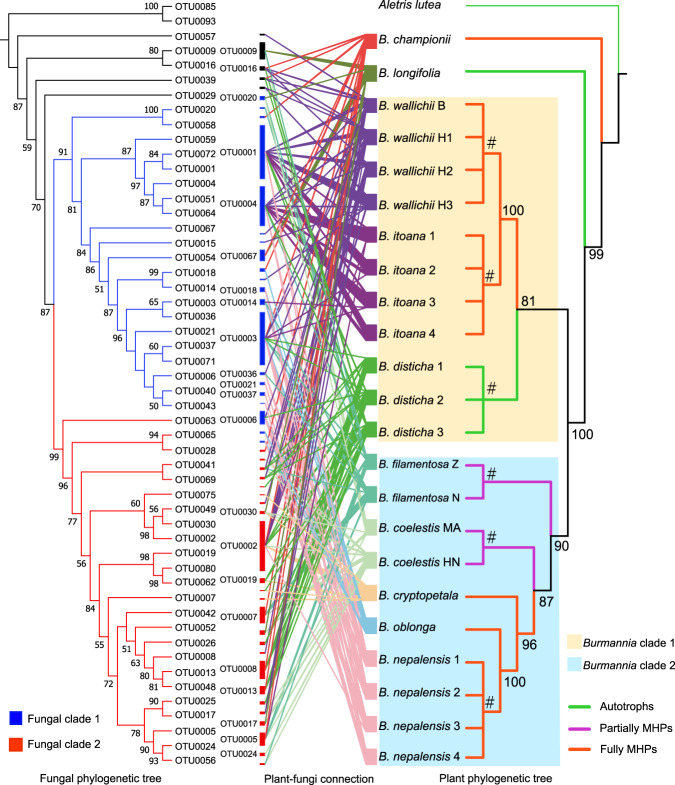
Mycoheterotrophic plants (MHPs) growing on arbuscular mycorrhizal fungi (AMF) usually maintain specialized mycorrhizal associations. The level of specificity varies between MHPs, although it remains largely unknown whether interactions with mycorrhizal fungi differ by plant lineage, species, and/or by population. Here, we investigate the mycorrhizal interactions among Burmannia species (Burmanniaceae) with different trophic modes using high-throughput DNA sequencing. We characterized the inter- and intraspecific dynamics of the fungal communities by assessing the composition and diversity of fungi among sites. We found that fully mycoheterotrophic species are more specialized in their fungal associations than chlorophyllous species, and that this specialization possibly results from the gradual loss of some fungal groups. In particular, although many fungal species were shared by different Burmannia species, fully MHP species typically host species-specific fungal assemblages, suggesting that they have a preference for the selected fungi. Although no apparent cophylogenetic relationship was detected between fungi and plants, we observe that evolutionarily closely related plants tend to have a greater proportion of shared or closely related fungal partners. Our findings suggest a host preference and specialization toward fungal assemblages in Burmannia, improving understanding of interactions between MHPs and fungi.
菌根异养植物(MHPs)生长在丛枝菌根真菌(AMF)上,通常维持着专门的菌根共生关系。虽然植物谱系、物种和/或种群之间的菌根真菌相互作用的特异性程度尚不清楚,但 MHPs 之间的特异性水平存在差异。在这里,我们使用高通量 DNA 测序研究了不同营养模式的 Burmannia 物种(Burmanniaceae)之间的菌根相互作用。我们通过评估不同地点真菌的组成和多样性来描述真菌的种间和种内动态。我们发现,完全菌根异养物种比叶绿素物种在其真菌联系上更加专门化,这种专门化可能是由于某些真菌群的逐渐丧失所致。特别是,尽管许多真菌物种被不同的 Burmannia 物种共享,但完全的 MHP 物种通常宿主具有物种特异性的真菌组合,这表明它们对所选真菌有偏好。尽管在真菌和植物之间没有检测到明显的共进化关系,但我们观察到进化上密切相关的植物往往具有更多的共享或密切相关的真菌伙伴。我们的研究结果表明,Burmannia 对真菌组合具有宿主偏好和特异性,这提高了对 MHPs 和真菌之间相互作用的理解。