Ogura-Tsujita Yuki, Yukawa Tomohisa, Kinoshita Akihiko
Faculty of Agriculture, Saga University, 1 Honjo-machi, Saga, 840-8502, Japan.
United Graduate School of Agricultural Sciences, Kagoshima University, 1-21-24 Korimoto, Kagoshima, 890-8580, Japan.
J Plant Res. 2021 Jan;134(1):19-41. doi: 10.1007/s10265-020-01244-6. Epub 2021 Jan 8.
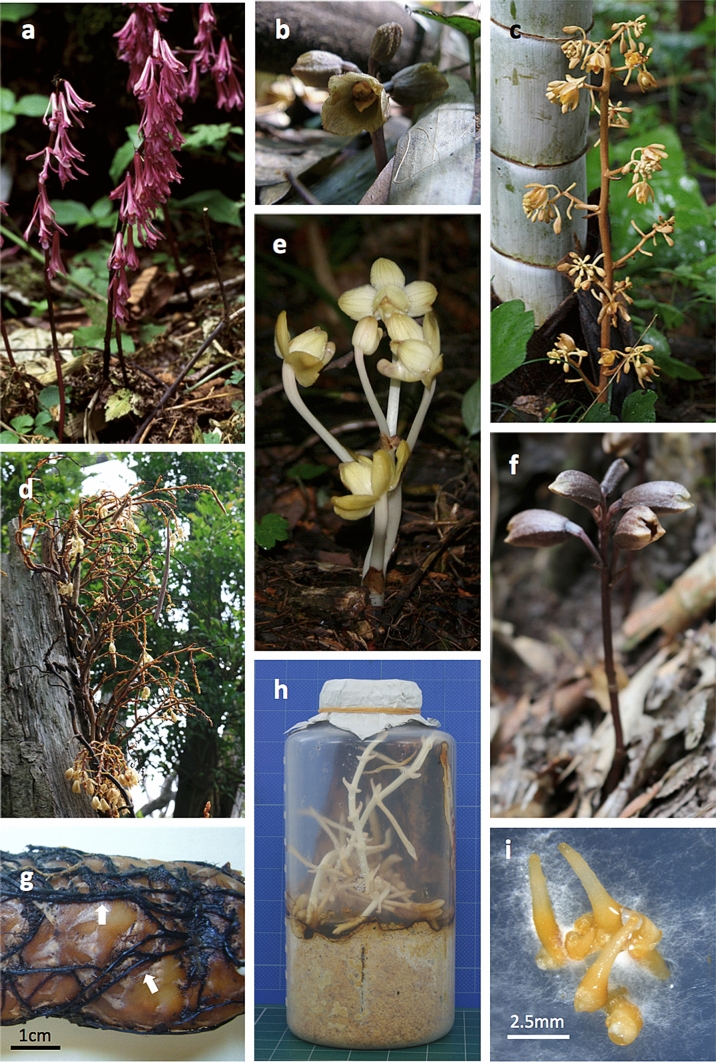
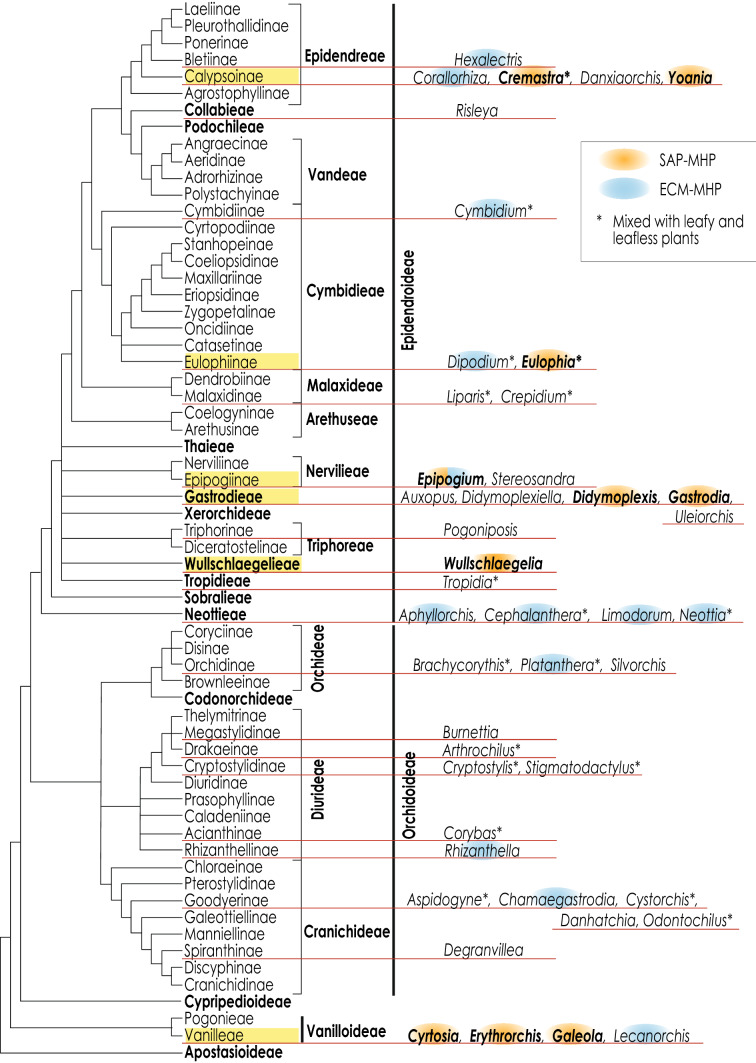
Mycoheterotrophic plants (MHPs) are leafless, achlorophyllous, and completely dependent on mycorrhizal fungi for their carbon supply. Mycorrhizal symbiosis is a mutualistic association with fungi that is undertaken by the majority of land plants, but mycoheterotrophy represents a breakdown of this mutualism in that plants parasitize fungi. Most MHPs are associated with fungi that are mycorrhizal with autotrophic plants, such as arbuscular mycorrhizal (AM) or ectomycorrhizal (ECM) fungi. Although these MHPs gain carbon via the common mycorrhizal network that links the surrounding autotrophic plants, some mycoheterotrophic lineages are associated with saprotrophic (SAP) fungi, which are free-living and decompose leaf litter and wood materials. Such MHPs are dependent on the forest carbon cycle, which involves the decomposition of wood debris and leaf litter, and have a unique biology and evolutionary history. MHPs associated with SAP fungi (SAP-MHPs) have to date been found only in the Orchidaceae and likely evolved independently at least nine times within that family. Phylogenetically divergent SAP Basidiomycota, mostly Agaricales but also Hymenochaetales, Polyporales, and others, are involved in mycoheterotrophy. The fungal specificity of SAP-MHPs varies from a highly specific association with a single fungal species to a broad range of interactions with multiple fungal orders. Establishment of symbiotic culture systems is indispensable for understanding the mechanisms underlying plant-fungus interactions and the conservation of MHPs. Symbiotic culture systems have been established for many SAP-MHP species as a pure culture of free-living SAP fungi is easier than that of biotrophic AM or ECM fungi. Culturable SAP-MHPs are useful research materials and will contribute to the advancement of plant science.
菌根异养植物(MHPs)没有叶子,不含叶绿素,完全依赖菌根真菌提供碳源。菌根共生是大多数陆地植物与真菌形成的一种互利共生关系,但菌根异养代表了这种共生关系的一种破坏,即植物寄生真菌。大多数菌根异养植物与能和自养植物形成菌根的真菌有关,如丛枝菌根(AM)真菌或外生菌根(ECM)真菌。尽管这些菌根异养植物通过连接周围自养植物的共同菌根网络获取碳,但一些菌根异养谱系与腐生(SAP)真菌有关,腐生真菌营自由生活,分解落叶和木材。这类菌根异养植物依赖于森林碳循环,森林碳循环涉及木材碎片和落叶的分解,并且具有独特的生物学和进化历史。与腐生真菌相关的菌根异养植物(SAP - MHPs)迄今为止仅在兰科中被发现,并且可能在该科内至少独立进化了九次。系统发育上不同的腐生担子菌,主要是伞菌目,但也有层孔菌目、多孔菌目等,参与了菌根异养过程。SAP - MHPs的真菌特异性从与单一真菌物种的高度特异性关联到与多个真菌目广泛的相互作用不等。建立共生培养系统对于理解植物 - 真菌相互作用的潜在机制以及菌根异养植物的保护至关重要。由于自由生活的腐生真菌的纯培养比生物营养型AM或ECM真菌更容易,许多SAP - MHP物种已经建立了共生培养系统。可培养的SAP - MHPs是有用的研究材料,将有助于植物科学的进步。