Liao Chenxi, Xiao Yin, Liu Lingbo
Institute of Hematology, Union Hospital, Tongji Medical College, Huazhong University of Science and Technology, Wuhan 430022, People's Republic of China.
Cancer Center, Union Hospital, Tongji Medical College, Huazhong University of Science and Technology, Wuhan 430022, People's Republic of China.
Cancer Manag Res. 2020 Dec 31;12:13553-13566. doi: 10.2147/CMAR.S285083. eCollection 2020.
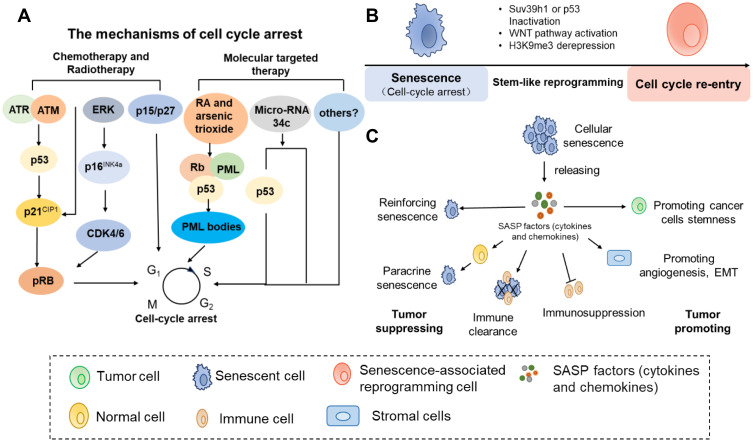
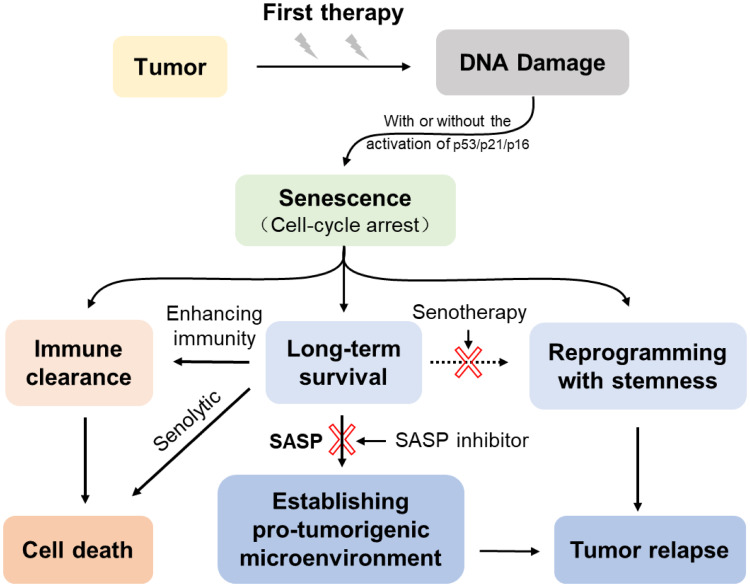
Cellular senescence is traditionally considered as stable cell cycle arrest state with other phenotypic alterations including the production of an array of cytokines and growth factors. Cancer cells undergo senescence in response to chemotherapeutic agents, radiotherapy and molecular targeted therapy. This form of senescence is termed therapy-induced senescence (TIS) and represents a desirable target in cancer therapy. Recent studies have shown that cellular senescence is a highly heterogeneous and dynamic process. Apart from being cleared by the immune system, the senescent cancer cells may survive for a long time and escape from senescence state. Notably, these cells even have the potential to regain stem-like state with high aggressiveness that eventually facilitates cancer recurrence. Furthermore, the senescence-associated secretory phenotype (SASP) of senescent cells is not always the same, and could establish immunosuppression and a protumor microenvironment. Given these detrimental effects, senescence-inducing chemotherapy followed by senotherapy (the "one-two punch" approach), has emerged. This combined therapy could mitigate unnecessary side effects of the persistent senescent cells, reduce the toxicity of pro-senescence therapy and prolong the survival of cancer patients, and it has a potential future in the precise treatment of cancer. Herein, we review the complex effects of therapy-induced senescence in cancer and highlight the great promise of two-step strategies in anticancer therapies.
细胞衰老传统上被认为是一种稳定的细胞周期停滞状态,并伴有其他表型改变,包括一系列细胞因子和生长因子的产生。癌细胞会因化疗药物、放疗和分子靶向治疗而发生衰老。这种衰老形式被称为治疗诱导的衰老(TIS),是癌症治疗中一个理想的靶点。最近的研究表明,细胞衰老是一个高度异质性和动态的过程。除了被免疫系统清除外,衰老的癌细胞可能会长期存活并逃离衰老状态。值得注意的是,这些细胞甚至有可能恢复到具有高侵袭性的干细胞样状态,最终促进癌症复发。此外,衰老细胞的衰老相关分泌表型(SASP)并不总是相同的,并且可能建立免疫抑制和促肿瘤微环境。鉴于这些有害影响,出现了先进行诱导衰老的化疗,然后进行衰老治疗的方法(“两拳出击”方法)。这种联合治疗可以减轻持续存在的衰老细胞带来的不必要副作用,降低促衰老治疗的毒性,延长癌症患者的生存期,并且在癌症的精准治疗方面具有潜在的前景。在此,我们综述了治疗诱导的衰老在癌症中的复杂作用,并强调了两步策略在抗癌治疗中的巨大前景。