Matheson Kimberly, Asokumar Ajani, Anisman Hymie
Department of Neuroscience, Carleton University, Ottawa, ON, Canada.
The Royal Ottawa's Institute of Mental Health Research, Ottawa, ON, Canada.
Front Behav Neurosci. 2020 Dec 21;14:596919. doi: 10.3389/fnbeh.2020.596919. eCollection 2020.
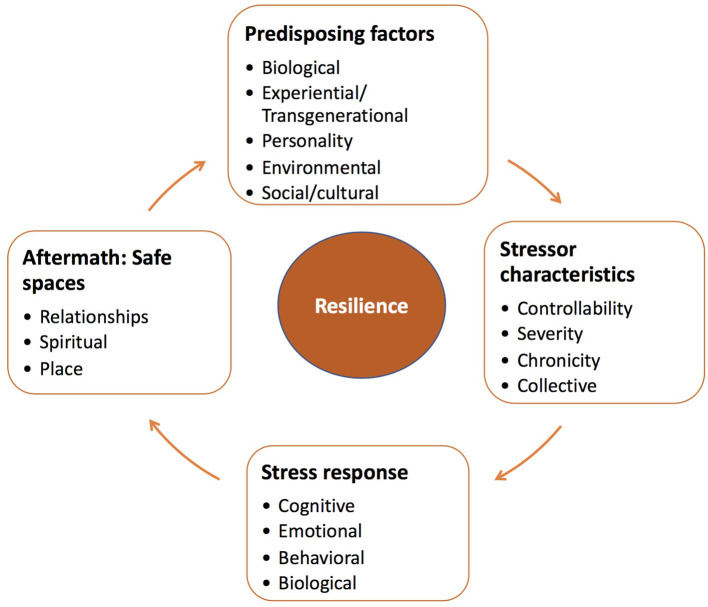
The relationship between adverse experiences and the emergence of pathology has often focused on characteristics of the stressor or of the individual (stressor appraisals, coping strategies). These features are thought to influence multiple biological processes that favor the development of mental and physical illnesses. Less often has attention focused on the aftermath of traumatic experiences, and the importance of safety and reassurance that is necessary for longer-term well-being. In some cases (e.g., post-traumatic stress disorder) this may be reflected by a failure of fear extinction, whereas in other instances (e.g., historical trauma), the uncertainty about the future might foster continued anxiety. In essence, the question becomes one of how individuals attain feelings of safety when it is fully understood that the world is not necessarily a safe place, uncertainties abound, and feelings of agency are often illusory. We consider how individuals acquire resilience in the aftermath of traumatic and chronic stressors. In this respect, we review characteristics of stressors that may trigger particular biological and behavioral coping responses, as well as factors that undermine their efficacy. To this end, we explore stressor dynamics and social processes that foster resilience in response to specific traumatic, chronic, and uncontrollable stressor contexts (intimate partner abuse; refugee migration; collective historical trauma). We point to resilience factors that may comprise neurobiological changes, such as those related to various stressor-provoked hormones, neurotrophins, inflammatory immune, microbial, and epigenetic processes. These behavioral and biological stress responses may influence, and be influenced by, feelings of safety that come about through relationships with others, spiritual and place-based connections.
不良经历与病理状态的出现之间的关系通常聚焦于应激源或个体的特征(应激源评估、应对策略)。这些特征被认为会影响多个有利于身心疾病发展的生物学过程。人们较少关注创伤经历的后果,以及长期幸福感所必需的安全感和安心感的重要性。在某些情况下(例如创伤后应激障碍),这可能表现为恐惧消退失败,而在其他情况下(例如历史创伤),对未来的不确定性可能会加剧持续的焦虑。从本质上讲,问题变成了这样一个问题:当人们充分认识到世界不一定是一个安全的地方、不确定性无处不在且掌控感往往是虚幻的时候,个体如何获得安全感。我们思考个体在创伤性和慢性应激源之后如何获得恢复力。在这方面,我们回顾可能引发特定生物学和行为应对反应的应激源特征,以及削弱其效力的因素。为此,我们探讨应激源动态和社会过程,这些过程有助于在应对特定的创伤性、慢性和不可控应激源情境(亲密伴侣虐待;难民迁移;集体历史创伤)时增强恢复力。我们指出恢复力因素可能包括神经生物学变化,例如与各种应激源引发的激素、神经营养因子、炎症免疫、微生物和表观遗传过程相关的变化。这些行为和生物学应激反应可能会受到通过与他人的关系、精神和基于地点的联系所产生的安全感的影响,并反过来影响这种安全感。