Lee Choong Man, Chung Il Yong, Park Yangsoon, Yun Keong Won, Jo Hwi Gyeong, Park Hye Jin, Lee Hee Jin, Lee Sae Byul, Kim Hee Jeong, Ko Beom Seok, Lee Jong Won, Son Byung Ho, Ahn Sei Hyun, Kim Jisun
Department of Surgery, Asan Medical Center, University of Ulsan College of Medicine, Seoul, Korea.
Division of Breast Surgery, Department of Surgery, Asan Medical Center, University of Ulsan College of Medicine, Seoul, Korea.
J Breast Cancer. 2020 Dec;23(6):610-621. doi: 10.4048/jbc.2020.23.e68.
Factors associated with invasive recurrence (REC) of ductal carcinoma in situ (DCIS) are less known. This study was aimed at identifying better biomarkers to predict the prognosis of DCIS.
RNA extracted from formalin-fixed paraffin-embedded blocks of twenty-four pure DCIS cases was subjected to differential gene expression analysis. The DCIS cases were selected by matching age and estrogen receptor status. Sixteen REC-free and 8 invasive-REC cases with disease-free interval of > 5 years were analyzed. Immunohistochemistry (IHC) staining was used to validate sixty-one independent pure DCIS cases, including invasive-REC (n = 16) and REC-free (n = 45) cases.
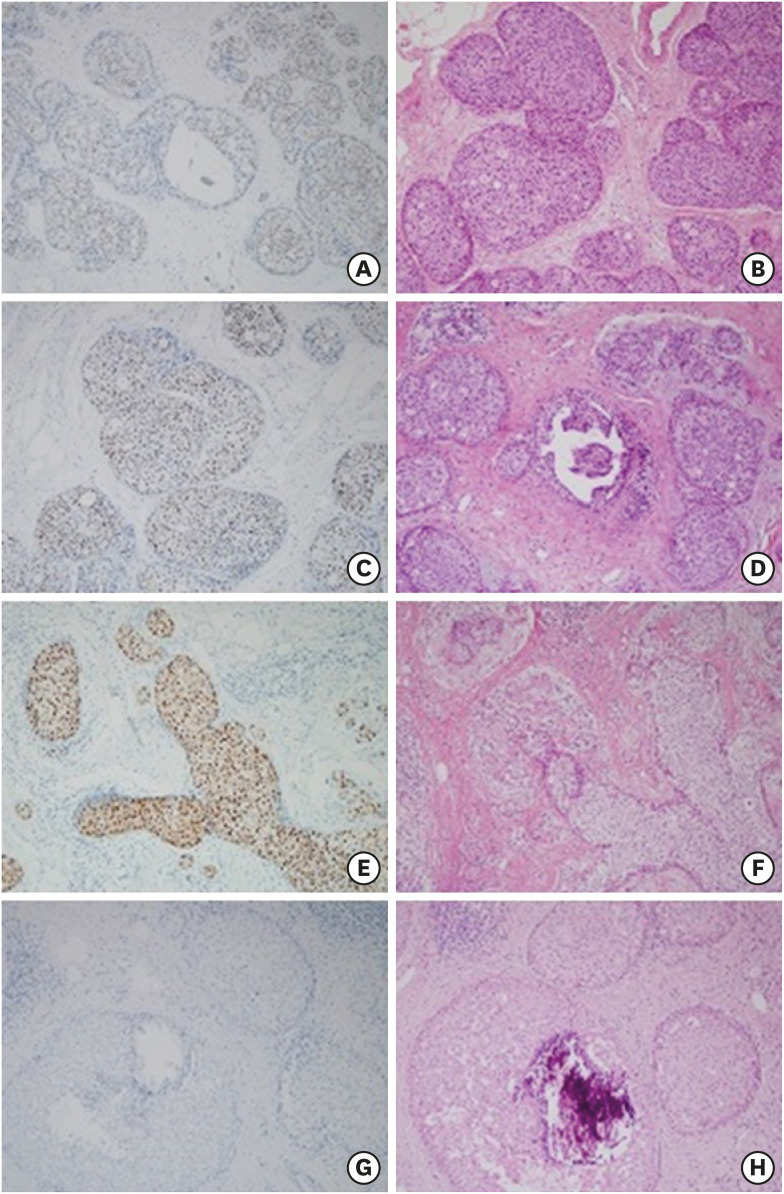
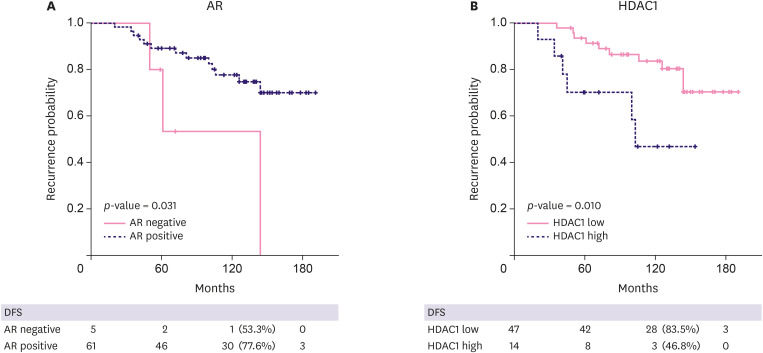
Eight differentially expressed genes (DEGs) were statistically significant (log 2-fold change [FC] < -1 or > 1 and < 0.001). Less than ½ fold expression of , androgen receptor (), , , , , , genes was observed in the REC group compared to the no evidence of disease group. and histone deacetylase 1 () genes were selected for external validation (: log 2-FC - 1.35, < 0.001, and : log 2-FC - 0.774, < 0.001). External validation showed that the absence of AR and high HDAC1 expression were independent risk factors for invasive REC (hazard ratio [HR], 5.04; 95% confidence interval [CI], 1.24-20.4; = 0.023 and HR, 3.07; 95% CI, 1.04-9.04; = 0.042). High nuclear grade 3 was also associated with long-term invasive REC.
Comparative gene expression analysis of pure DCIS revealed 8 DEGs among recurring cases. External validation with IHC suggested that the absence of AR and overexpression of HDAC1 are associated with a greater risk of long-term invasive REC of pure DCIS.
与导管原位癌(DCIS)侵袭性复发(REC)相关的因素鲜为人知。本研究旨在确定更好的生物标志物以预测DCIS的预后。
从24例纯DCIS病例的福尔马林固定石蜡包埋块中提取RNA,进行差异基因表达分析。通过匹配年龄和雌激素受体状态选择DCIS病例。分析了16例无复发和8例侵袭性复发且无病生存期>5年的病例。采用免疫组织化学(IHC)染色对61例独立的纯DCIS病例进行验证,包括侵袭性复发(n = 16)和无复发(n = 45)病例。
8个差异表达基因(DEG)具有统计学意义(log2倍变化[FC]< -1或>1且P<0.001)。与无疾病证据组相比,REC组中雄激素受体(AR)、[此处可能有基因名称缺失]、[此处可能有基因名称缺失]、[此处可能有基因名称缺失]、[此处可能有基因名称缺失]、[此处可能有基因名称缺失]、[此处可能有基因名称缺失]基因的表达低于1/2倍。选择AR和组蛋白去乙酰化酶1(HDAC1)基因进行外部验证(AR:log2-FC -1.35,P<0.001,HDAC1:log2-FC -0.774,P<0.001)。外部验证表明,AR缺失和HDAC1高表达是侵袭性REC的独立危险因素(风险比[HR],5.04;95%置信区间[CI],1.24 - 20.4;P = 0.023和HR,3.07;95%CI,1.04 - 9.04;P = 0.042)。高核分级3级也与长期侵袭性REC相关。
纯DCIS的比较基因表达分析揭示了复发病例中的8个DEG。IHC外部验证表明,AR缺失和HDAC1过表达与纯DCIS长期侵袭性REC的更高风险相关。