Kim Ji Young, Yang Kyung Min, Youn Ji Hyun, Park Heejun, Hahn Hyung Min, Lee Il Jae
Department of Surgery, Ajou University Hospital, Suwon, Korea.
Department of Plastic and Reconstructive Surgery, Ajou University School of Medicine, Suwon, Korea.
J Breast Cancer. 2020 Dec;23(6):635-646. doi: 10.4048/jbc.2020.23.e64.
Acellular dermal matrix (ADM) supports tissue expanders or implants in implant-based breast reconstruction. The characteristics of ADM tissue are defined by the manufacturing procedure, such as decellularization, preservation, and sterilization, and are directly related to clinical outcomes. This study aimed to compare the properties of a new pre-hydrated-ADM (H-ADM-low) obtained using a decellularization reagent reduction process with a low concentration of detergent with those of radiation-sterilized H-ADM and freeze-dried ADM (FD-ADM).
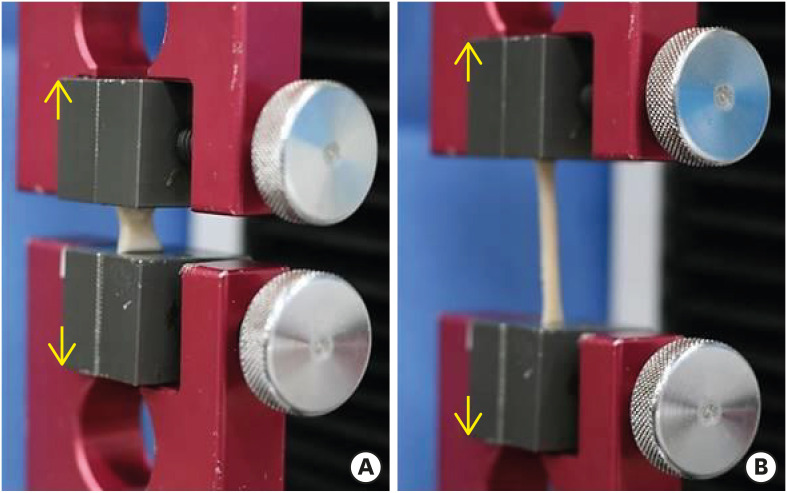
ADMs were evaluated in terms of structure, mechanical quality, and cytotoxicity using histochemical staining, tensile strength testing, and cell viability analysis.
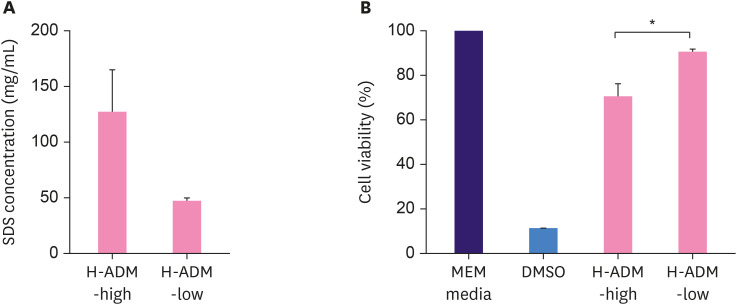
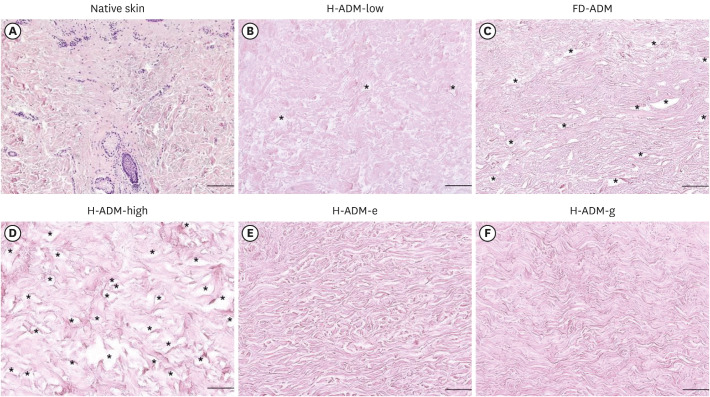
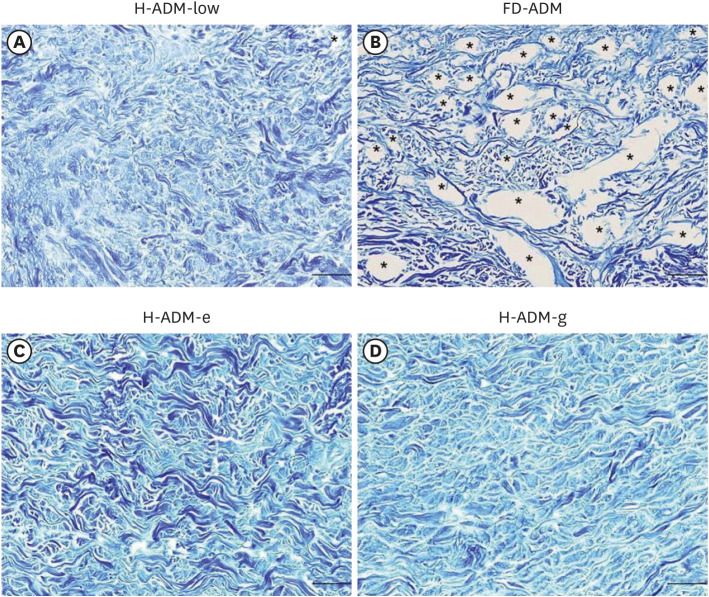
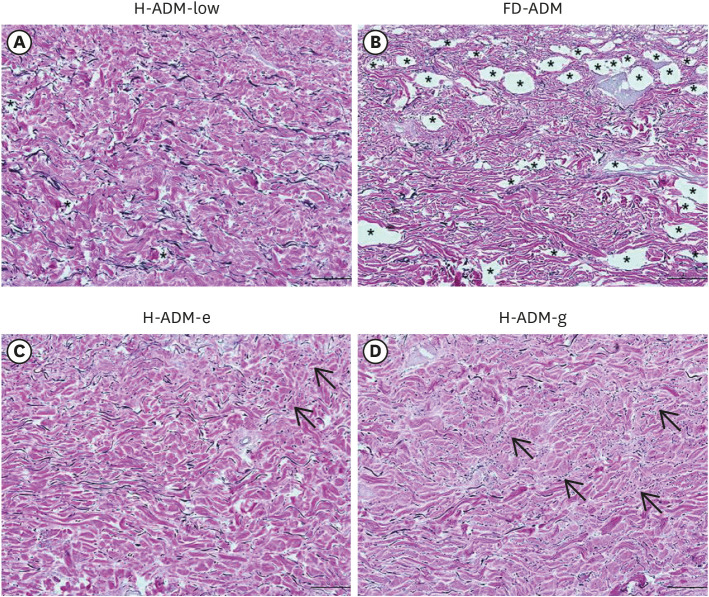
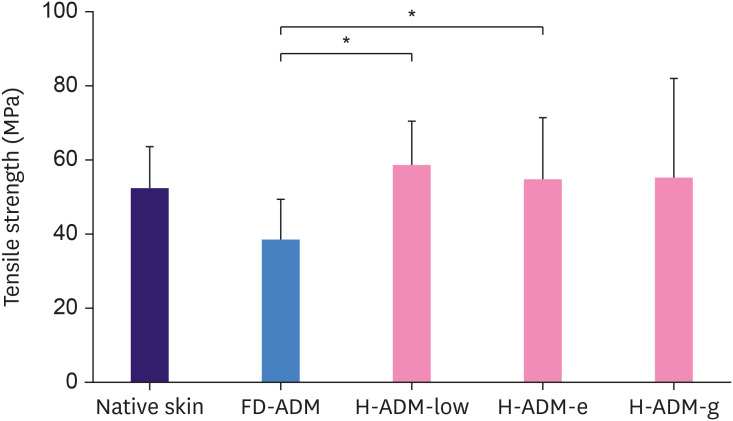
The tissue structure of H-ADM-low (CGDERM ONE-STEP) was similar to that of native skin despite complete decellularization. By contrast, in FD-ADM, the tissue structure was damaged by the freeze-drying process, and radiation-sterilized H-ADM showed a compact fibrillar arrangement. Furthermore, matrix components such as collagen and elastin were preserved in H-ADM-low, whereas a loss of elastin fibers with fragmented distribution was observed in radiation-sterilized H-ADMs. H-ADM-low's tensile strength (58.84 MPa) was significantly greater than that of FD-ADM (38.60 MPa) and comparable with that of radiation-sterilized H-ADMs. The residual detergent content in H-ADM-low (47.45 mg/L) was 2.67-fold lower than that of H-ADM decellularized with a conventional detergent concentration (126.99 mg/mL), and this finding was consistent with the cell viability results (90.7% and 70.7%, respectively), indicating that H-ADM-low has very low cytotoxicity.
H-ADM-low produced through aseptic processes retains the original tissue structure, demonstrates excellent mechanical properties, and does not affect cell viability. Therefore, this newer H-ADM is suitable for use in implant-based breast reconstruction.
在基于植入物的乳房重建中,脱细胞真皮基质(ADM)可支撑组织扩张器或植入物。ADM组织的特性由制造过程决定,如脱细胞、保存和灭菌,且与临床结果直接相关。本研究旨在比较一种使用低浓度去污剂的脱细胞试剂减量法获得的新型预水化ADM(H-ADM-low)与辐射灭菌的H-ADM和冻干ADM(FD-ADM)的性能。
使用组织化学染色、拉伸强度测试和细胞活力分析,从结构、机械质量和细胞毒性方面对ADM进行评估。
尽管完全脱细胞,但H-ADM-low(CGDERM ONE-STEP)的组织结构与天然皮肤相似。相比之下,在FD-ADM中,组织结构因冻干过程而受损,辐射灭菌的H-ADM呈现紧密的纤维排列。此外,H-ADM-low中保留了胶原蛋白和弹性蛋白等基质成分,而在辐射灭菌的H-ADM中观察到弹性纤维丢失且分布破碎。H-ADM-low的拉伸强度(58.84 MPa)显著高于FD-ADM(38.60 MPa),与辐射灭菌的H-ADM相当。H-ADM-low中的残留去污剂含量(47.45 mg/L)比用传统去污剂浓度脱细胞的H-ADM低2.67倍,这一发现与细胞活力结果一致(分别为90.7%和70.7%),表明H-ADM-low的细胞毒性非常低。
通过无菌工艺生产的H-ADM-low保留了原始组织结构,具有优异的机械性能,且不影响细胞活力。因此,这种新型H-ADM适用于基于植入物的乳房重建。