Marshall Emily, Nomi Jason S, Dirks Bryce, Romero Celia, Kupis Lauren, Chang Catie, Uddin Lucina Q
Department of Psychology, University of Miami, Coral Gables, FL, USA.
Department of Electrical Engineering and Computer Science, Vanderbilt University, Nashville, TN, USA.
Netw Neurosci. 2020 Dec 1;4(4):1219-1234. doi: 10.1162/netn_a_00163. eCollection 2020.
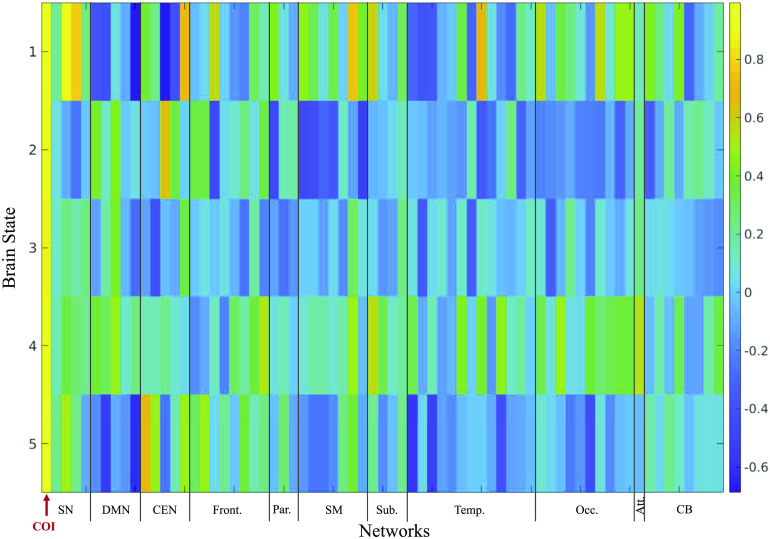
Brain connectivity studies of autism spectrum disorder (ASD) have historically relied on static measures of functional connectivity. Recent work has focused on identifying transient configurations of brain activity, yet several open questions remain regarding the nature of specific brain network dynamics in ASD. We used a dynamic coactivation pattern (CAP) approach to investigate the salience/midcingulo-insular (M-CIN) network, a locus of dysfunction in ASD, in a large multisite resting-state fMRI dataset collected from 172 children (ages 6-13 years; = 75 ASD; = 138 male). Following brain parcellation by using independent component analysis, dynamic CAP analyses were conducted and -means clustering was used to determine transient activation patterns of the M-CIN. The frequency of occurrence of different dynamic CAP brain states was then compared between children with ASD and typically developing (TD) children. Dynamic brain configurations characterized by coactivation of the M-CIN with central executive/lateral fronto-parietal and default mode/medial fronto-parietal networks appeared less frequently in children with ASD compared with TD children. This study highlights the utility of time-varying approaches for studying altered M-CIN function in prevalent neurodevelopmental disorders. We speculate that altered M-CIN dynamics in ASD may underlie the inflexible behaviors commonly observed in children with the disorder.
自闭症谱系障碍(ASD)的脑连接性研究历来依赖于功能连接的静态测量方法。最近的研究工作聚焦于识别大脑活动的瞬态配置,然而,关于ASD中特定脑网络动力学的本质仍存在一些悬而未决的问题。我们使用动态共激活模式(CAP)方法,在一个从172名儿童(年龄6 - 13岁;n = 75名ASD患者;n = 138名男性)收集的大型多站点静息态功能磁共振成像(fMRI)数据集中,研究了显著性/中扣带回 - 脑岛(M - CIN)网络,该网络是ASD中的一个功能障碍位点。通过独立成分分析进行脑区划分后,进行动态CAP分析,并使用K均值聚类来确定M - CIN的瞬态激活模式。然后比较了ASD儿童和发育正常(TD)儿童之间不同动态CAP脑状态的出现频率。与TD儿童相比,以M - CIN与中央执行/外侧额顶叶和默认模式/内侧额顶叶网络共激活为特征的动态脑配置在ASD儿童中出现的频率较低。这项研究强调了时变方法在研究常见神经发育障碍中M - CIN功能改变方面的实用性。我们推测,ASD中M - CIN动力学的改变可能是该疾病儿童中常见的刻板行为的基础。