Departamento de Neurologia, Hospital das Clínicas, Faculdade de Medicina, Universidade de São Paulo, Av. Dr. Enéas de Carvalho Aguiar, 255, 5° andar, sala 5084 Cerqueira César, São Paulo, SP, 05403-900, Brazil.
Departamento de Neurorradiologia, Hospital das Clínicas, Faculdade de Medicina, Universidade de São Paulo, São Paulo, Brazil.
Neurol Sci. 2021 Feb;42(2):479-489. doi: 10.1007/s10072-020-04946-w. Epub 2021 Jan 7.
To describe the clinical, neurological, neuroimaging, and cerebrospinal fluid (CSF) findings associated with encephalopathy in patients admitted to a COVID-19 tertiary reference center.
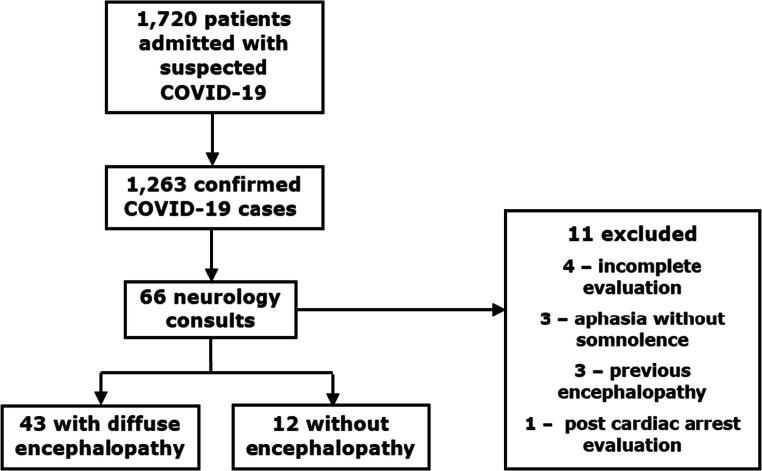
We retrospectively reviewed records of consecutive patients with COVID-19 evaluated by a consulting neurology team from March 30, 2020 through May 15, 2020.
Fifty-five patients with confirmed SARS-CoV-2 were included, 43 of whom showed encephalopathy, and were further divided into mild, moderate, and severe encephalopathy groups. Nineteen patients (44%) had undergone mechanical ventilation and received intravenous sedatives. Eleven (26%) patients were on dialysis. Laboratory markers of COVID-19 severity were very common in encephalopathy patients, but did not correlate with the severity of encephalopathy. Thirty-nine patients underwent neuroimaging studies, which showed mostly non-specific changes. One patient showed lesions possibly related to CNS demyelination. Four had suffered an acute stroke. SARS-CoV-2 was detected by RT-PCR in only one of 21 CSF samples. Two CSF samples showed elevated white blood cell count and all were negative for oligoclonal bands. In our case series, the severity of encephalopathy correlated with higher probability of death during hospitalization (OR = 5.5 for each increment in the degree of encephalopathy, from absent (0) to mild (1), moderate (2), or severe (3), p < 0.001).
In our consecutive series with 43 encephalopathy cases, neuroimaging and CSF analysis did not support the role of direct viral CNS invasion or CNS inflammation as the cause of encephalopathy.
描述入住 COVID-19 三级参考中心的患者中与脑病相关的临床、神经科、神经影像学和脑脊液 (CSF) 发现。
我们回顾性分析了 2020 年 3 月 30 日至 2020 年 5 月 15 日期间由咨询神经科团队评估的连续 COVID-19 患者的记录。
共纳入 55 例确诊 SARS-CoV-2 的患者,其中 43 例出现脑病,并进一步分为轻度、中度和重度脑病组。19 例(44%)接受了机械通气和静脉镇静治疗。11 例(26%)患者接受了透析。COVID-19 严重程度的实验室标志物在脑病患者中非常常见,但与脑病的严重程度无关。39 例患者进行了神经影像学研究,结果显示大多数为非特异性改变。1 例患者显示可能与 CNS 脱髓鞘相关的病变。4 例发生急性中风。仅在 21 份 CSF 样本中的 1 份中检测到 SARS-CoV-2。2 份 CSF 样本显示白细胞计数升高,所有样本均未出现寡克隆带。在本病例系列中,脑病的严重程度与住院期间死亡的可能性更高相关(每增加脑病程度 1 度,即从无(0)到轻度(1)、中度(2)或重度(3),OR 为 5.5,p < 0.001)。
在我们的连续系列中,有 43 例脑病病例,神经影像学和 CSF 分析不支持直接病毒 CNS 侵袭或 CNS 炎症作为脑病的原因。