Department of Neurosurgery Qilu Hospital of Shandong University and Institute of Brain and Brain-Inspired ScienceShandong University Jinan Shandong Province China.
Shandong Key Laboratory of Brain Function Remodeling Jinan Shandong Province China.
J Am Heart Assoc. 2021 Jan 19;10(2):e018633. doi: 10.1161/JAHA.120.018633. Epub 2021 Jan 7.
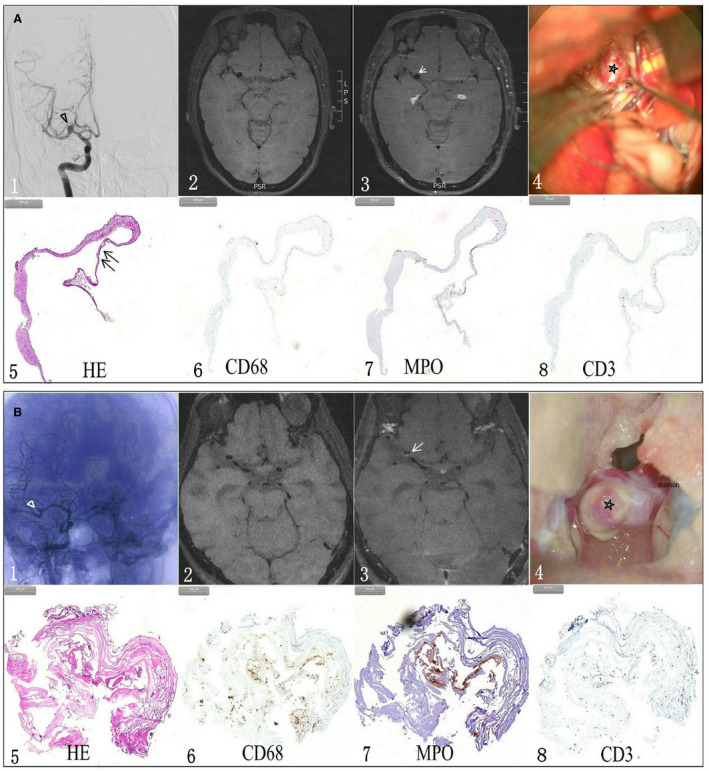
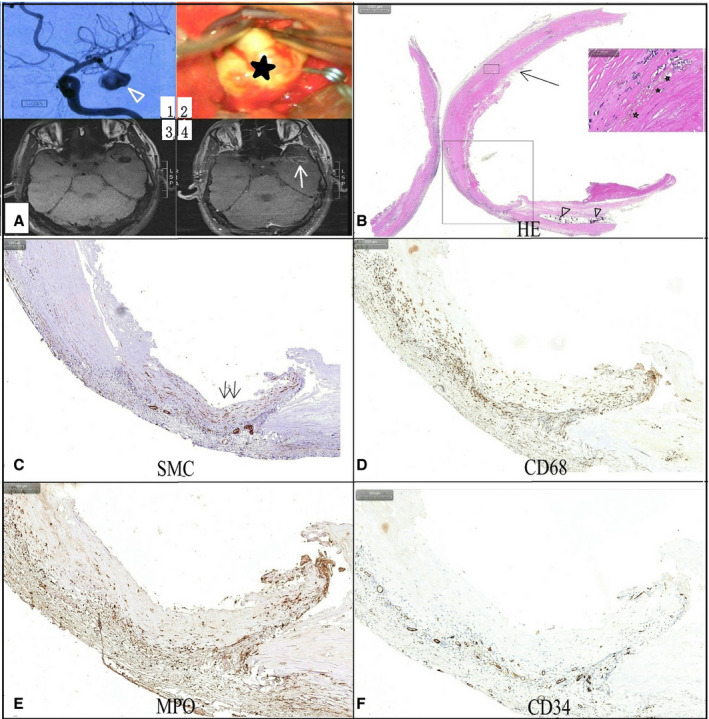
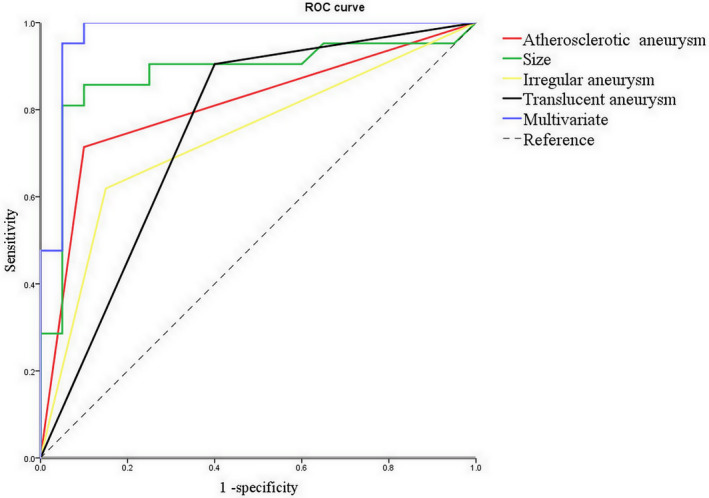
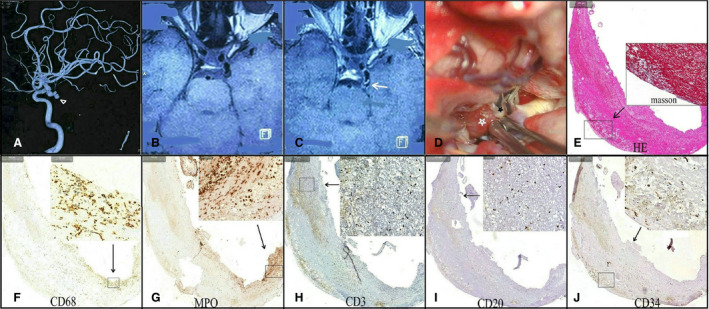
Background Unruptured intracerebral aneurysm wall enhancement (AWE) on vessel wall magnetic resonance imaging scans may be a promising predictor for rupture-prone intracerebral aneurysms. However, the pathophysiology of AWE remains unclear. To this end, the association between AWE and histopathological changes was assessed in this study. Methods and Results A total of 35 patients with 41 unruptured intracerebral aneurysms who underwent surgical clipping were prospectively enrolled. A total of 27 aneurysms were available for histological evaluation. The macroscopic and microscopic features of unruptured intracerebral aneurysms with and without enhancement were assessed. The microscopic features studied included inflammatory cell invasion and vasa vasorum, which were assessed using immunohistochemical staining with CD68, CD3, CD20, and myeloperoxidase for the former and CD34 for the latter. A total of 21 (51.2%) aneurysms showed AWE (partial AWE, n=7; circumferential AWE, n=14). Atherosclerotic and translucent aneurysms were identified in 17 and 14 aneurysms, respectively. Aneurysm size, irregularity, and atherosclerotic and translucent aneurysms were associated with AWE on univariate analysis (<0.05). Multivariate logistic regression analysis showed that atherosclerosis was the only factor significantly and independently associated with AWE (=0.027). Histological assessment revealed that inflammatory cell infiltration, intraluminal thrombus, and vasa vasorum were significantly associated with AWE (<0.05). Conclusions Though AWE on vessel wall magnetic resonance imaging scans may be associated with the presence of atherosclerotic lesions in unruptured intracerebral aneurysms, inflammatory cell infiltration within atherosclerosis, intraluminal thrombus, and vasa vasorum may be the main pathological features associated with AWE. However, the underlying pathological mechanism for AWE still needs to be further studied.
血管壁磁共振成像扫描显示的未破裂颅内动脉瘤壁增强(AWE)可能是预测易破裂颅内动脉瘤的有前途的指标。然而,AWE 的病理生理学仍然不清楚。为此,本研究评估了 AWE 与组织病理学变化之间的关系。
本研究前瞻性纳入了 35 名接受手术夹闭的 41 个未破裂颅内动脉瘤患者。共有 27 个动脉瘤可用于组织学评估。评估了增强和未增强的未破裂颅内动脉瘤的大体和微观特征。研究的微观特征包括炎症细胞浸润和血管周腔,使用 CD68、CD3、CD20 和髓过氧化物酶对前者进行免疫组织化学染色,并用 CD34 对后者进行免疫组织化学染色。共有 21 个(51.2%)动脉瘤显示 AWE(部分 AWE,n=7;环形 AWE,n=14)。分别在 17 个和 14 个动脉瘤中发现了动脉粥样硬化和半透明动脉瘤。单因素分析显示,动脉瘤大小、不规则性以及动脉粥样硬化和半透明动脉瘤与 AWE 相关(<0.05)。多因素逻辑回归分析显示,动脉粥样硬化是唯一与 AWE 显著相关的因素(=0.027)。组织学评估显示,炎症细胞浸润、管腔内血栓和血管周腔与 AWE 显著相关(<0.05)。
尽管血管壁磁共振成像扫描上的 AWE 可能与未破裂颅内动脉瘤中的动脉粥样硬化病变有关,但动脉粥样硬化内的炎症细胞浸润、管腔内血栓和血管周腔可能是与 AWE 相关的主要病理特征。然而,AWE 的潜在病理机制仍需要进一步研究。