Department of Cardiology, Xinhua Hospital, School of Medicine, Shanghai Jiao Tong University, Shanghai, China.
Department of Cardiology, Smidt Heart Institute, Cedars-Sinai Medical Center, 8700 Beverly BLVD, Los Angeles, CA, USA.
Pflugers Arch. 2021 Mar;473(3):491-506. doi: 10.1007/s00424-020-02500-3. Epub 2021 Jan 7.
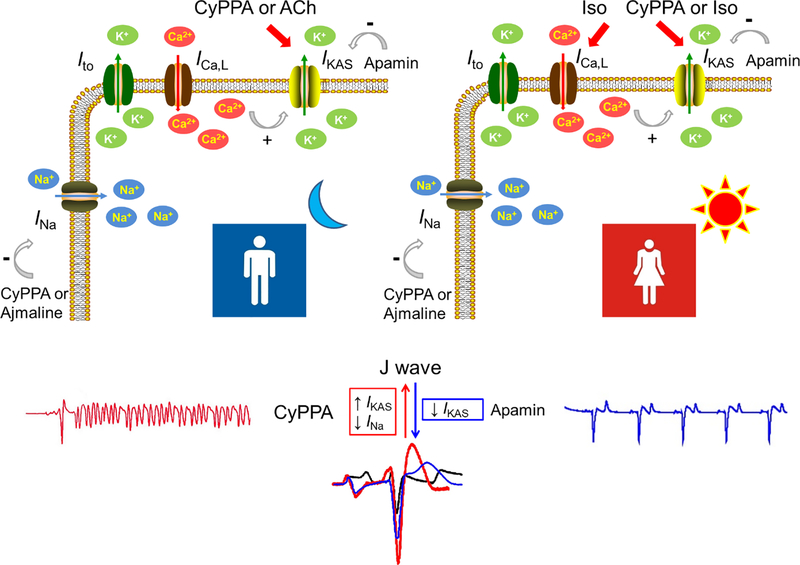
Apamin-sensitive small-conductance calcium-activated potassium (SK) current (I) plays an important role in cardiac repolarization under a variety of physiological and pathological conditions. The regulation of cardiac I relies on SK channel expression, intracellular Ca, and interaction between SK channel and intracellular Ca. I activation participates in multiple types of arrhythmias, including atrial fibrillation, ventricular tachyarrhythmias, and automaticity and conduction abnormality. Recently, sex dimorphisms in autonomic control have been noticed in I activation, resulting in sex-differentiated action potential morphology and arrhythmogenesis. This review provides an update on the Ca-dependent regulation of cardiac I and the role of I on arrhythmias, with a special focus on sex differences in I activation. We propose that sex dimorphism in autonomic control of I may play a role in J wave syndrome.
钙激活小电导钾通道(SK)电流(I)在多种生理和病理条件下对心脏复极化起着重要作用。心脏 I 的调节依赖于 SK 通道表达、细胞内 Ca 和 SK 通道与细胞内 Ca 的相互作用。I 的激活参与了多种类型的心律失常,包括心房颤动、室性心动过速和自动性及传导异常。最近,人们注意到 I 激活中的自主神经控制存在性别二态性,导致动作电位形态和心律失常发生的性别差异。本综述介绍了心脏 I 的 Ca 依赖性调节以及 I 在心律失常中的作用,特别关注了 I 激活中的性别差异。我们提出,I 的自主神经控制的性别二态性可能在 J 波综合征中起作用。