Hoffman Carson, Periyasamy Sarvesh, Longhurst Colin, Medero Rafael, Roldan-Alzate Alejandro, Speidel Michael A, Laeseke Paul F
Department of Medical Physics, University of Wisconsin - Madison, 1111 Highland Ave, Madison, WI, 53705, USA.
Department of Biomedical Engineering, University of Wisconsin - Madison, 1111 Highland Ave, Madison, WI, 53705, USA.
CVIR Endovasc. 2021 Jan 7;4(1):11. doi: 10.1186/s42155-020-00199-y.
2D digital subtraction angiography (DSA) is utilized qualitatively to assess blood velocity changes that occur during arterial interventions. Quantitative angiographic metrics, such as blood velocity, could be used to standardize endpoints during angiographic interventions.
To assess the accuracy and precision of a quantitative 2D DSA (qDSA) technique and to determine its feasibility for in vivo measurements of blood velocity.
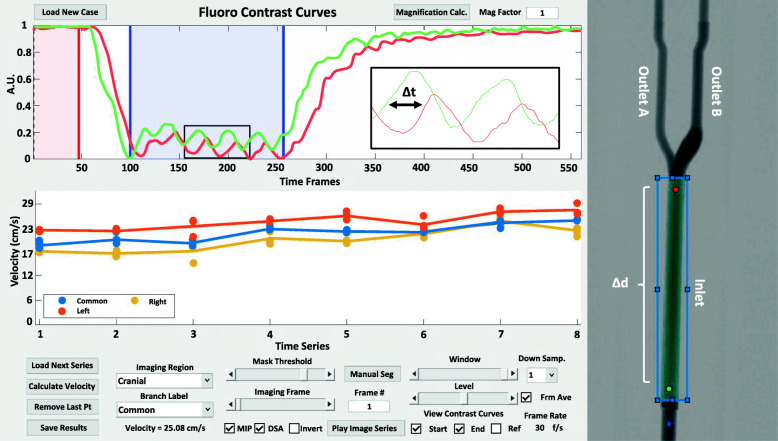
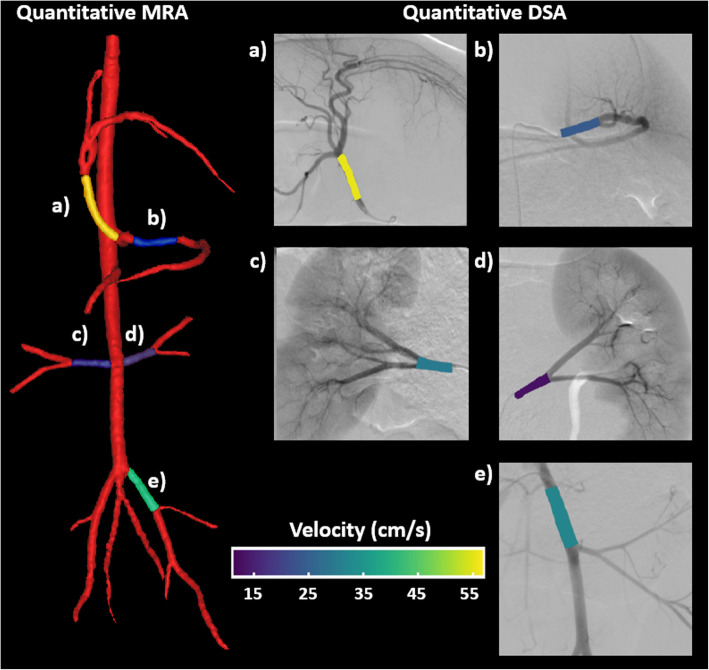
A quantitative DSA technique was developed to calculate intra-procedural blood velocity. In vitro validation was performed by comparing velocities from the qDSA method and an ultrasonic flow probe in a bifurcation phantom. Parameters of interest included baseline flow rate, contrast injection rate, projection angle, and magnification. In vivo qDSA analysis was completed in five different branches of the abdominal aorta in two 50 kg swine and compared to 4D Flow MRI. Linear regression, Bland-Altman, Pearson's correlation coefficient and chi squared tests were used to assess the accuracy and precision of the technique.
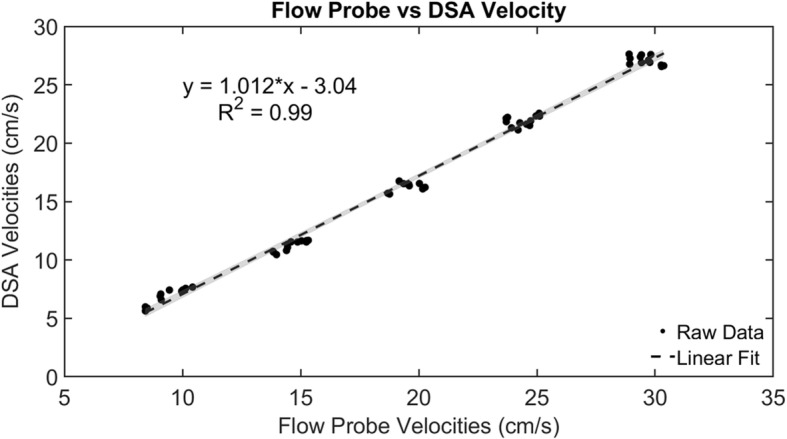
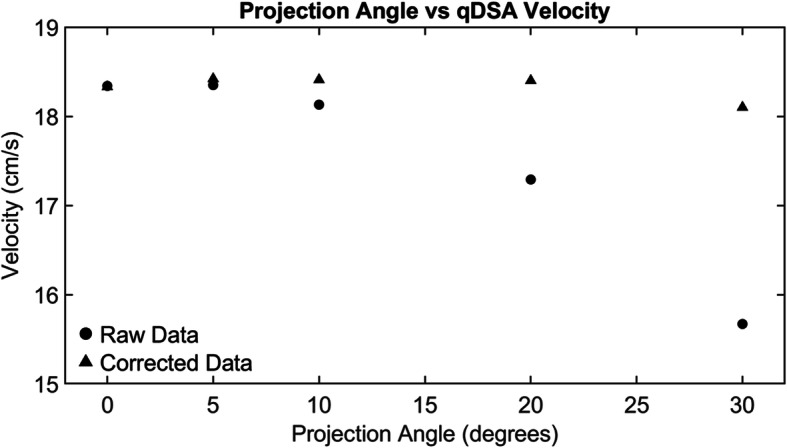
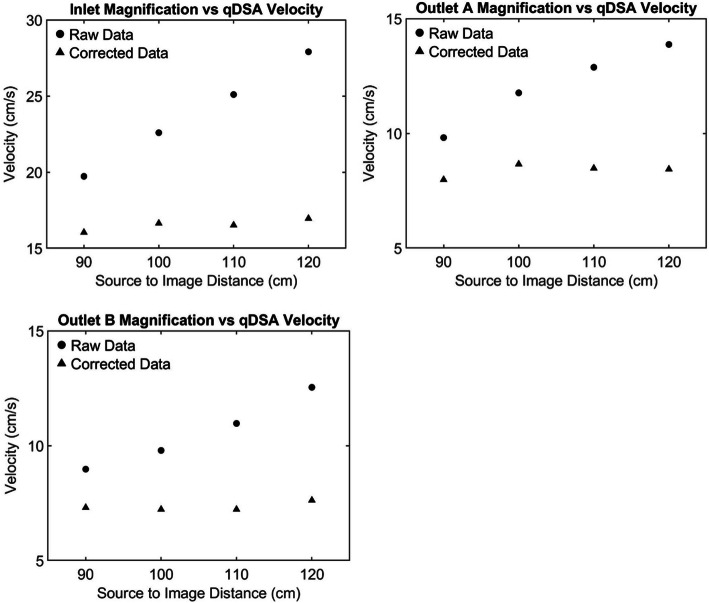
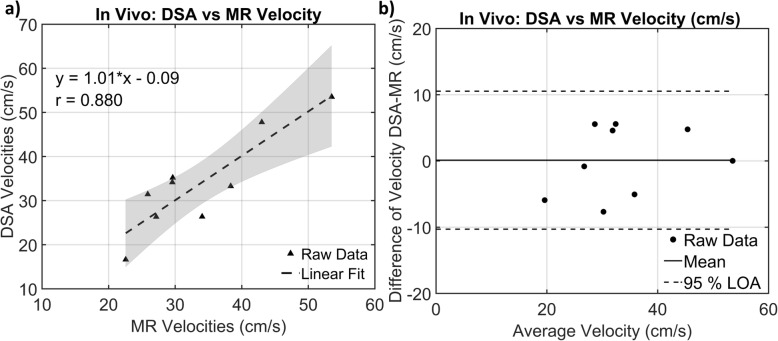
In vitro validation showed strong correlation between qDSA and flow probe velocities over a range of contrast injection and baseline flow rates (slope = 1.012, 95% CI [0.989,1.035], Pearson's r = 0.996, p < .0001). The application of projection angle and magnification corrections decreased variance to less than 5% the average baseline velocity (p = 0.999 and p = 0.956, respectively). In vivo validation showed strong correlation with a small bias between qDSA and 4D Flow MRI velocities for all five abdominopelvic arterial vessels of interest (slope = 1.01, Pearson's r = 0.880, p = <.01, Bias = 0.117 cm/s).
The proposed method allows for accurate and precise calculation of blood velocities, in near real-time, from time resolved 2D DSAs.
二维数字减影血管造影(DSA)用于定性评估动脉介入过程中发生的血流速度变化。血管造影定量指标,如血流速度,可用于标准化血管造影介入过程中的终点。
评估定量二维DSA(qDSA)技术的准确性和精密度,并确定其在体内测量血流速度的可行性。
开发了一种定量DSA技术来计算术中血流速度。通过在分叉模型中比较qDSA方法和超声流量探头的速度进行体外验证。感兴趣的参数包括基线流速、造影剂注射速率、投影角度和放大倍数。在两头50公斤的猪的腹主动脉的五个不同分支中完成了体内qDSA分析,并与四维血流磁共振成像(4D Flow MRI)进行比较。使用线性回归、布兰德-奥特曼分析、皮尔逊相关系数和卡方检验来评估该技术的准确性和精密度。
体外验证显示,在一系列造影剂注射和基线流速范围内,qDSA与流量探头速度之间具有强相关性(斜率=1.012,95%置信区间[0.989,1.035],皮尔逊相关系数r=0.996,p<0.0001)。投影角度和放大倍数校正的应用将方差降低到平均基线速度的5%以下(分别为p=0.999和p=0.956)。体内验证显示,对于所有五条感兴趣的腹盆腔动脉血管,qDSA与4D Flow MRI速度之间具有强相关性且偏差较小(斜率=1.01,皮尔逊相关系数r=0.880,p<0.01,偏差=0.117厘米/秒)。
所提出的方法能够从时间分辨二维DSA中近乎实时地准确精确计算血流速度。