Laboratory of BioNanoTechnology, Wageningen University & Research, AXIS Building, Bornse Weilanden 9, 6708 WG, Wageningen, The Netherlands.
Interventional Molecular Imaging Laboratory, Department of Radiology, Leiden University Medical Center, Albinusdreef 2, 2300 RC, Leiden, The Netherlands.
ACS Nano. 2021 Jan 26;15(1):1666-1674. doi: 10.1021/acsnano.0c09322. Epub 2021 Jan 7.
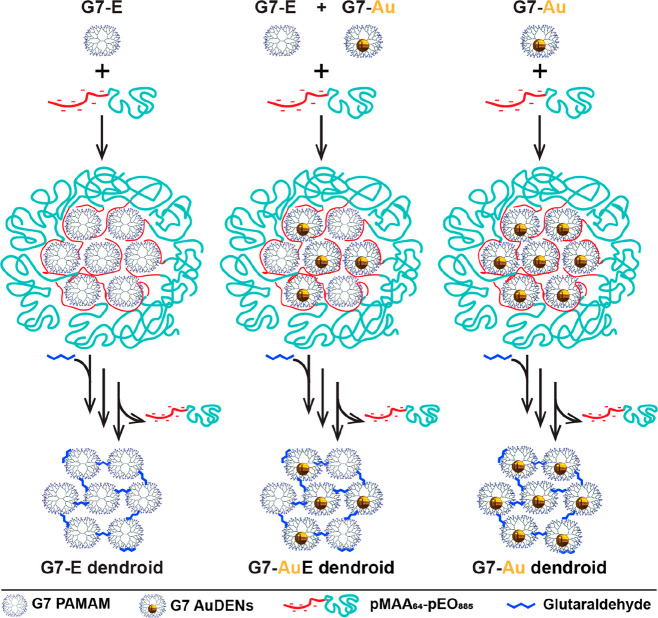
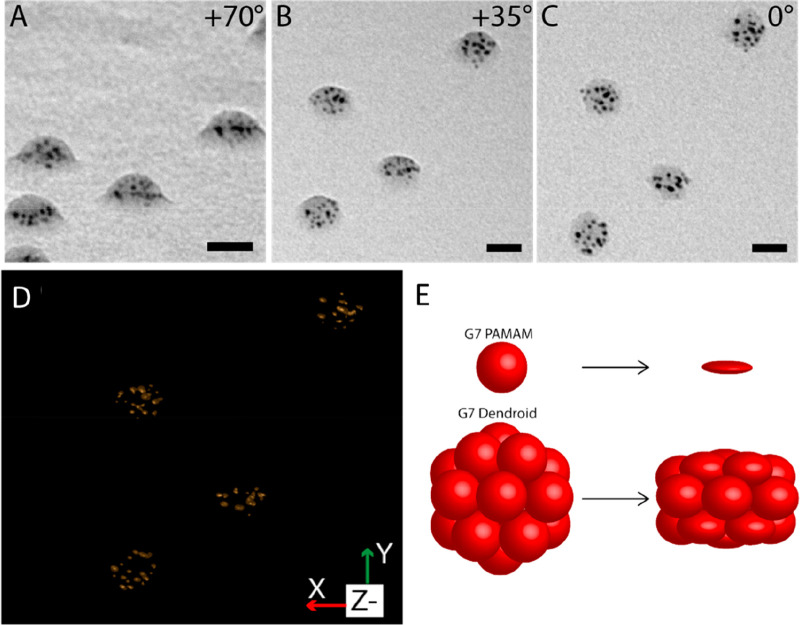
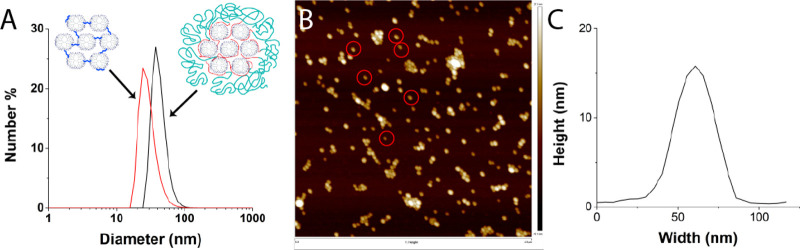
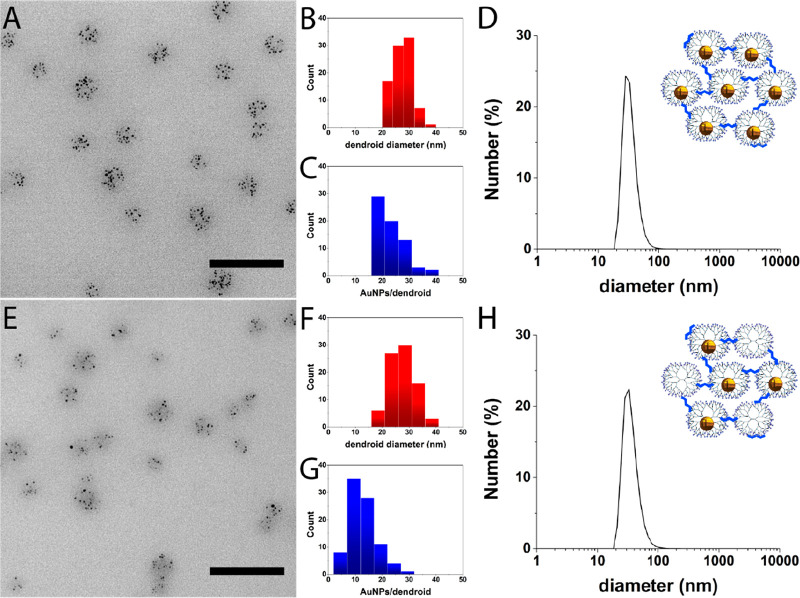
A versatile method is presented to form dendrimer superstructures by exploiting coacervate-core micelles as a template to confine and organize the hyperbranched macromolecules. First, complex coacervate-core micelles are formed from negative-neutral block copolymers and positively charged polyamidoamine dendrimers. The dendrimers inside the micellar core are then covalently cross-linked with each other upon addition of glutaraldehyde. After removal of the block copolymer from the assembly by increasing the salt concentration, consecutively, the formed Schiff bases cross-linking the dendrimers are reduced to amines, followed by a final dialysis step. This leads to well-defined covalently cross-linked nanostructures, coined dendroids, with a size of around 30 nm in diameter and a molecular weight of approximately 2.5 MDa. By incorporating dendrimer-encapsulated gold nanoparticles (AuDENs) into the micelle template strategy, the aggregation number of dendrimers inside the dendroids is determined by counting the nanoparticles in TEM micrographs. Furthermore, TEM performed at different tilt angles and AFM analysis corroborate formation of stable, covalently linked three-dimensional structures. Reconstruction of the TEM tilt series results in a tomogram further illustrating the 3D distribution of the gold nanoparticles, and hence the individual dendrimers, in the nanostructure. These dendroids appear to have a hard, poorly compressible core and a relatively soft outside. The versatility of the hierarchical building up of the supermolecules is illustrated by the controlled and synchronous incorporation of empty dendrimers and AuDENs into a single hybrid dendroid structure. The presented strategy allows for the preparation of a variety of classes of supermolecules, depending on the type of micellar-core macromolecule, .., dendrimer, cross-linker, and nanoparticles, used. Considering the broad interest in dendrimers as well as micelles in a plethora of research areas, .., (targeted) drug delivery, biomedical imaging, theragnostics, and catalysis, there is a great potential for dendroids and related classes of covalently linked macromolecules, ., supermolecules.
提出了一种通用的方法,通过利用凝聚核胶束作为模板来限制和组织超支化大分子,从而形成树状大分子超结构。首先,由带负电的中性嵌段共聚物和带正电荷的聚酰胺胺树状大分子形成复杂的凝聚核胶束。然后,在加入戊二醛后,胶束核内的树状大分子彼此共价交联。通过增加盐浓度从组装体中除去嵌段共聚物后,形成的席夫碱交联树突进一步还原为胺,最后进行透析步骤。这导致形成尺寸约为 30nm 直径和分子量约为 2.5MDa 的定义明确的共价交联纳米结构,称为树状类。通过将树状大分子包封的金纳米粒子(AuDENs)掺入胶束模板策略中,通过在 TEM 显微照片中计数纳米粒子来确定树状类内树状大分子的聚集数。此外,在不同倾斜角度下进行的 TEM 和 AFM 分析证实了稳定的、共价连接的三维结构的形成。TEM 倾斜系列的重建导致断层摄影进一步说明了金纳米粒子的 3D 分布,从而说明了纳米结构中各个树状大分子的分布。这些树状类似乎具有坚硬、不易压缩的核心和相对柔软的外部。通过将空树状大分子和 AuDENs 受控且同步地掺入单个混合树状类结构中,展示了超分子的分级构建的多功能性。所提出的策略允许根据所使用的胶束核大分子、树状大分子、交联剂和纳米粒子的类型制备各种类别的超分子。考虑到在众多研究领域中对树状大分子和胶束的广泛兴趣,例如靶向药物传递、生物医学成像、治疗学和催化,树状类和相关类别的共价连接的大分子,例如超分子具有很大的潜力。