Gao Yan, Wang Kaiyu, Zhang Jin, Duan Xingmei, Sun Qiu, Men Ke
State Key Laboratory of Biotherapy and Cancer Center West China Hospital of Sichuan University Chengdu Sichuan Province China.
Department of Pharmacy Personalized Drug Therapy Key Laboratory of Sichuan Province Sichuan Academy of Medical Sciences & Sichuan Provincial People's Hospital School of Medicine University of Electronic Science and Technology of China Chengdu Sichuan Province China.
MedComm (2020). 2023 Jan 11;4(1):e187. doi: 10.1002/mco2.187. eCollection 2023 Feb.
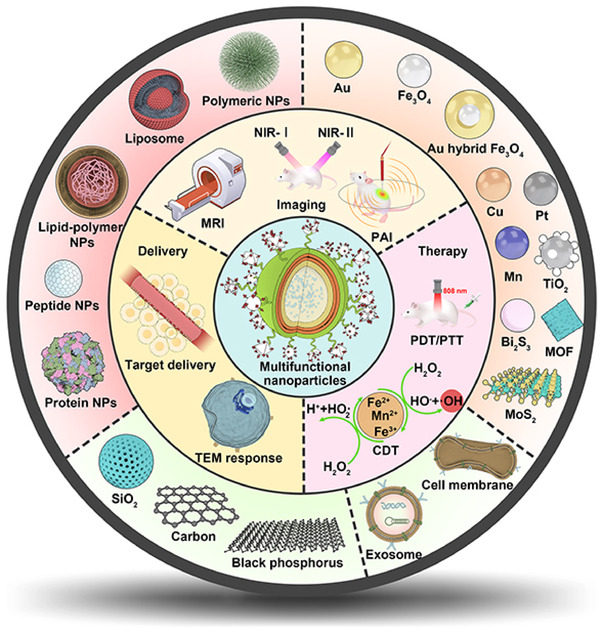
Cancer is a complex disease associated with a combination of abnormal physiological process and exhibiting dysfunctions in multiple systems. To provide effective treatment and diagnosis for cancer, current treatment strategies simultaneously focus on various tumor targets. Based on the rapid development of nanotechnology, nanocarriers have been shown to exhibit excellent potential for cancer therapy. Compared with nanoparticles with single functions, multifunctional nanoparticles are believed to be more aggressive and potent in the context of tumor targeting. However, the development of multifunctional nanoparticles is not simply an upgraded version of the original function, but involves a sophisticated system with a proper backbone, optimized modification sites, simple preparation method, and efficient function integration. Despite this, many well-designed multifunctional nanoparticles with promising therapeutic potential have emerged recently. Here, to give a detailed understanding and analyzation of the currently developed multifunctional nanoparticles, their platform structures with organic or inorganic backbones were systemically generalized. We emphasized on the functionalization and modification strategies, which provide additional functions to the nanoparticle. We also discussed the application combination strategies that were involved in the development of nanoformulations with functional crosstalk. This review thus provides an overview of the construction strategies and application advances of multifunctional nanoparticles.
癌症是一种复杂的疾病,与异常的生理过程以及多个系统的功能障碍相关。为了对癌症进行有效的治疗和诊断,当前的治疗策略同时聚焦于各种肿瘤靶点。基于纳米技术的快速发展,纳米载体已显示出在癌症治疗方面的巨大潜力。与具有单一功能的纳米颗粒相比,多功能纳米颗粒在肿瘤靶向方面被认为更具攻击性和效力。然而,多功能纳米颗粒的开发并非简单地是原始功能的升级版,而是涉及一个复杂的系统,该系统要有合适的骨架、优化的修饰位点、简单的制备方法以及高效的功能整合。尽管如此,最近已经出现了许多具有良好治疗潜力的精心设计的多功能纳米颗粒。在此,为了详细了解和分析当前开发的多功能纳米颗粒,对其具有有机或无机骨架的平台结构进行了系统总结。我们强调了功能化和修饰策略,这些策略为纳米颗粒赋予了额外的功能。我们还讨论了在具有功能串扰的纳米制剂开发中所涉及的应用组合策略。因此,本综述提供了多功能纳米颗粒的构建策略和应用进展的概述。