Trauma TopCare, ETZ Hospital (Elisabeth-TweeSteden Ziekenhuis), Tilburg, The Netherlands.
Center of Research on Psychological and Somatic Disorders, Department of Medical and Clinical Psychology, Tilburg University, Tilburg, The Netherlands.
PLoS One. 2021 Jan 7;16(1):e0245198. doi: 10.1371/journal.pone.0245198. eCollection 2021.
Injury can have physical, psychological and social consequences. It is unclear which factors have an impact on patients' wellbeing after injury. This study aimed to explore, using focus groups, patients' experiences and wellbeing after injury and which factors, impede or facilitate patients' wellbeing.
Trauma patients, treated in the shock room of the Elisabeth-TweeSteden Hospital, the Netherlands, participated in focus groups. Purposive sampling was used. Exclusion criteria were younger than 18 years old, severe traumatic brain injury, dementia, and insufficient knowledge of the Dutch language. The interviews were recorded, transcribed verbatim, and analyzed using coding technique open, axial, and selective coding, based on phenomenological approach.
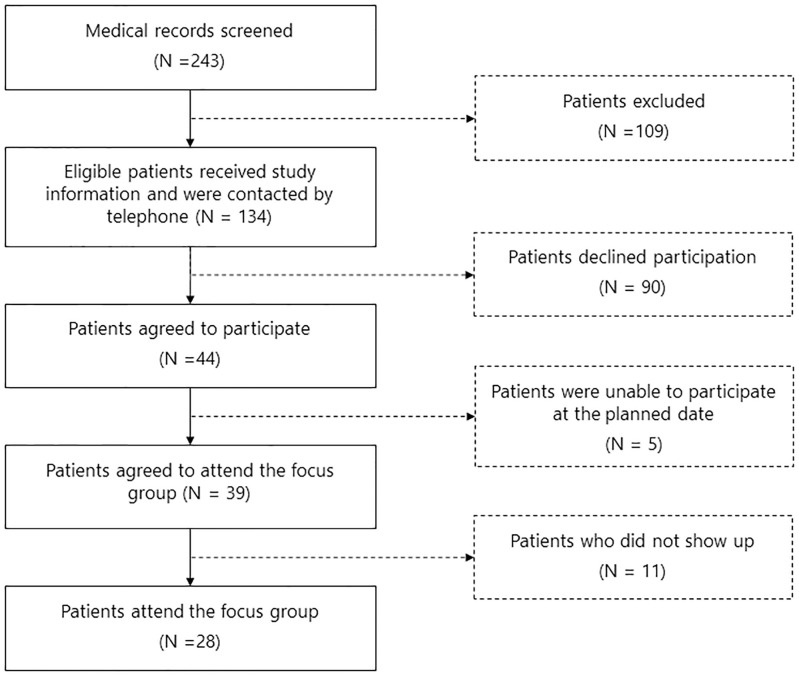
Six focus groups (3 to 7 participants) were held before data saturation was reached. In total, 134 patients were invited, 28 (21%) agreed to participate (Median age: 59.5; min. 18 -max. 84). Main reasons to decline were fear that the discussion would be too confronting or patients experienced no problems regarding the trauma or treatment. Participants experienced difficulties on physical (no recovery to pre-trauma level), psychological (fear of dying or for permanent limitations, symptoms of posttraumatic stress disorder, cognitive dysfunction), social (impact on relatives and social support) wellbeing. These are impeding factors for recovery. However, good communication, especially clarity about the injury and expectations concerning recovery and future perspectives could help patients in surrendering to care. Patients felt less helpless when they knew what to expect.
This is the first study that explored patients' experiences and wellbeing after injury. Patients reported that their injury had an impact on their physical, psychological, and social wellbeing up to 12 months after injury. Professionals with the knowledge of consequences after injury could improve their anticipation on patients' need.
伤害会带来身体、心理和社会方面的后果。目前尚不清楚哪些因素会对患者受伤后的幸福感产生影响。本研究旨在通过焦点小组探讨创伤患者受伤后的经历和幸福感,以及哪些因素会阻碍或促进患者的幸福感。
荷兰伊丽莎白-特温斯特登医院休克室收治的创伤患者参与了焦点小组。采用目的抽样法。排除标准为年龄小于 18 岁、严重颅脑损伤、痴呆和荷兰语知识不足。访谈进行了录音,并使用基于现象学方法的开放式、轴向和选择性编码技术进行了逐字转录和分析。
在达到数据饱和之前,共进行了 6 个焦点小组(每组 3-7 名参与者)。共邀请了 134 名患者,28 名(21%)同意参加(中位数年龄:59.5;最小 18 岁,最大 84 岁)。拒绝的主要原因是担心讨论过于棘手,或者患者在创伤或治疗方面没有问题。参与者在身体方面(无法恢复到受伤前的水平)、心理方面(对死亡或永久限制的恐惧、创伤后应激障碍症状、认知功能障碍)和社会方面(对亲属的影响和社会支持)都存在幸福感困难。这些都是康复的阻碍因素。然而,良好的沟通,特别是对受伤情况的明确说明,以及对康复和未来前景的期望,都可以帮助患者接受治疗。当患者知道自己的期望时,他们会感到不那么无助。
这是第一项探讨患者受伤后经历和幸福感的研究。患者报告说,他们的受伤对他们受伤后 12 个月内的身体、心理和社会幸福感产生了影响。了解受伤后果的专业人员可以提高他们对患者需求的预期。