Institute of Health and Environment, Seoul National University, Gwanak-ro, Seoul, 08826, Republic of Korea.
Department of Biostatistics and Epidemiology, Graduate School of Public Health, Seoul National University, Gwanak-gu, Seoul, 00826, Republic of Korea.
BMC Public Health. 2021 Jan 7;21(1):68. doi: 10.1186/s12889-020-10067-y.
Dust storms affect human health by impairing visibility and promoting interactions with microscopic organisms, such as bacteria and fungi. Although ST-elevation MI (STEMI) and non-ST-elevation MI (NSTEMI) differ mechanistically, few studies have investigated the incidence of cardiovascular diseases according to infarction type; these studies have yielded inconsistent findings. This study aimed to examine whether PM size (< 2.5 μm (PM) and < 10 μm (PM)) modifies the effect of Asian dust on acute myocardial infarction (AMI), with separate analyses for STEMI and NSTEMI.
MI-related data from 9934 emergency visits were collected from the Korea AMI Registry from 2005 to 2017. Asian dust events were defined as days with visibility of ≤10 km. Generalized linear models were used to analyze data with natural cubic splines. To examine potential modifiers, analyses were stratified by age, smoking status, and body mass index (BMI).
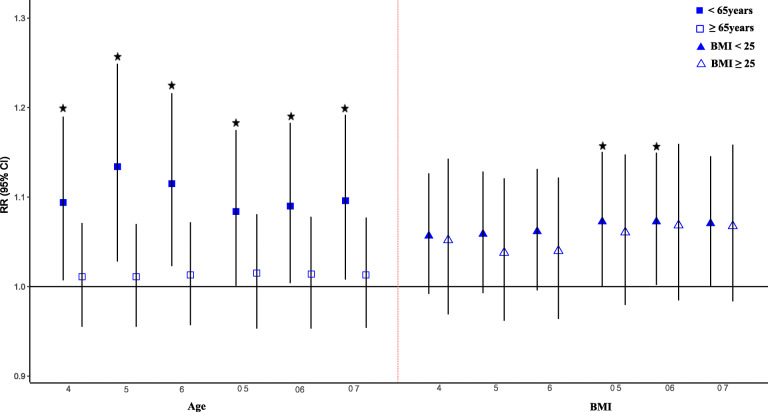
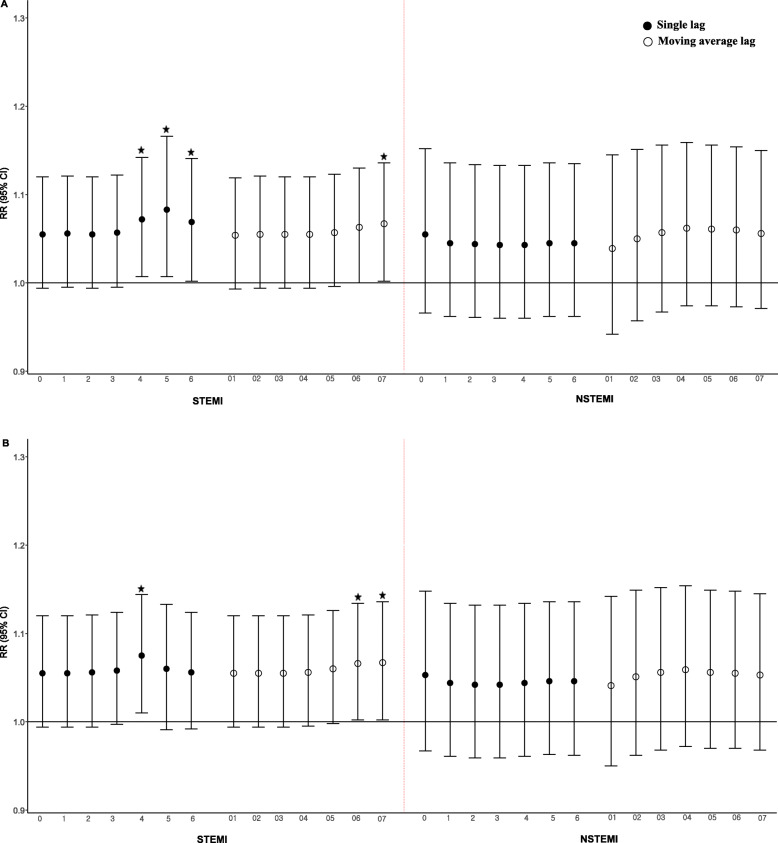
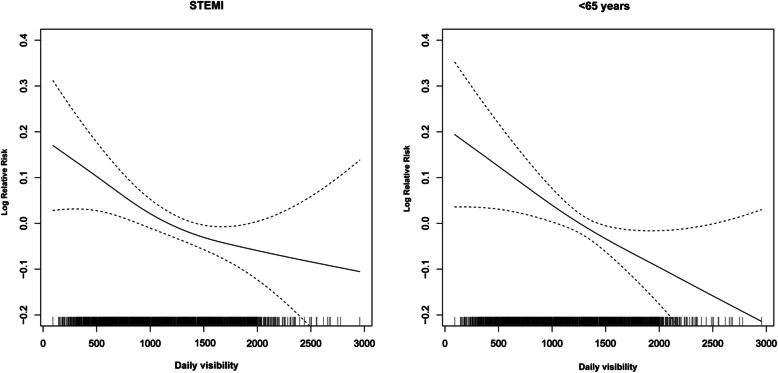
No significant associations were observed between Asian dust and AMI. By adjusting for different lag structures, a significant effect was exclusively observed in STEMI. For moving average lags, the largest value at lag 5 (relative risk [RR] 1.083; 95% confidence interval [CI], 1.007-1.166) for single and lags 0-7 (RR 1.067; 95% CI: 1.002-1.136) was observed for PM; for PM, the largest significant effect was observed at lag 4 (RR 1.075; 95% CI: 1.010-1.144) for single and lags 0-7 (RR 1.067; 95% CI: 1.002-1.136). RRs were significantly higher in < 65-year-olds than in ≥65-year-olds. Additionally, RRs between the BMI < 25 and BMI ≥ 25 groups were not different; statistically significant effects were observed for concentration at lags 0-5 (RR: 1.073; 95% CI: 1.002-1.150) and lags 0-6 (RR: 1.071; 95% CI: 1.001-1.146) in the BMI < 25 group. A negative exposure-response association was observed between daily average visibility-adjusted PM and STEMI and daily average visibility-adjusted PM in < 65-year-olds.
Reducing PM and PM emissions, particularly during the days of Asian dust, may be crucial and reduce STEMI and AMI incidence among < 65-year-olds. These results indicate that the Asian dust alarm system needs revision to protect vulnerable populations.
沙尘暴通过降低能见度和促进与细菌和真菌等微生物的相互作用来影响人类健康。虽然 ST 段抬高型心肌梗死 (STEMI) 和非 ST 段抬高型心肌梗死 (NSTEMI) 在机制上有所不同,但很少有研究根据梗死类型调查心血管疾病的发病率;这些研究得出的结果不一致。本研究旨在根据 STEMI 和 NSTEMI 分别分析,研究 PM 大小(<2.5μm(PM)和<10μm(PM))是否会改变亚洲沙尘对急性心肌梗死 (AMI) 的影响。
从 2005 年至 2017 年,从韩国 AMI 登记处收集了 9934 次急诊就诊的与 MI 相关的数据。亚洲沙尘事件被定义为能见度≤10km 的日子。使用广义线性模型对具有自然三次样条的数据分析。为了检验潜在的调节剂,根据年龄、吸烟状况和体重指数 (BMI) 进行分层分析。
亚洲沙尘与 AMI 之间无显著关联。通过调整不同的滞后结构,仅在 STEMI 中观察到显著影响。对于移动平均滞后,单个滞后 5 的最大值(相对风险 [RR] 1.083;95%置信区间 [CI],1.007-1.166)和滞后 0-7(RR 1.067;95% CI:1.002-1.136)观察到 PM;对于 PM,最大的显著影响发生在单个滞后 4(RR 1.075;95% CI:1.010-1.144)和滞后 0-7(RR 1.067;95% CI:1.002-1.136)。<65 岁者的 RR 明显高于≥65 岁者。此外,BMI<25 组和 BMI≥25 组之间的 RR 无差异;在 BMI<25 组中,滞后 0-5(RR:1.073;95% CI:1.002-1.150)和滞后 0-6(RR:1.071;95% CI:1.001-1.146)观察到统计学显著影响。在<65 岁者中,每日平均可见度调整后的 PM 和 STEMI 与每日平均可见度调整后的 PM 之间呈负暴露反应关系。
减少 PM 和 PM 排放,特别是在亚洲沙尘天气期间,可能至关重要,可以降低<65 岁人群中 STEMI 和 AMI 的发病率。这些结果表明,亚洲沙尘警报系统需要修订,以保护弱势群体。