Zhang Qian, Qi Weipeng, Yao Wei, Wang Mei, Chen Yiyong, Zhou Yujie
Department of Emergency, Anzhen Hospital, Capital Medical University.
J Epidemiol. 2016 Oct 5;26(10):538-545. doi: 10.2188/jea.JE20150209. Epub 2016 Apr 9.
Epidemiology studies have shown a consistently increased risk of acute myocardial infarction (AMI) correlated with particulate matter (PM) exposure. However, little is known about the association with specific AMI subtypes. In this work, we investigated the association between short-term PM exposure and emergency department visits (EDVs) for AMI, ST-elevation myocardial infarction (STEMI), and non-ST-elevation myocardial infarction (NSTEMI).
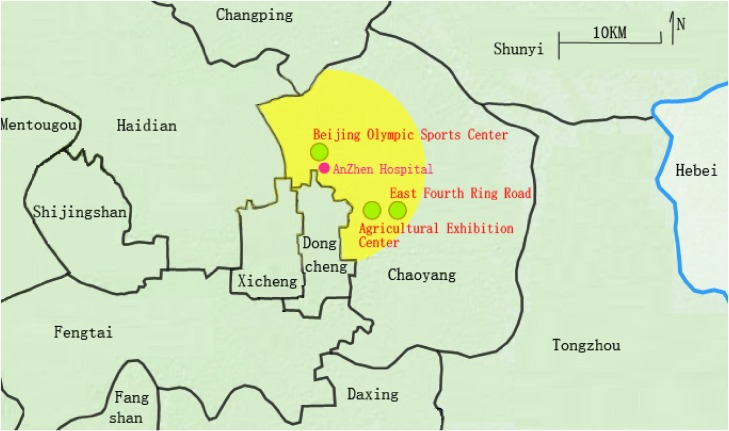
We based this case-crossover study on 2749 patients from Chaoyang District hospitalized with AMI in Anzhen Hospital during 2014. Meteorological and air pollution data were collected during this period. We used a time-stratified case-crossover design with lag model, adjusted for meteorological conditions and/or other gaseous pollutants, to estimate risk of EDVs for AMI, STEMI, and NSTEMI. We conducted stratified analyses by gender, age, season, and comorbid conditions to examine potential effect modification.
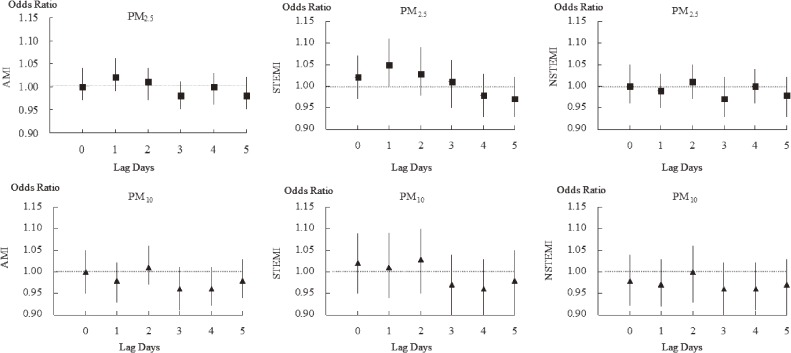
We found that each 10 µg/m increment of PM concentration (1-day lagged) was associated with an increased risk of EDVs for STEMI (OR 1.05; 95% CI, 1.00-1.11). We found no association of PM concentration with overall AMI or NSTEMI. No effect modification was found when stratified by gender, season, or comorbid conditions, even though the effect size was larger in patients who were male, smokers, and comorbid with hypertension. Patients aged ≥65 years showed a significantly increased risk of STEMI associated with PM in the previous day than those aged <65 years.
Our study indicated a transient effect of short-term PM exposure on EDVs for STEMI. Patients aged ≥65 years appeared to be particularly susceptible. Our findings suggest that studies of the association between PM exposure and AMI should consider AMI subtypes, lag times, and individual characteristics.
流行病学研究表明,接触颗粒物(PM)与急性心肌梗死(AMI)风险持续增加相关。然而,对于与特定AMI亚型的关联知之甚少。在本研究中,我们调查了短期PM暴露与因AMI、ST段抬高型心肌梗死(STEMI)及非ST段抬高型心肌梗死(NSTEMI)而进行的急诊就诊(EDV)之间的关联。
本病例交叉研究基于2014年期间在安贞医院住院治疗的2749例朝阳区AMI患者。在此期间收集了气象和空气污染数据。我们采用时间分层病例交叉设计及滞后模型,对气象条件和/或其他气态污染物进行校正,以估计因STEMI、NSTEMI及AMI而进行急诊就诊的风险。我们按性别、年龄、季节和合并症进行分层分析,以检验潜在的效应修饰。
我们发现,PM浓度每增加10μg/m³(滞后1天)与STEMI急诊就诊风险增加相关(比值比1.05;95%置信区间,1.00 - 1.11)。我们未发现PM浓度与总体AMI或NSTEMI之间存在关联。按性别、季节或合并症分层时未发现效应修饰,尽管在男性、吸烟者及合并高血压的患者中效应量更大。≥65岁的患者与<65岁的患者相比,前一天PM暴露与STEMI风险显著增加相关。
我们的研究表明短期PM暴露对STEMI急诊就诊有短暂影响。≥65岁的患者似乎特别易感。我们的研究结果表明,PM暴露与AMI之间关联的研究应考虑AMI亚型、滞后时间及个体特征。