Department of Nuclear Medicine, 108 Central Military Hospital, 1st Tran Hung Dao, Hai Ba Trung, Ha Noi, Vietnam.
Washington University School of Medicine, Mallinckrodt Institute of Radiology, St Louis, MO, USA.
Cancer Imaging. 2021 Jan 7;21(1):8. doi: 10.1186/s40644-020-00378-z.
In this study, we investigated the relationship between clinicopathologic factors, BRAF mutation status and [F] F-fluoro-2-deoxyglucose (FDG) avidity in patients with radioiodine (RAI)-negative recurrent or metastatic differentiated thyroid cancer (DTC).
From 2015 to 2018 all patients with suspected recurrent or metastatic radioiodine-negative DTC patients who underwent FDG positron emission tomography/computed tomography (PET/CT) were retrospectively reviewed. Suspected lesions on FDG PET/CT were biopsied and underwent BRAF mutation testing by immunohistochemistry and real-time PCR. Tumor size, recurrent versus metastatic disease, histopathologic features including classical type versus aggressive subtypes (poorly differentiated, tall cell, columnar cell, hobnail variants) and BRAF mutation status were correlated with the SUVmax of highest hypermetabolic lesions on FDG PET/CT by the univariate analysis using logistic regression.
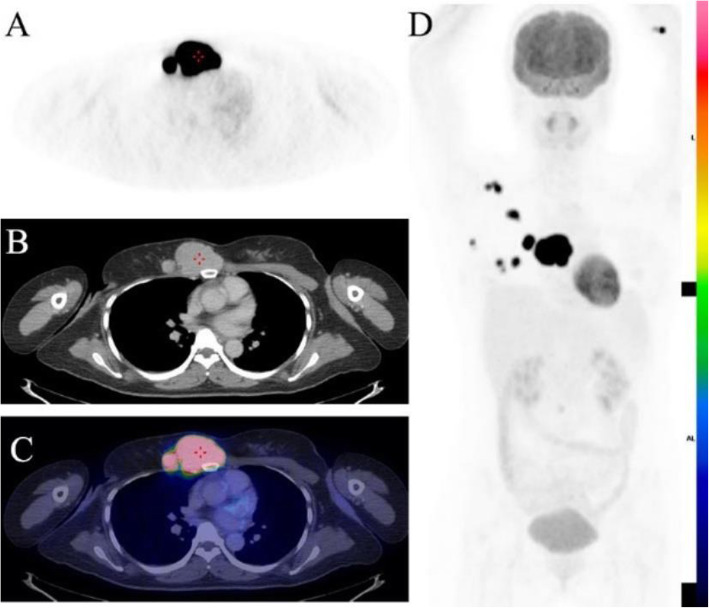
Sixty-three consecutive patients, 55 (87.3%) female, with median age of 48 (range 17-81) were included. The majority of patients had BRAF mutation and classical subtype, 55/63 (87.3%) and 45/63(71.4%), respectively. Thyroglobulin at the time of suspected recurrence was 262.7 ng/ml (range 16.3-1000) and patients received a median 3 prior RAI treatments. Fifty-four patients (85.7%) had local recurrence. The majority of patients 58/63 (92.1%) had FDG-avid disease on PET/CT. On univariate analysis, tumor size aggressive histopathologic types and distant metastasis are the significant factors for predicting FDG uptake, p = 0.04, p = 0.001 and p = 0.004 respectively. Although FDG uptake of BRAF bearing recurrent/metastatic RAIR DTC lesions was higher than those without the mutation, the difference did not reach statistical significance, SUVmax of 7.11 versus 4.91, respectively, p = 0.2.
The majority of recurrent or metastatic RAI-negative DTC have BRAF mutation and detectable disease on FDG PET/CT. FDG avidity of the recurrent or metastatic RAI-negative DTC is independently associated with the aggressive histopathologic features.
本研究旨在探讨 BRAF 基因突变状态与放射性碘(RAI)阴性复发性或转移性分化型甲状腺癌(DTC)患者的[F]氟-2-脱氧葡萄糖(FDG)摄取之间的关系。
回顾性分析 2015 年至 2018 年所有疑似复发性或转移性 RAI 阴性 DTC 患者的 FDG 正电子发射断层扫描/计算机断层扫描(PET/CT)资料。对 FDG PET/CT 可疑病灶进行活检,并通过免疫组织化学和实时 PCR 检测 BRAF 基因突变。使用单变量分析中的逻辑回归,将肿瘤大小、复发性与转移性疾病、组织病理学特征(包括经典型与侵袭性亚型[低分化、高柱状细胞、柱状细胞、钉状细胞变异型])和 BRAF 突变状态与 FDG PET/CT 上最高代谢活跃病灶的 SUVmax 进行相关性分析。
共纳入 63 例连续患者,其中 55 例(87.3%)为女性,中位年龄为 48 岁(范围 17-81 岁)。大多数患者存在 BRAF 突变和经典型,分别为 55/63(87.3%)和 45/63(71.4%)。怀疑复发时的甲状腺球蛋白为 262.7ng/ml(范围 16.3-1000),且中位接受了 3 次 RAI 治疗。54 例(85.7%)患者有局部复发。63 例患者中,58 例(92.1%)PET/CT 显示 FDG 摄取阳性。单因素分析显示,肿瘤大小、侵袭性组织病理学类型和远处转移是预测 FDG 摄取的显著因素,p=0.04、p=0.001 和 p=0.004。尽管携带 BRAF 基因突变的复发性/转移性 RAI 阴性 DTC 病灶的 FDG 摄取高于无突变者,但差异无统计学意义,SUVmax 分别为 7.11 与 4.91,p=0.2。
大多数 RAI 阴性复发性或转移性 DTC 存在 BRAF 突变,并可在 FDG PET/CT 上检测到疾病。复发性或转移性 RAI 阴性 DTC 的 FDG 摄取与侵袭性组织病理学特征独立相关。