Department of Nuclear Medicine, Seoul National University Hospital, 28 Yongon-Dong, Jongno-Gu, Seoul, 03080, Republic of Korea.
Department of Nuclear Medicine, National Cancer Center, 323 Ilsan-ro, Ilsandong-gu, Goyang-si, Gyeonggi-do, 10408, Republic of Korea.
BMC Cancer. 2019 Dec 30;19(1):1260. doi: 10.1186/s12885-019-6482-7.
The principle of loss of iodine uptake and increased glucose metabolism according to dedifferentiation of thyroid cancer is clinically assessed by imaging. Though these biological properties are widely applied to appropriate iodine therapy, the understanding of the genomic background of this principle is still lacking. We investigated the association between glucose metabolism and differentiation in advanced thyroid cancer as well as papillary thyroid cancer (PTC).
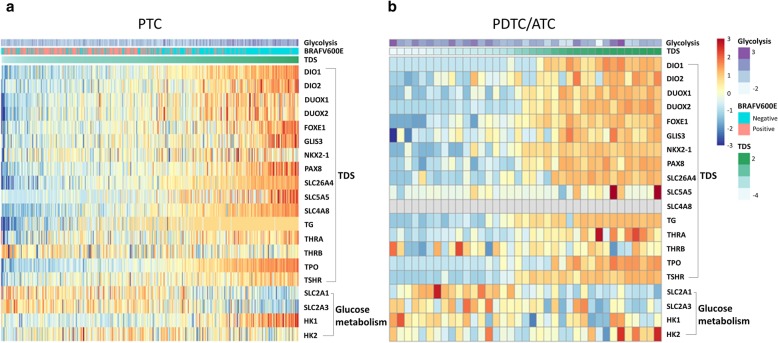
We used RNA sequencing of 505 patients with PTC obtained from the Cancer Genome Archives and microarray data of poorly-differentiated and anaplastic thyroid cancer (PDTC/ATC). The signatures of GLUT and glycolysis were estimated to assess glucose metabolic profiles. The glucose metabolic profiles were associated with tumor differentiation score (TDS) and BRAFV600E mutation status. In addition, survival analysis of glucose metabolic profiles was performed for predicting recurrence-free survival.
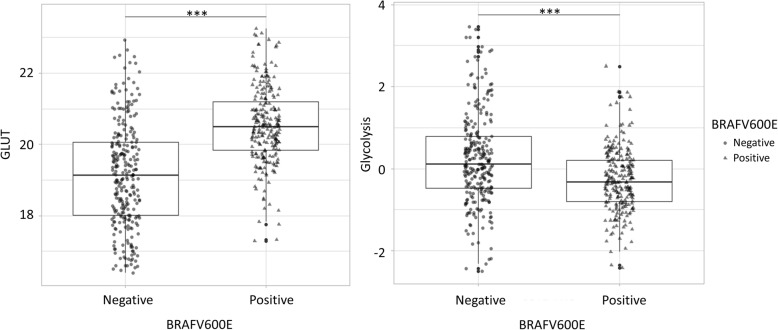
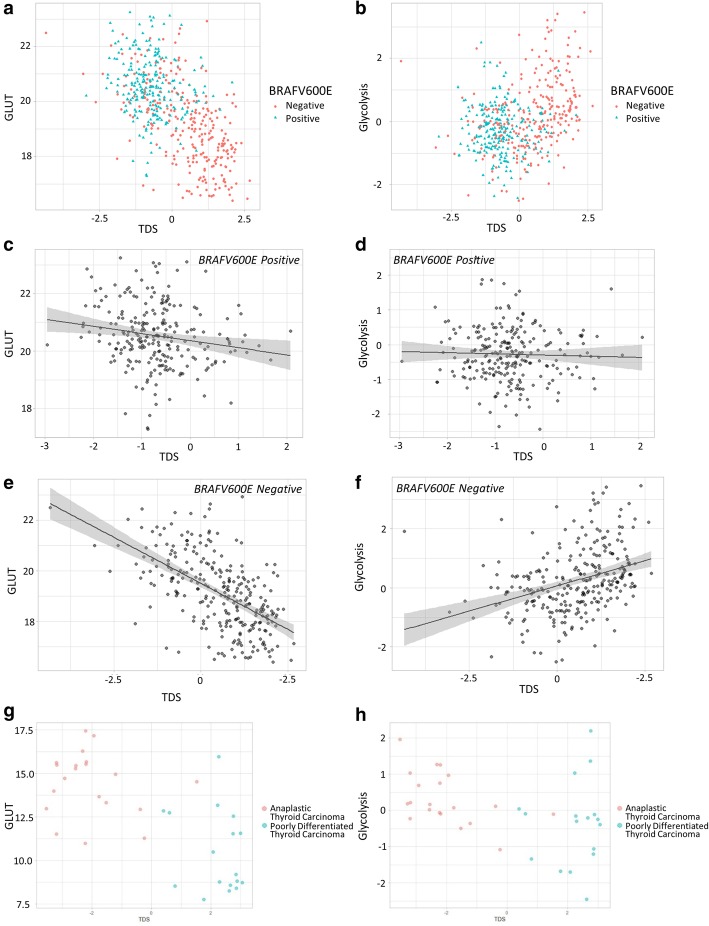
In PTC, the glycolysis signature was positively correlated with TDS, while the GLUT signature was inversely correlated with TDS. These correlations were significantly stronger in the BRAFV600E negative group than the positive group. Meanwhile, both GLUT and glycolysis signatures were negatively correlated with TDS in advanced thyroid cancer. The high glycolysis signature was significantly associated with poor prognosis in PTC in spite of high TDS. The glucose metabolic profiles are intricately associated with tumor differentiation in PTC and PDTC/ATC.
As glycolysis was an independent prognostic marker, we suggest that the glucose metabolism features of thyroid cancer could be another biological progression marker different from differentiation and provide clinical implications for risk stratification.
Not applicable.
根据甲状腺癌去分化的碘摄取损失和葡萄糖代谢增加的原理,通过影像学来临床评估。尽管这些生物学特性广泛应用于适当的碘治疗,但对这一原理的基因组背景的理解仍有所欠缺。我们研究了晚期甲状腺癌以及甲状腺乳头状癌(PTC)中葡萄糖代谢与分化之间的关系。
我们使用从癌症基因组档案中获得的 505 例 PTC 的 RNA 测序和低分化及间变性甲状腺癌(PDTC/ATC)的微阵列数据。估计 GLUT 和糖酵解特征以评估葡萄糖代谢谱。葡萄糖代谢谱与肿瘤分化评分(TDS)和 BRAFV600E 突变状态相关联。此外,还对葡萄糖代谢谱进行了生存分析,以预测无复发生存率。
在 PTC 中,糖酵解特征与 TDS 呈正相关,而 GLUT 特征与 TDS 呈负相关。在 BRAFV600E 阴性组中,这些相关性比阳性组强得多。同时,在晚期甲状腺癌中,GLUT 和糖酵解特征均与 TDS 呈负相关。尽管 TDS 较高,但高糖酵解特征与 PTC 的预后不良显著相关。葡萄糖代谢谱与 PTC 和 PDTC/ATC 的肿瘤分化密切相关。
由于糖酵解是独立的预后标志物,因此我们认为甲状腺癌的葡萄糖代谢特征可能是不同于分化的另一种生物学进展标志物,并为风险分层提供了临床意义。
不适用。