Department of Psychology, Columbia University, New York, NY, USA.
Einhorn Clinical Research Center, New York Eye and Ear Infirmary of Mount Sinai, New York, NY, USA.
Eye (Lond). 2021 Nov;35(11):2973-2982. doi: 10.1038/s41433-020-01296-x. Epub 2021 Jan 7.
To understand the problems involved in using global OCT measures for detecting progression in early glaucoma.
SUBJECTS/METHODS: Eyes from 76 patients and 28 healthy controls (HC) had a least two OCT scans at least 1 year apart. To determine the 95% confidence intervals (CI), 151 eyes (49 HC and 102 patients) had at least two scans within 6 months. All eyes had 24-2 mean deviation ≥-6dB. The average (global) thicknesses of the circumpapillary retinal nerve fibre layer (cRNFL), G, and of the retinal ganglion cell layer plus inner plexiform layer (RGCLP), G, were calculated. Using quantile regression, the 95% CI intervals were determined. Eyes outside the CIs were classified as "progressors." For a reference standard (RS), four experts evaluated OCT and VF information.
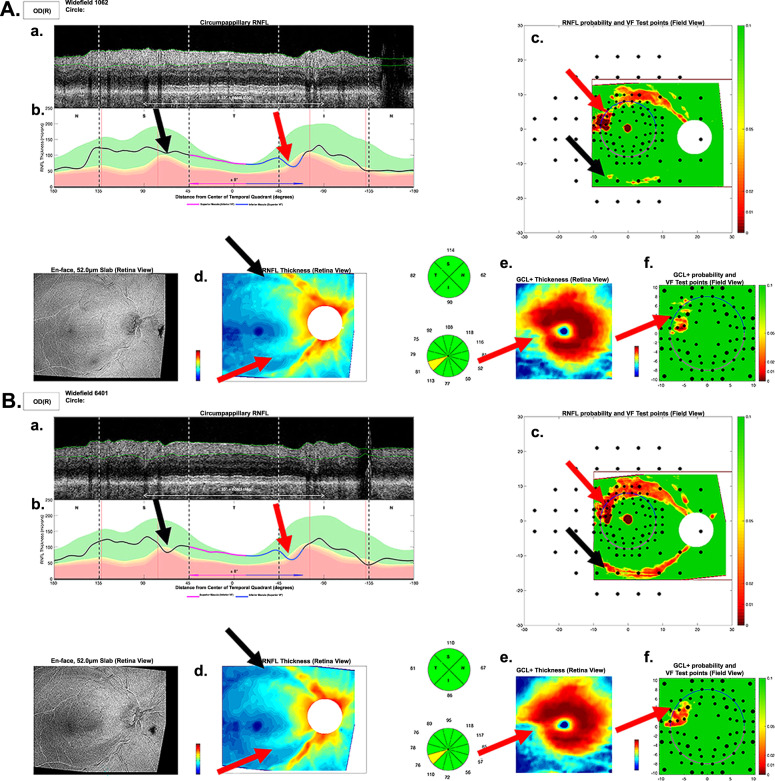
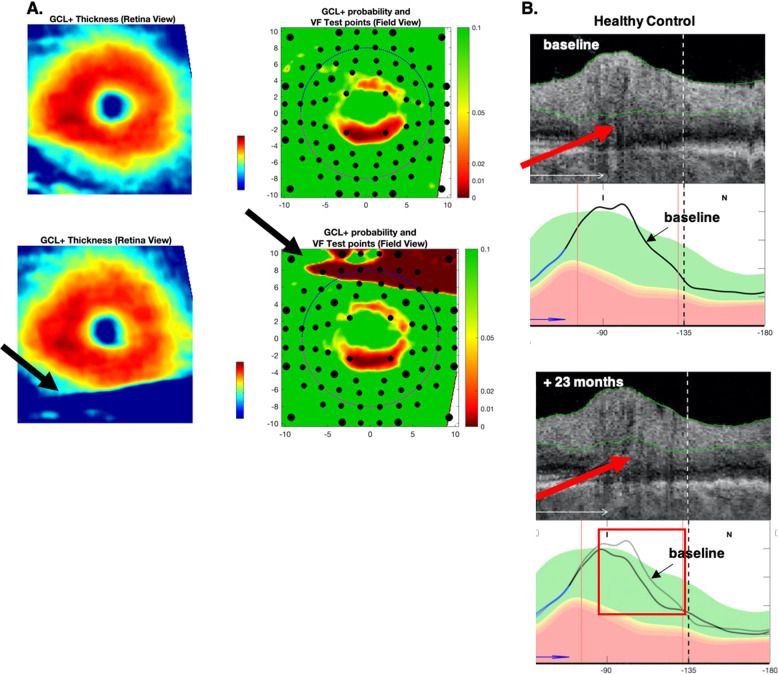
Compared to the RS, 31 of the 76 (40.8%) patient eyes were identified as progressors (RS-P), and 45 patient, and all 28 HC, eyes as nonprogressors (RS-NP). The metrics missed (false negative, FN) 15 (48%) (G) and 9 (29%) (G) of the 31 RS-P. Further, G and/or G falsely identified (false positive, FP) 10 (22.2%) of 45 patient RS-NP eyes and 7 (25%) of the 28 HC eyes as progressing. Post-hoc analysis identified three reasons (segmentation, centring, and local damage) for these errors.
Global metrics lead to FPs and FNs because of problems inherent in OCT scanning (segmentation and centring), and to FNs because they can miss local damage. These problems are difficult, if not impossible, to correct, and raise concerns about the advisability of using G and G for detecting progression.
了解使用全球 OCT 测量值检测早期青光眼进展所涉及的问题。
对象/方法:76 名患者和 28 名健康对照者(HC)的眼睛至少相隔 1 年进行了两次 OCT 扫描。为了确定 95%置信区间(CI),151 只眼睛(49 只 HC 和 102 只患者)在 6 个月内至少进行了两次扫描。所有眼睛的 24-2 平均偏差(MD)≥-6dB。计算了环周视网膜神经纤维层(cRNFL)、G 和视网膜神经节细胞层加内丛状层(RGCLP)、G 的平均(整体)厚度。使用分位数回归确定 95%CI 间隔。超出 CI 的眼睛被分类为“进展者”。对于参考标准(RS),四位专家评估了 OCT 和 VF 信息。
与 RS 相比,76 名患者中有 31 只(40.8%)眼睛被确定为进展者(RS-P),45 名患者和所有 28 名 HC 眼睛被确定为非进展者(RS-NP)。指标遗漏(假阴性,FN)了 31 个 RS-P 中的 15 个(G)和 9 个(G)。此外,G 和/或 G 错误地将 45 名患者 RS-NP 中的 10 只(22.2%)和 28 名 HC 中的 7 只(25%)眼睛识别为进展。事后分析确定了这些错误的三个原因(分割、居中、和局部损伤)。
由于 OCT 扫描(分割和居中)固有的问题,全局指标会导致 FP 和 FN,并因遗漏局部损伤而导致 FN。这些问题很难(如果不是不可能)纠正,这引发了对使用 G 和 G 检测进展的合理性的担忧。