Hailemariam Shewangizaw, Nigusse Aderajew, Kebede Alemi
Department of Midwifery, College of Health Science, Mizan-Tepi University, Mizan-Teferi, Ethiopia.
Department of Population and Family Health, Institute of Health Science, Jimma University, Jimma, Ethiopia.
Can J Infect Dis Med Microbiol. 2020 Dec 14;2020:8848016. doi: 10.1155/2020/8848016. eCollection 2020.
In spite of the fact that female sex workers being regarded as core transmitters of sexually transmitted infections to the general population, previous studies undertaken around STIs in Ethiopia fail to consider this segment of the population. Hence, the present study investigated the prevalence of self-reported symptoms of STIs and the risk factors among FSWs in Adama Town, Ethiopia.
A cross-sectional study was conducted from May 01, 2017, to April 30, 2017, in Adama Town. Three hundred ninety female sex workers were selected from 120 licensed drinking establishments by using simple random sampling technique. The interviewer-administered structured tool was used to collect data. Data were entered using EPI data version 3.1 and exported to SPSS version 20 for analysis. Bivariate and multivariable logistic regression analyses were used to identify factors associated with the outcome variable.
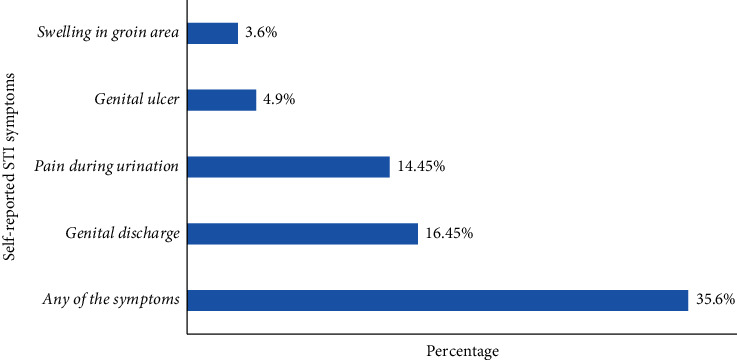
Among the requested 423 female sex workers, 390 willingly responded to the interviewer-administered structured questionnaires making a response rate of 92.2%. One hundred thirty-nine (35.6%, 95% CI (33.8%-37.4%) of the female sex workers reported one or more STI symptoms. Several risk factors were identified including inconsistent condom use with a nonpaying client (AOR = 5.43, 95% CI: 2.73, 10.80), alcohol use before sex (AOR = 2.41, 95% CI: 1.35, 4.30), longer duration of sex work (AOR = 2.27, 95% CI: 1.26, 4.08), and having poor knowledge of STIs (AOR = 2.44, 95% CI: 1.31, 4.54).
Self-reported symptom of STI among female sex workers in Adama Town is relatively high when compared with previous studies. Hence, health education programs should address the issue of inconsistent condom use with nonpaying clients, alcohol consumption before sex, and knowledge of STIs, with a particular emphasis on those female sex workers who stayed longer in the business.
尽管女性性工作者被视为向普通人群传播性传播感染的核心群体,但此前在埃塞俄比亚开展的关于性传播感染的研究并未将这部分人群纳入考量。因此,本研究调查了埃塞俄比亚阿达马镇女性性工作者自我报告的性传播感染症状患病率及其风险因素。
于2017年5月1日至2017年4月30日在阿达马镇开展了一项横断面研究。采用简单随机抽样技术,从120家有执照的饮酒场所中选取了390名女性性工作者。使用由访谈员执行的结构化工具收集数据。数据使用EPI数据3.1版本录入,并导出至SPSS 20版本进行分析。采用双变量和多变量逻辑回归分析来确定与结果变量相关的因素。
在被邀请的423名女性性工作者中,390人愿意回答访谈员执行的结构化问卷,回复率为92.2%。139名(35.6%,95%置信区间(33.8%-37.4%))女性性工作者报告了一种或多种性传播感染症状。确定了几个风险因素,包括与非付费客户使用避孕套不一致(比值比=5.43,95%置信区间:2.73,10.80)、性行为前饮酒(比值比=2.41,95%置信区间:1.35,4.30)、性工作持续时间较长(比值比=2.27,95%置信区间:1.26,4.08)以及对性传播感染知识了解不足(比值比=2.44,95%置信区间:1.31,4.54)。
与之前的研究相比,阿达马镇女性性工作者自我报告的性传播感染症状发生率相对较高。因此,健康教育项目应解决与非付费客户使用避孕套不一致、性行为前饮酒以及性传播感染知识等问题,尤其要关注从事该行业时间较长的女性性工作者。